AI Integration · Developer Tools
Grok 4.6 Is Out: What Actually Changed Since 4.5
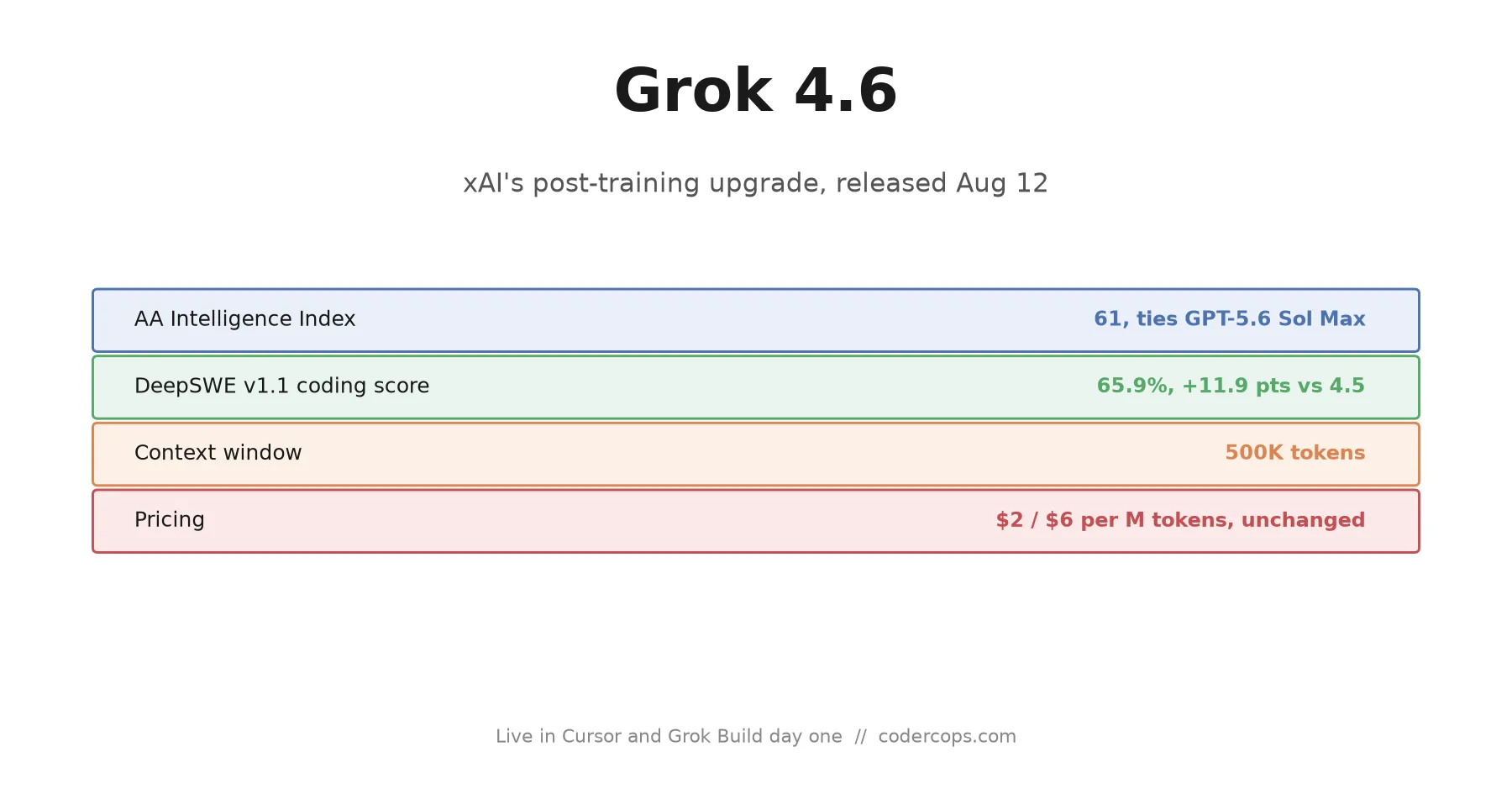
xAI shipped Grok 4.6 on August 12, a post-training upgrade with a 500K context window and an 11.9-point jump on DeepSWE coding benchmarks. Pricing didn't move. Here's what's genuinely different and where it fits your stack.

Abhishek Gupta
4 min read
Sponsored
xAI shipped Grok 4.6 on August 12, five weeks after Grok 4.5 launched with Cursor’s training data as its headline story. This time the headline is different: a real, measurable coding jump and a much bigger context window, at the same price as before.
That last part matters more than it sounds. When a model gets better without getting more expensive, the decision to upgrade is close to automatic for anyone already on the previous version. The harder question is whether it’s good enough now to pull in teams still running something else.
What actually changed
xAI is calling this a post-training upgrade rather than a new model generation, and the description matches. Grok 4.6 uses the same base as 4.5, with a longer supplemental training run, regenerated supervised fine-tuning trajectories, and reinforcement learning specifically in agentic environments spanning coding, web development, CAD, and kernel optimization work. xAI also says the model shows more self-checking behavior on longer tasks now, verifying its own output before moving to the next step instead of producing a single pass and stopping.
The context window is the other headline change: 500,000 tokens, up from 200K on Grok 4.5. For a coding model, that’s the difference between working through a large monorepo in chunks and holding significantly more of it in view at once, or running a longer agentic session without losing earlier context to a rolling window.
The coding number that matters
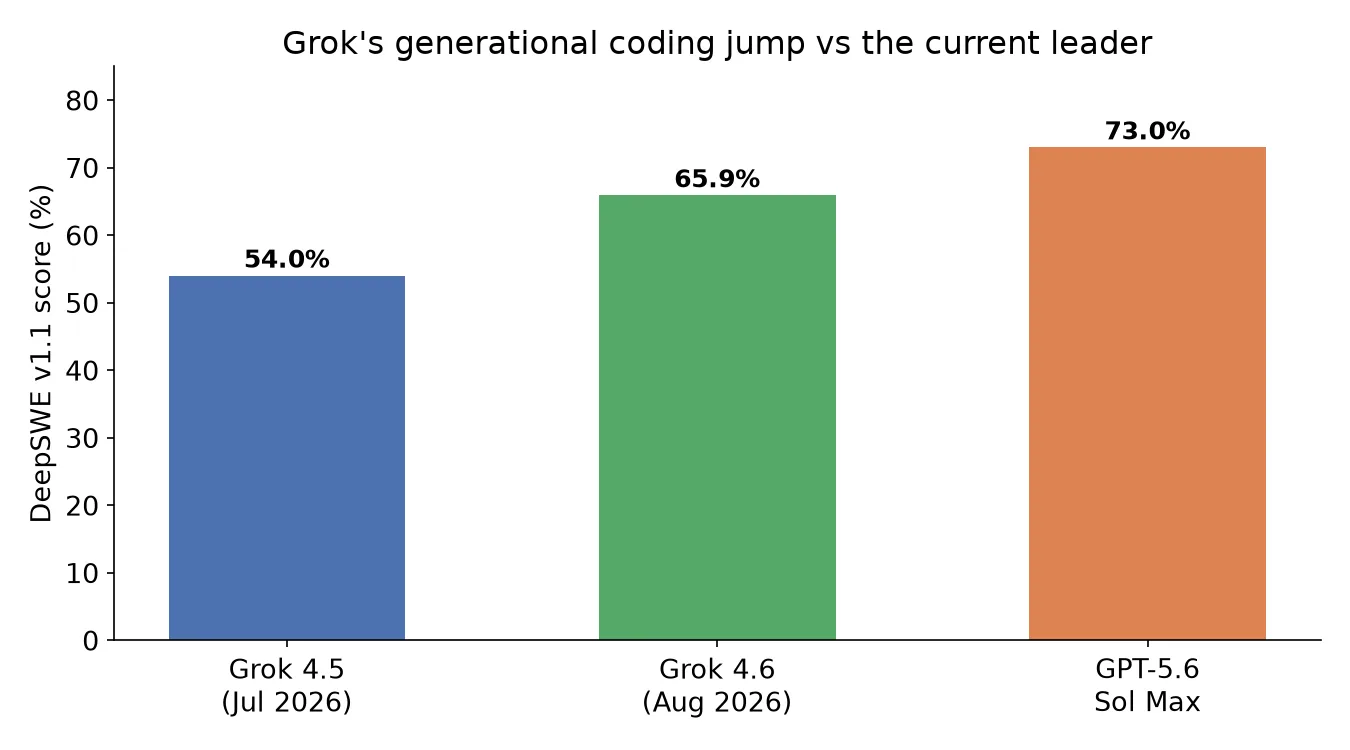
DeepSWE v1.1 measures real-world software engineering task completion, not toy problems. Grok 4.5 scored roughly 54% at launch. Grok 4.6 scores 65.9%, an 11.9 point jump in a single post-training cycle, which is a large move for a model that didn’t change its base architecture. GPT-5.6 Sol Max still leads at 73%, so the gap didn’t close entirely, but it went from a wide margin to something worth testing head-to-head on your own codebase before assuming the leader is automatically the right call for your workload.
Grok 4.6 also scores 69.9% on CursorBench v3.2 and, per xAI’s own benchmarks, leads on CursorBench, FrontierCode, and AA-Briefcase specifically. Those are the benchmark categories most tied to agentic coding workflows rather than general knowledge, which lines up with where xAI focused the reinforcement learning.
Where it sits on the broader leaderboard
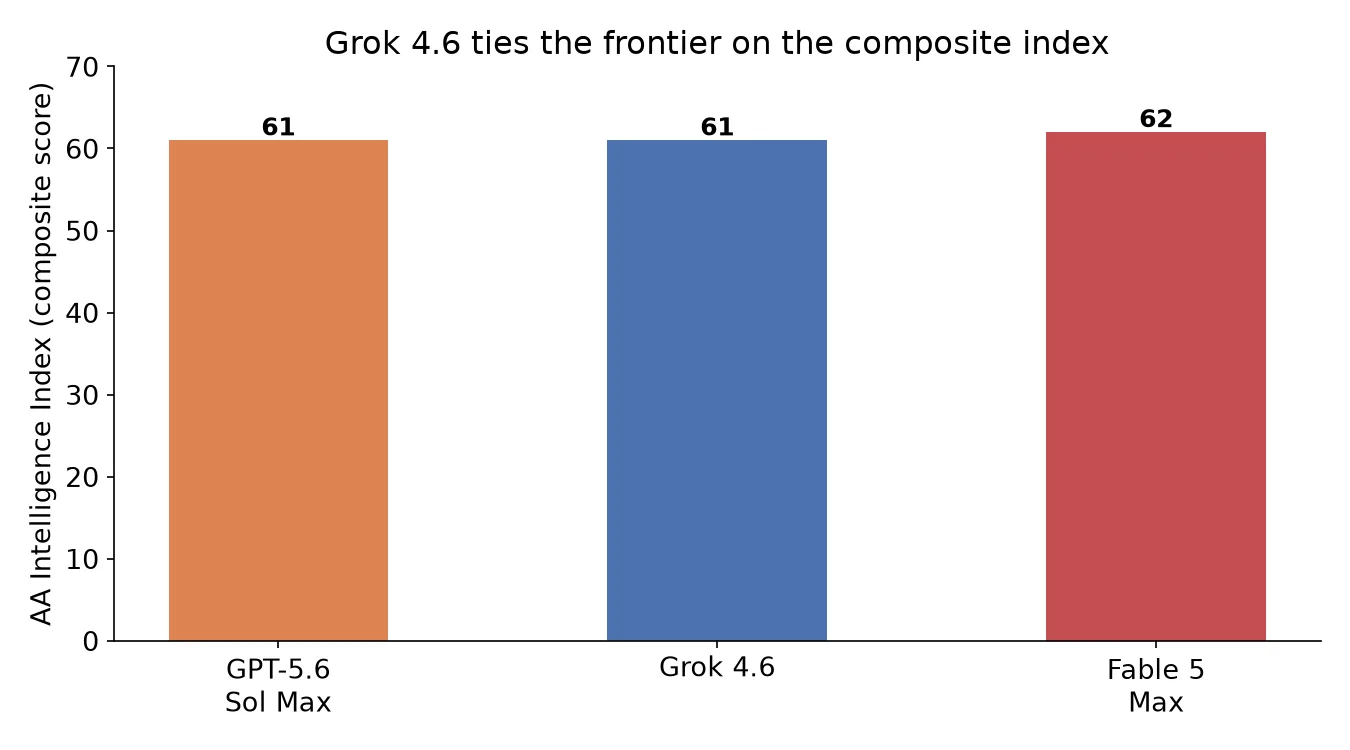
The Artificial Analysis Intelligence Index rolls up nine separate benchmarks into one composite number, useful precisely because it resists cherry-picking a single test a model happens to win. Grok 4.6 scores 61, exactly tying GPT-5.6 Sol Max and sitting one point behind the current top score. That’s a meaningfully different position than Grok 4.5 occupied at launch, when the pitch was “cheaper and close enough.” Grok 4.6 is close enough to call frontier-adjacent on its own merits, not just on price.
Pricing didn’t move, and that’s the actual story
$2 per million input tokens, $6 per million output tokens under a 200K context window, doubling to $4/$12 above it. Those are the exact tiers Grok 4.5 launched at in July. Cached input tokens run $0.50 per million. There’s also a fast variant and a priority-processing tier at 2x standard pricing for teams that need faster scheduling, but the baseline number didn’t change.
For teams already running Grok 4.5 in production, this removes the usual friction of a model upgrade: no new pricing tier to model out, no budget conversation, no re-negotiation of per-request cost assumptions. It’s a straightforward drop-in upgrade at the same unit economics, which is a different proposition than most model releases that pair new capability with a new, higher price.
Should you switch
If you’re already on Grok 4.5, the case for moving to 4.6 is close to automatic: better coding scores, a larger context window, identical pricing. There’s little downside to testing it against your current workload this week.
If you’re evaluating from scratch, or currently running GPT-5.6 or Claude Opus for coding tasks, the DeepSWE gap (65.9% vs 73% for GPT-5.6 Sol Max) is real enough to test rather than assume away. Benchmark scores tell you what a lab wants to highlight; a scoped trial against a real task from your own backlog tells you what actually matters for your codebase. That’s the same evaluation discipline worth applying to Grok 4.5 when it launched, and it still holds: run the comparison yourself before routing production traffic through either one.
It’s live in Cursor and Grok Build starting day one, so the trial itself doesn’t require new tooling if either is already part of your workflow.
Frequently asked questions
- What's new in Grok 4.6 compared to Grok 4.5?
- xAI describes it as a post-training upgrade: a longer supplemental training run, regenerated supervised fine-tuning trajectories, and reinforcement learning across coding, web development, CAD, and kernel optimization tasks. It's not a new base model architecture. The context window also grew from 200K to 500K tokens.
- Is Grok 4.6 better at coding than Grok 4.5?
- Yes, measurably. DeepSWE v1.1, a benchmark for real-world software engineering tasks, went from roughly 54% to 65.9%, an 11.9 point jump in one generation. It still trails GPT-5.6 Sol Max's 73% on the same benchmark, but the gap closed significantly.
- Did Grok 4.6 get more expensive?
- No. Pricing stayed at $2 per million input tokens and $6 per million output tokens for contexts under 200K, doubling to $4/$12 above that threshold, the exact tiers Grok 4.5 launched at. If you were already budgeting for 4.5, 4.6 doesn't change that math.
- Where does Grok 4.6 land against GPT-5.6 and other frontier models?
- On the Artificial Analysis Intelligence Index, a composite score built from nine separate benchmarks, Grok 4.6 scores 61, tying GPT-5.6 Sol Max exactly and sitting one point behind the current highest published score. It's genuinely frontier-adjacent now, not a budget alternative pretending to be.
- Should I switch from Grok 4.5 to 4.6?
- If you're already on Grok 4.5 and the price didn't change, there's little reason not to move: it's a strict capability upgrade at the same cost. If you're evaluating providers fresh, the DeepSWE gap against GPT-5.6 Sol Max (65.9% vs 73%) is worth testing against your own workload before committing, especially for tasks that lean hard on multi-step reasoning rather than raw throughput.
Sources
Sponsored
More from this category
More from AI Integration
 R.01
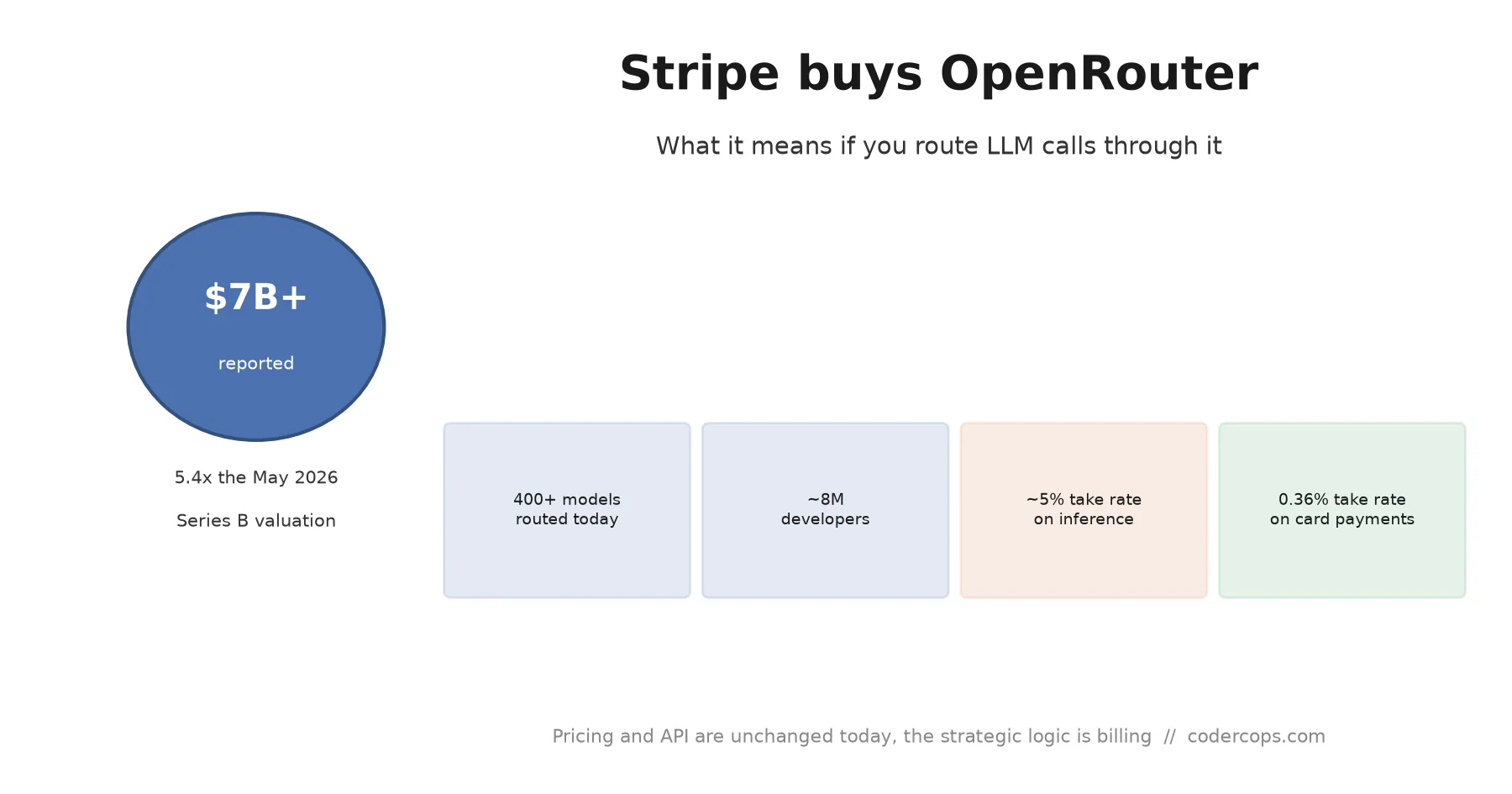
R.01 Stripe Bought OpenRouter for $7B. Here's What It Means If You Route LLM Calls
 R.02
R.02 Gemini 3.7 Flash Is Out: What Google's Coding-Focused Model Actually Changes
 R.03
R.03 Gemini 3.7 Flash Is Out: Google's Cheap, Fast Coding Model Just Got Better at Both
Sponsored
Discussion
Join the conversation.
Comments are powered by GitHub Discussions. Sign in with your GitHub account to leave a comment.
Sponsored