AI Integration · Model Releases
Mistral's Shieldstral: A 3B Moderation Model You Can Reprogram With a Sentence
Shieldstral is a 3-billion-parameter open-weight model that judges text and images against safety policies written in plain language at inference time, no retraining required. Here's what that actually changes for teams building moderation.

Shashikant Gupta
5 min read
Sponsored
Most moderation models ship with their rules baked in. You get a fixed list of harm categories, and if your product needs a narrower or stranger rule, “no discussion of a specific competitor’s product,” “flag anything that looks like a minor in an uploaded photo,” “no fan art of this particular copyrighted character,” you’re fine-tuning or building a second system on top. Mistral’s Shieldstral, released August 4, skips that step by taking the policy itself as an input, written in plain language, at the moment it evaluates content.
What actually shipped
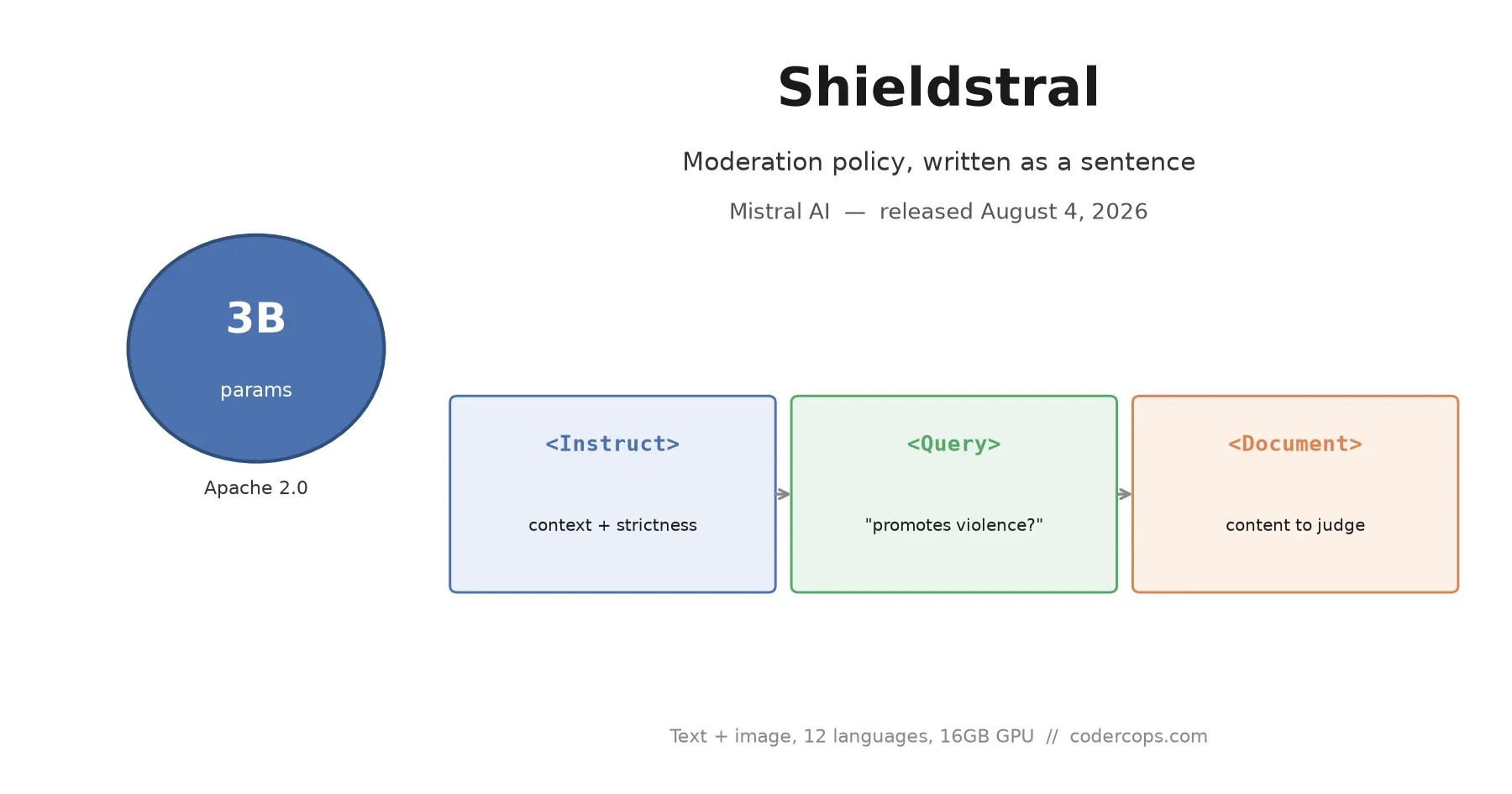
Shieldstral is a 3-billion-parameter model built on Mistral’s Ministral-3-3B backbone with a Pixtral vision encoder bolted on for image understanding, trained on 54.1 million contrastive pairs across 12 languages. It’s released on Hugging Face under Apache 2.0, meaning no licensing fee and no restriction on commercial use or self-hosting, and it runs on a single 16GB GPU, well within reach for a team that couldn’t justify the inference budget for a larger guard model.
The interesting part is the request format. Each call to Shieldstral has three parts:
<Instruct>: Evaluation context and strictness level for this check
<Query>: A single yes/no question, e.g. "Does this content promote physical violence?"
<Document>: The content being judged
Change the <Query>, and you’ve changed what the model is checking for, no retraining, no fine-tuning job, no new model version to deploy. Mistral’s own framing treats moderation as a question-answering task rather than a fixed classification task, and that reframing is the actual product here.
Why the fixed-taxonomy approach was the bottleneck
A conventional guard model, trained on categories like hate speech, self-harm, and sexual content, works well for the harms every platform needs to catch. It works badly for the harm that’s specific to your product. A marketplace that needs to catch counterfeit-goods listings, a kids’ education app that needs a stricter bar than general hate-speech filtering, a community forum that needs to flag brigading behavior, none of that maps cleanly onto a general-purpose taxonomy, and building a custom classifier for each narrow policy is expensive enough that most teams don’t bother. They either over-block with a blunt keyword filter or under-moderate and hope.
Shieldstral’s bet is that a policy written as a plain-language instruction and a yes/no question generalizes well enough, across a broad enough range of phrasing, that teams can define product-specific rules the same way they’d write a content guideline document, then hand that guideline straight to the model. Mistral claims the result matches open guard models up to seven times its size on text safety benchmarks and sets a new mark on multimodal moderation, evaluating text and images through one unified interface instead of separate pipelines.
Where the flexibility gets expensive
The tradeoff is that “phrase your policy as a prompt” reintroduces prompt engineering as a real cost center, in a place teams might not expect it. A poorly worded <Query> doesn’t throw an error, it just quietly flags the wrong things, and because the failure mode is silent rather than a crash, it’s the kind of bug that survives a demo and shows up as a moderation gap or a false-positive spike weeks later in production.
That’s a familiar shape if you’ve worked with LLM-based classifiers of any kind: precision on the exact prompt you tested against doesn’t guarantee precision on the traffic you’ll actually see. The mitigation is the same discipline as evaluating any LLM feature before it ships, build a labeled set of real edge cases, run the policy against it, and treat a passing eval as the entry condition for deployment, not the finish line.
What to actually do with it
Test it against your hardest existing cases first, not a blank slate. If your current moderation stack has a known list of borderline content it gets wrong, run that list through Shieldstral with a few different phrasings of your policy before deciding whether it’s better or just different.
Treat the policy prompt as a versioned artifact. Changing the <Query> changes production behavior the same way changing model weights would. It belongs in source control with a changelog, not in a config field someone edits without review.
Use the multimodal path for the cases that actually need it. Text-only moderation is cheaper to run and easier to eval. Reach for the vision encoder specifically where image content is the real risk, rather than routing everything through the multimodal path by default.
Shieldstral is a genuinely different design point from the guard models that came before it, not just a smaller, cheaper version of the same idea. Whether that design point beats a fixed-taxonomy model for a given product depends entirely on how well your team can write and maintain the policies driving it, which makes this one of the rare model releases where the eval work matters more than the benchmark score. Open-weight models closing this kind of gap with purpose-built commercial tools is part of a broader shift we’ve tracked in open-source AI’s rising market share, and it’s worth testing against your own policies before the next release changes the comparison again.
Frequently asked questions
- What is Shieldstral?
- A 3-billion-parameter open-weight moderation model from Mistral AI, released August 4, 2026. It classifies text and images against safety policies, but unlike most guard models, the policy itself is written in plain language and passed in at inference time instead of being fixed by training.
- How is that different from a normal content moderation model?
- Most guard models are trained against a fixed taxonomy: hate speech, violence, sexual content, and so on, with the categories baked into the weights. Changing what counts as unsafe means retraining or fine-tuning. Shieldstral takes the policy as input, an instruction describing the evaluation context and a specific yes/no question about the content, so a team can add or narrow a rule by changing the prompt, not the model.
- Is Shieldstral actually free to use commercially?
- Yes. It's released under the Apache 2.0 license on Hugging Face, which permits commercial use, modification, and self-hosting without a licensing fee. The cost that remains is compute: it needs a GPU with at least 16GB of memory to run.
- What languages does it support?
- Twelve: English, French, Spanish, German, Italian, Portuguese, Dutch, Chinese, Japanese, Korean, Arabic, and Russian. Coverage quality across those languages isn't uniform in most multilingual models, so testing your actual moderation policy against your actual traffic's language mix is worth doing before relying on it broadly.
- Should we replace our existing moderation stack with Shieldstral?
- Not without testing it against your specific policies first. A policy-adaptive model trades a fixed, well-tested category list for flexibility that depends on how precisely you phrase the policy and question. Run it against a labeled set of your own edge cases, the borderline content your current system gets wrong, before treating it as a drop-in replacement rather than an additional signal.
Sources
Sponsored
More from this category
More from AI Integration
 R.01
R.01 Stripe Bought OpenRouter for $7B. Here's What It Means If You Route LLM Calls
 R.02
R.02 Gemini 3.7 Flash Is Out: What Google's Coding-Focused Model Actually Changes
 R.03
R.03 Gemini 3.7 Flash Is Out: Google's Cheap, Fast Coding Model Just Got Better at Both
Sponsored
Discussion
Join the conversation.
Comments are powered by GitHub Discussions. Sign in with your GitHub account to leave a comment.
Sponsored