AI Integration · Developer Tools
42% of Developers Say AI Writes Half Their Code
A Q3 2026 survey of 705 developers found 42% now have AI write half their code, up from 12% a year ago. The catch: review time grew faster than coding time shrank.

Shashikant Gupta
5 min read

Sponsored
A year ago, 12% of developers said AI wrote half or more of their code. This quarter, that number is 42%. That’s not a gradual curve, it’s a jump most engineering leaders felt happen underneath their own teams without a clean before-and-after moment to point to.
The number comes from BairesDev’s Q3 2026 Dev Barometer, a quarterly survey of 705 developers across more than 60 countries plus 41 enterprise CTOs. A second, independent survey, Sonar’s State of Code Developer Survey, arrived at almost the same figure from a different question: developers there estimated 42% of their code is currently AI-generated or assisted, up from just 6% in 2023. Two different survey houses, two different questions, the same number. That’s the kind of convergence that’s hard to wave away as one vendor’s marketing.
What actually changed
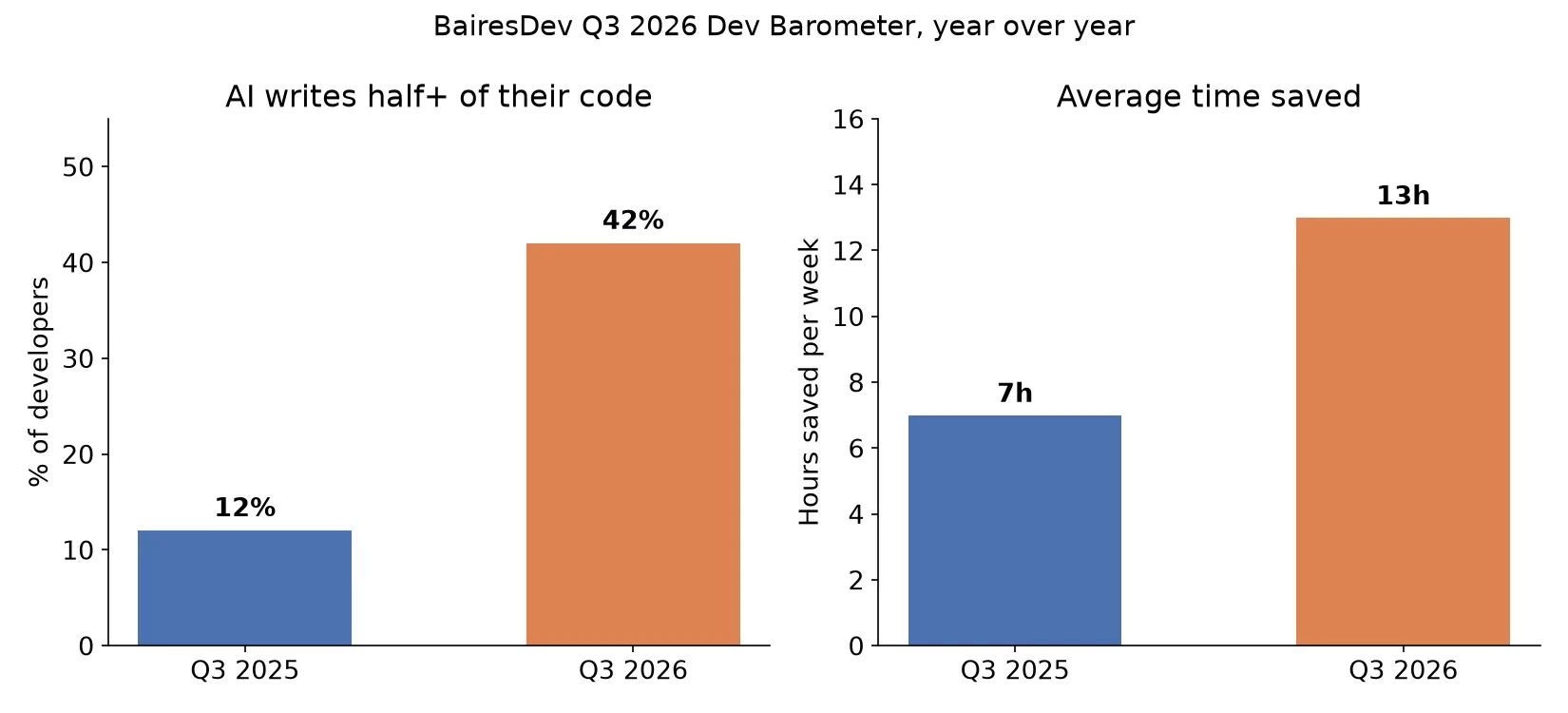
The obvious story is speed: developers in the BairesDev survey reported saving roughly 13 hours a week on average, nearly double the 7 hours reported in the same quarter last year. If that were the whole picture, it would be an unambiguous win, and a lot of the coverage of this survey stopped right there.
It isn’t the whole picture. Of the 41 CTOs surveyed alongside the developers, 78% said they’d increased spending on code review, quality assurance, and validation specifically to handle AI-generated work. Read those two numbers together and the story changes shape: time saved writing code didn’t simply convert into time saved overall. A chunk of it got reallocated to a step that used to be lighter, because the input to that step changed.
It’s the kind of bottleneck any delivery team, CoderCops included, has to plan around on client engagements. A team ships a feature in half the sprint time it used to take, then the PR sits in review for two extra days because the reviewer has to build a mental model of code they didn’t write, from a system they didn’t design that step, to verify logic that reads plausibly but wasn’t necessarily reasoned through the way a human author would explain it if you asked.
The work moved, it didn’t shrink
“Developers say they’re moving a layer above the code” is how one summary of the BairesDev data put it, and that’s a precise way to describe what we’re actually seeing: less time typing, more time reviewing, debugging, and securing what a model produced. That’s not a complaint about AI tools. It’s a description of where the bottleneck moved to.
This matters because a lot of teams still measure “AI adoption” by counting completions accepted or lines generated. Those numbers went up across the board this year and they’ll keep going up. But they say nothing about whether your review process has capacity for the volume for it’s now receiving. A five-person team that doubled its code output via AI assistance and kept the same two reviewers doing the same depth of review per pull request either slowed down its merge cadence or quietly lowered its review bar. Neither of those shows up in a “lines of code” dashboard.
Sonar’s numbers point the same direction from the trend side: developers surveyed there expect the AI-generated share of their code to grow by more than half again by 2027, from 42% up past 60%. Whatever review process handles today’s 42% comfortably needs headroom for that trajectory, not just capacity for the current load.
What to actually do with this
Three things worth checking on your own team, none of which require waiting for next year’s survey to confirm the trend:
Measure review time separately from coding time. If your sprint retros only track story points delivered, you’re missing the metric that this data says is actually moving. Track median time-in-review and see if it’s crept up in the last two quarters. If it has, that’s your version of the 78% CTO number.
Match review depth to code provenance, not just risk category. AI-generated code that touches auth, payments, or data access deserves the scrutiny it always did. But even boilerplate-looking AI output benefits from a reviewer asking “would I have written this line this way,” because a model producing plausible-looking code that’s subtly wrong is a well-documented failure mode, not a hypothetical one. Our breakdown of what AI code review tools actually catch, and where humans still win, goes deeper on where to draw that line.
Don’t celebrate the percentage, celebrate the defect rate. A team where AI writes 60% of the code and ships fewer regressions than it did at 20% has genuinely gotten better. A team where AI writes 60% of the code and ships the same regression rate just moved risk around without reducing it. Only one of those is progress, and the survey numbers alone can’t tell you which one you’re in. Your own incident log can.
The 12-to-42 jump is real and it’s not slowing down. What it changes is where your team’s actual constraint sits, and for most teams, that constraint quietly moved from the editor to the review queue sometime in the last twelve months.
Frequently asked questions
- What percentage of code is AI-generated in 2026?
- Two independent 2026 surveys landed close together: BairesDev's Q3 Dev Barometer found 42% of developers say AI writes half or more of their code, and Sonar's State of Code survey found developers estimate 42% of their code overall is AI-generated or assisted. Both put the AI share of code roughly in the low-to-mid 40s, a sharp jump from single digits just three years ago.
- Has AI adoption actually made developers faster?
- Partially. BairesDev found average time saved per developer rose from about 7 hours a week to 13 hours year over year, which is real. But 78% of the CTOs in the same survey reported increasing spending on code review, QA, and validation, meaning a meaningful share of the time saved writing code is being spent reviewing it instead.
- Should engineering teams track how much code is AI-generated?
- It's a vanity metric on its own. What matters more is review throughput and defect rate on AI-assisted code versus human-written code. A team generating 60% of its code with AI but reviewing all of it at the same rigor as before hasn't necessarily gained anything, the labor moved from writing to reading, and reading someone else's code, even a model's, is often slower per line than writing your own.
- What's the risk of AI writing an increasing share of production code?
- The main risk isn't bad code slipping through occasionally, every codebase has some of that. It's the mismatch between how fast code generation scaled and how slowly review capacity scaled with it. If your review process was sized for a team writing code by hand, it's now undersized for a team where 40%+ of the diff arrived from a model, and that gap is where regressions live.
Sources
Sponsored
More from this category
More from AI Integration



Sponsored
Discussion
Join the conversation.
Comments are powered by GitHub Discussions. Sign in with your GitHub account to leave a comment.
Sponsored