Cybersecurity · Vulnerability Management
JetBrains Patches Five Critical Hub and IDE Flaws
Auth bypass, account takeover, and RCE across JetBrains Hub, IntelliJ IDEA, and Code With Me are now patched. What each CVE does and which build fixes it.

Abhishek Gupta
5 min read
Sponsored
If your team self-hosts JetBrains’ Hub, YouTrack, or TeamCity, or leans on Code With Me for remote pairing, JetBrains just shipped patches you don’t want to sit on. Five vulnerabilities across the on-premise ecosystem, three in Hub and two in the IntelliJ IDEA / Code With Me stack, cover the full range from account takeover to remote code execution.
The five vulnerabilities
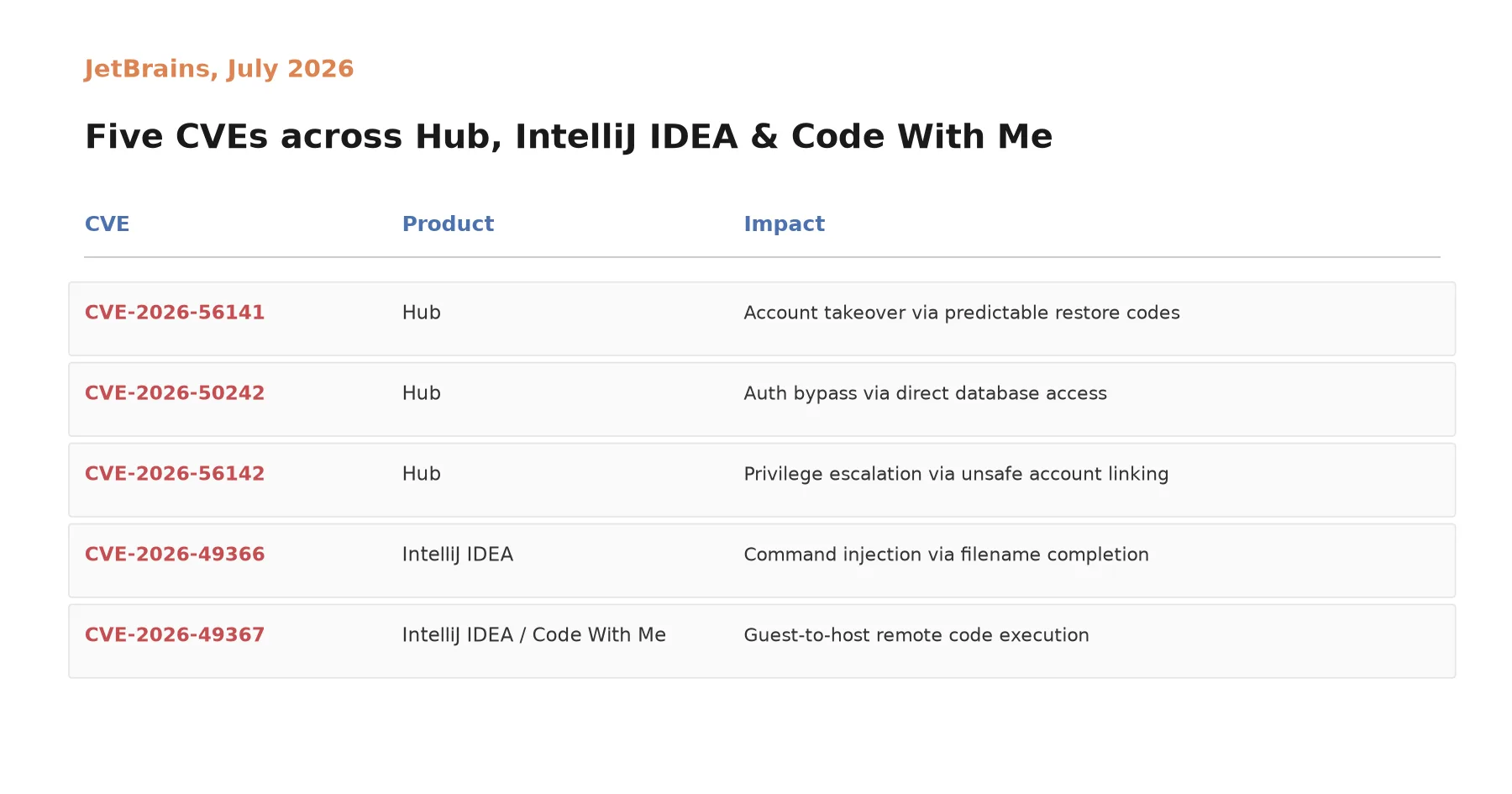
| CVE | Component | Impact |
|---|---|---|
| CVE-2026-56141 | Hub | Account takeover via predictable restore codes (insufficient randomness, CWE-338) |
| CVE-2026-50242 | Hub | Authentication bypass via direct database access, granting admin control without credentials |
| CVE-2026-56142 | Hub | Privilege escalation via unsafe linking of authentication records to accounts |
| CVE-2026-49366 | IntelliJ IDEA | Command injection triggered via filename completion |
| CVE-2026-49367 | IntelliJ IDEA / Code With Me | Low-privileged guest in a collaboration session can execute commands on the host |
Three of these live in Hub, the shared identity and user-management layer that sits in front of JetBrains’ other on-premise server products. That’s a meaningful detail: a bug in Hub isn’t scoped to one tool, it’s scoped to whatever authentication boundary Hub is supposed to be enforcing for everything behind it.
Why the Hub bugs matter more than a typical auth bug
CVE-2026-56141 is an account-recovery flaw. Hub’s restore-code generation didn’t have enough entropy, so an attacker who can predict or brute-force the code space can hijack an account through the “I forgot my credentials” flow rather than the login form. Recovery paths exist to be a safety net, not a shortcut, and a predictable one defeats the purpose of the primary authentication it’s supposed to back up.
CVE-2026-50242 is more direct: authentication bypass via direct database access, which gets an attacker administrative control without valid credentials at all. Combined with CVE-2026-56142, a privilege escalation bug where an already-authenticated user can manipulate linked authentication records to promote their own access, the practical read is that Hub had three independent routes to elevated access, not one bug with three symptoms.
Attack surface before patching:

  Unauthenticated attacker
      │
      ├─ CVE-2026-56141: guess/predict restore code ──► account takeover
      ├─ CVE-2026-50242: direct DB access ─────────────► admin, no credentials
      │
  Authenticated low-privilege user
      │
      └─ CVE-2026-56142: manipulate auth record links ─► privilege escalation
If you’re running any 2024–2026 release line of Hub, all three apply until you’re on a patched build. Fixes landed in Hub 2026.1.13757, with backports to the 2025.3, 2025.2, 2025.1, 2024.3, and 2024.2 LTS branches, so check your exact branch rather than assuming a recent-ish install is covered.
The IDE-side risk: Code With Me
CVE-2026-49367 is the one worth flagging separately, because it changes who counts as a plausible attacker. Code With Me is JetBrains’ built-in pair-programming feature: one developer hosts a session, others join as guests with configurable permission levels. The vulnerability lets a low-privileged guest in a Code With Me session execute commands on the host’s machine, bypassing the permission boundary the feature is built around.
That matters because the threat model for “someone I invited into a live coding session” is normally “a colleague or a vetted external collaborator,” not “an attacker with arbitrary code execution on my laptop.” A bug here quietly upgrades every guest invite into a decision with more consequence than most developers realize they’re making. CVE-2026-49366, a command injection bug triggered via filename completion in the same IDE line, is a smaller-scope companion issue but worth patching in the same pass since it ships in the same release.
What to do
- Update Hub first if you self-host it. Move to 2026.1.13757 or the appropriate backported LTS build for your branch. This is the component with the most severe and most numerous fixes.
- Update IntelliJ IDEA and any IntelliJ-based IDE (WebStorm, PyCharm, GoLand, and others share the platform) to the current release to pick up the Code With Me and filename-completion fixes.
- Audit recent Code With Me sessions if you run this feature regularly with external collaborators, particularly any sessions granted guest access before you patched.
- Rotate credentials tied to Hub-managed accounts if you have reason to believe CVE-2026-50242 or CVE-2026-56141 could have been exploited against your instance before patching, since both bugs bypass normal authentication rather than merely weakening it.
If you’re evaluating your team’s broader exposure to this class of issue, the tradeoffs between different authentication protocols are worth revisiting alongside patch management. A well-designed auth protocol doesn’t help if the identity provider sitting in front of it has an unpatched bypass, which is exactly the situation Hub’s users were in here.
Developer tooling doesn’t get the same security scrutiny as production-facing infrastructure, mostly because it feels internal. Bugs like these are the reminder that “internal” and “low-risk” aren’t the same thing, especially for a tool like Hub that’s explicitly an identity boundary, or a feature like Code With Me that’s explicitly designed to let outside collaborators onto your machine.
Frequently asked questions
- What products does this vulnerability cluster affect?
- JetBrains' on-premise ecosystem: Hub (the shared authentication and user-management layer for JetBrains' server products), IntelliJ IDEA and other IntelliJ-based IDEs, and the Code With Me collaborative coding feature. If you run Hub, YouTrack, or TeamCity on your own infrastructure, or you use Code With Me to pair-program with someone outside your organization, you're in the affected population.
- What's the worst-case impact if I don't patch?
- Two separate paths to full account or admin compromise on Hub (CVE-2026-56141 via predictable account-recovery codes, CVE-2026-50242 via direct database access bypassing authentication entirely), plus a privilege escalation bug that lets a regular authenticated user promote themselves. On the IDE side, CVE-2026-49367 lets a guest in a Code With Me session run commands on the host's machine, which is a meaningfully different risk model than most IDE bugs since it means an external collaborator, not just malicious code you opened, can be the attacker.
- Is SaaS-hosted JetBrains (like JetBrains-hosted Space or cloud IDEs) affected?
- This cluster is specifically about self-hosted, on-premise installations of Hub, YouTrack, TeamCity, and the desktop IntelliJ-based IDEs. If your team relies entirely on JetBrains-managed cloud infrastructure rather than running these products yourselves, your direct exposure is lower, but you should still update the desktop IDEs, since IntelliJ IDEA and Code With Me run locally regardless of how your other infrastructure is hosted.
- What versions fix these vulnerabilities?
- Hub's three issues are resolved in Hub 2026.1.13757, with backports to the 2025.3, 2025.2, 2025.1, 2024.3, and 2024.2 long-term support branches. IntelliJ IDEA's fixes shipped in the corresponding current release; if you're on an older LTS line, check JetBrains' security bulletin for your specific branch's fixed build before assuming you're covered.
- Why does a predictable restore code count as a critical bug?
- Account recovery flows exist specifically to let someone back into an account without their original credentials, which makes them a high-value target if they're weak. CVE-2026-56141 stems from insufficient randomness in how Hub generates restore codes (a CWE-338 class issue), meaning an attacker who can predict or narrow down the valid code space can hijack an account through the 'forgot my credentials' path instead of attacking the login form directly. It's a reminder that recovery flows need the same security scrutiny as the primary authentication path, not less.
Sources
Sponsored
More from this category
More from Cybersecurity
Sponsored
Discussion
Join the conversation.
Comments are powered by GitHub Discussions. Sign in with your GitHub account to leave a comment.
Sponsored