AI Integration · Model Releases
MiniMax M3: Open-Weight, Frontier-Tier Coding
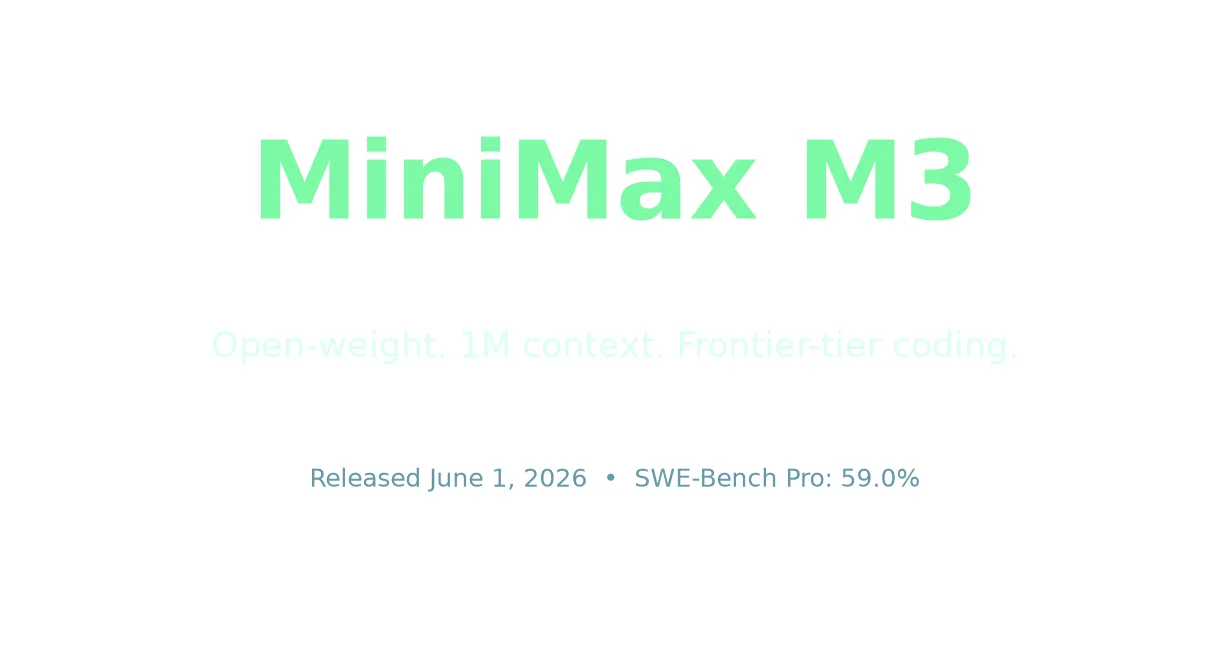
MiniMax M3 is the first open-weight model to combine frontier-tier coding, a 1M-token context, and native multimodality. What it does, and how it benchmarks.

Prathviraj Singh
6 min read
Sponsored
Six months ago, if you wanted frontier-tier coding performance from a model you could run on your own hardware, the honest answer was that you couldn’t. The open-weight options were good but clearly behind the proprietary frontier, GPT-4o, Gemini Ultra, and the like. That gap is now much smaller.
MiniMax M3, released June 1, 2026, is the data point. It leads the open-weight coding leaderboard at 59.0% on SWE-Bench Pro, a benchmark that tests models on real GitHub issues. That puts it ahead of DeepSeek-R1 (55.0%), Qwen3-235B (54.2%), and the prior MiniMax model M1 (56.0%). It also has a 1-million-token context window and handles images natively in the same model.
This is meaningful progress, and it’s worth understanding what’s actually happening.
What M3 is built on
MiniMax has been iterating fast. M1 launched in May 2026 with a hybrid attention architecture that addressed a genuine limitation in transformer models: the quadratic cost of standard attention on long contexts. Standard attention gets slower and more memory-intensive as context grows. The M1 architecture combined sliding-window attention for recent tokens with global attention for distant tokens, keeping long-context inference practical without the exponential cost.
M3 takes that foundation and extends it in three directions:
Coding performance. The training mix and alignment process shifted toward software engineering tasks. The 59.0% SWE-Bench Pro number isn’t from architectural magic alone, it reflects a model trained specifically to understand code in context, reason about bugs, and produce working patches.
1-million-token context. This is where the hybrid attention pays off. At 1 million tokens, you can load a full medium-sized codebase into context without chunking. For retrieval-augmented tasks, that means the model can actually read everything rather than depending on an embedding search to pick the right chunks.
Native multimodality. M3 processes images and text in the same model without a separate vision encoder stitched on. For software engineering use cases, this matters for things like reviewing screenshots, understanding UI from images, or working with diagrams alongside code.
The benchmark numbers in context
SWE-Bench Pro is harder than the original SWE-Bench because the dataset was rebuilt to reduce contamination, the benchmark tasks didn’t appear in model training data. The scores are lower but more credible.
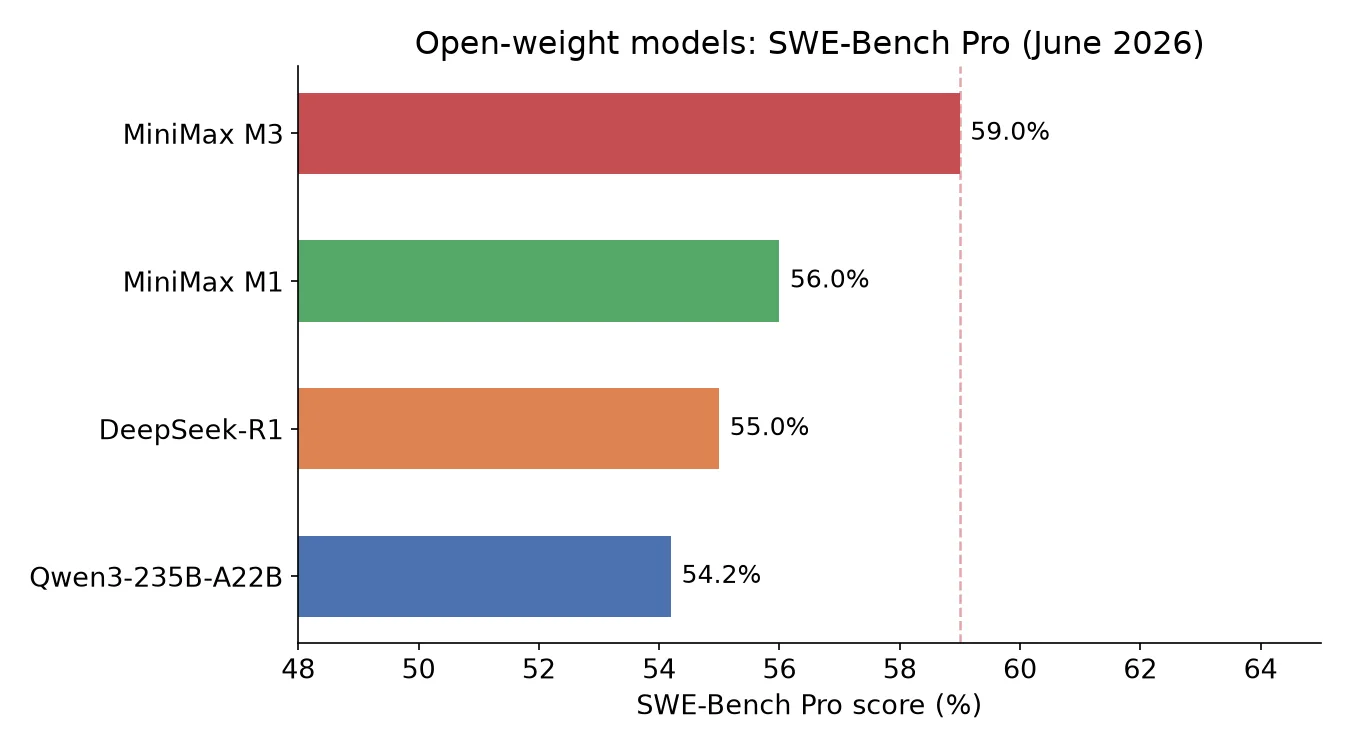
A 59.0% score means M3 successfully patches roughly 6 in 10 real GitHub issues when given the codebase and the issue text. For comparison, state-of-the-art proprietary models were scoring in the high 50s to low 60s range earlier this year. The gap between “best open-weight” and “best proprietary” is now a few percentage points rather than a factor of two.
This doesn’t mean open-weight models have caught up entirely. On general reasoning, instruction following, and tasks outside software engineering, the frontier proprietary models still have edges. SWE-Bench Pro is one slice of capability. But for teams whose primary use case is coding assistance, code generation, and software engineering tasks, the gap has closed enough to matter.
What you can actually do with it
The open-weight nature is the practical lever. A few things that follow from it:
Self-hosted coding assistant. You can run M3 on your own GPU infrastructure (it’s a large model, you need meaningful hardware, or a provider like Together AI or Fireworks that serves open-weight models), and connect it to your IDE without sending code to a third-party API. For teams with compliance requirements or sensitive codebases, this is significant.
Fine-tuning on your codebase. The weights are available for fine-tuning. If your codebase has unusual patterns, internal libraries, or domain-specific conventions, you can fine-tune M3 on your internal code and get a model that knows your context. This is something you can’t do with closed proprietary models.
Long-context document and code analysis. The 1-million-token context window is the other major practical capability. Tasks that previously required chunking strategies (“analyze this entire repo for security issues,” “review this 500-page specification”), become direct operations. You load everything and ask.
# Example: loading a full small codebase into context (via API or local inference)
import glob

# Gather all Python files in a project
files = glob.glob("myproject/**/*.py", recursive=True)
context = ""
for f in files:
    with open(f) as fh:
        context += f"# {f}\n{fh.read()}\n\n"

# With a 1M-token context, even sizeable codebases fit
# Average Python file: ~200 lines, ~3,000 tokens
# 1M tokens = ~330 average Python files
prompt = f"""
{context}

Identify all database queries that don't use parameterized statements.
List each one with the file path and line number.
"""
For most teams, 300+ Python files covers the entire application layer. For codebases larger than that, you’d still need chunking or retrieval, but the threshold for “fits in context” went from a single file to a full small project.
How to try it
MiniMax has made M3 available through their API and, for the weights, via Hugging Face. If you want to self-host:
- The model is on Hugging Face under the MiniMax-AI organization
- Hardware requirement: roughly 2x80GB VRAM for the full model at 16-bit precision, or quantized versions at lower precision for smaller GPU setups
- For teams without GPU infrastructure, Together AI, Fireworks, and OpenRouter all serve M3 via API
The API surface follows OpenAI-compatible conventions, so existing code that calls a chat completion endpoint works with minimal changes:
from openai import OpenAI

client = OpenAI(
    base_url="https://api.minimax.io/v1",
    api_key="your-minimax-key",
)

response = client.chat.completions.create(
    model="minimax-m3",
    messages=[
        {"role": "user", "content": "Review this function for potential memory leaks: ..."}
    ],
    max_tokens=2048,
)
The broader open-weight picture
M3 is one data point in a trend that’s been running for two years. Open-weight models have closed the gap with proprietary systems faster than most researchers predicted. Six months ago, the gap for coding was around 10-15 percentage points on SWE-Bench. Today it’s under 5.
That doesn’t mean proprietary models are irrelevant. For teams that want the simplest possible integration, the best possible performance on the widest range of tasks, and don’t have data residency requirements, paying for API access to a frontier proprietary model is still sensible. But for teams where data privacy, cost at scale, or fine-tuning access matter, the open-weight options in mid-2026 are genuinely competitive in a way they weren’t in 2024.
MiniMax M3 is the clearest evidence of that in the coding category. The announcement is at minimax.io/blog/minimax-m3. If open-weight coding models are relevant to your infrastructure decisions, this one is worth benchmarking on your own tasks. For teams thinking about when to self-host versus use managed inference, the broader decision framework is covered in how to hire an AI engineer in 2026, understanding what open-weight deployment requires informs what skills you need on the team.
Frequently asked questions
- What is MiniMax M3?
- MiniMax M3 is an open-weight large language model released June 1, 2026, by MiniMax (a Chinese AI lab). It's the latest in the MiniMax model family, following M1 and M2. M3 leads the open-weight coding benchmarks with a 59.0% SWE-Bench Pro score, has a 1-million-token context window, and supports text, images, and code natively in the same model.
- What does 'open-weight' mean in practice?
- Open-weight means the model weights are publicly downloadable. You can run the model on your own infrastructure, fine-tune it on your data, and build applications without paying per-token API fees. It's different from 'open-source' in the strict sense (the training data and code may not be published), but the weights are what matter most for practical use.
- How does MiniMax M3 compare to other open-weight coding models?
- As of June 2026, M3 leads the open-weight SWE-Bench Pro leaderboard at 59.0%, ahead of MiniMax M1 (56.0%), DeepSeek-R1 (55.0%), and Qwen3-235B-A22B (54.2%). For general reasoning and coding, Qwen3-235B is the other top contender; for long-context tasks, M3's 1M-token context gives it a structural advantage.
- What is SWE-Bench and why does it matter for coding models?
- SWE-Bench (Software Engineering Benchmark) tests models on real GitHub issues — give the model a bug report and the codebase, ask it to produce a patch. SWE-Bench Pro is a harder variant with less data contamination. It's the closest existing benchmark to actual software engineering work, which is why coding model comparisons anchor on it.
Sources
Sponsored
More from this category
More from AI Integration
Sponsored
Discussion
Join the conversation.
Comments are powered by GitHub Discussions. Sign in with your GitHub account to leave a comment.
Sponsored