AI Integration · Model Releases
Meta Muse Glimmer: A 30B Agent Model That Runs on One GPU, No Cloud Required
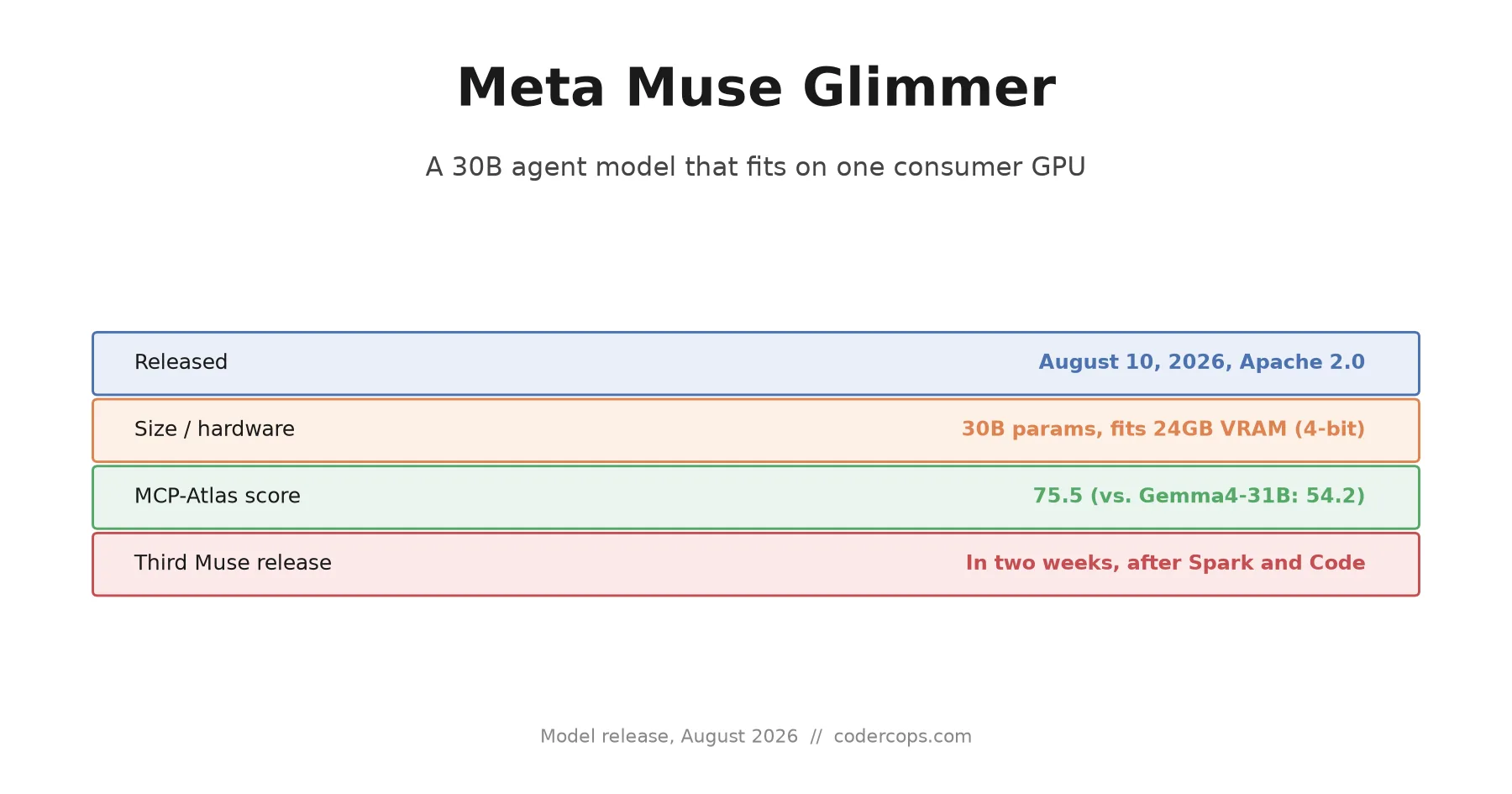
Meta shipped Muse Glimmer on August 10, an Apache 2.0 model built for local agent tasks that fits on a single 24GB consumer GPU and beats larger rivals on tool-use benchmarks. Here's what it's actually for.

Shashikant Gupta
5 min read
Sponsored
Meta shipped its third distinct agent model in two weeks on August 10, and this one is meant to never leave your machine. Muse Glimmer is a 30-billion-parameter model, released free under Apache 2.0, built to run local agent workloads on a single consumer GPU instead of a hosted API call.
What actually shipped
Glimmer is a dense 30B model, not a mixture-of-experts design, which matters for the hardware story: Meta says it fits on 24GB of VRAM using 4-bit quantization paired with DFlash speculative decoding, a technique that predicts several tokens ahead and verifies them in a batch rather than generating strictly one at a time. That combination is what gets a 30B-class model down to a single card people already own, rather than requiring a multi-GPU rig or a rented cloud instance just to try it.
The model supports tool use, multi-step reasoning, and failure recovery, meaning it’s designed to notice when a tool call didn’t produce the expected result and adjust rather than continuing on bad information. Meta also built it for scaffold compatibility with existing agent orchestrators, so it’s meant to slot into an agent framework you’re already running rather than requiring a Muse-specific harness.
The benchmark that’s driving the comparisons
Meta tested Glimmer against two other open-weight models in a similar 27-to-31-billion-parameter range: Google’s Gemma4-31B and Alibaba’s Qwen3.6-27B. On MCP-Atlas, a benchmark built specifically to measure multi-step tool-call orchestration (the thing an agent actually does all day, as opposed to single-turn question answering), Glimmer scored 75.5 against Gemma4-31B’s 54.2 and Qwen3.6-27B’s 62.5.
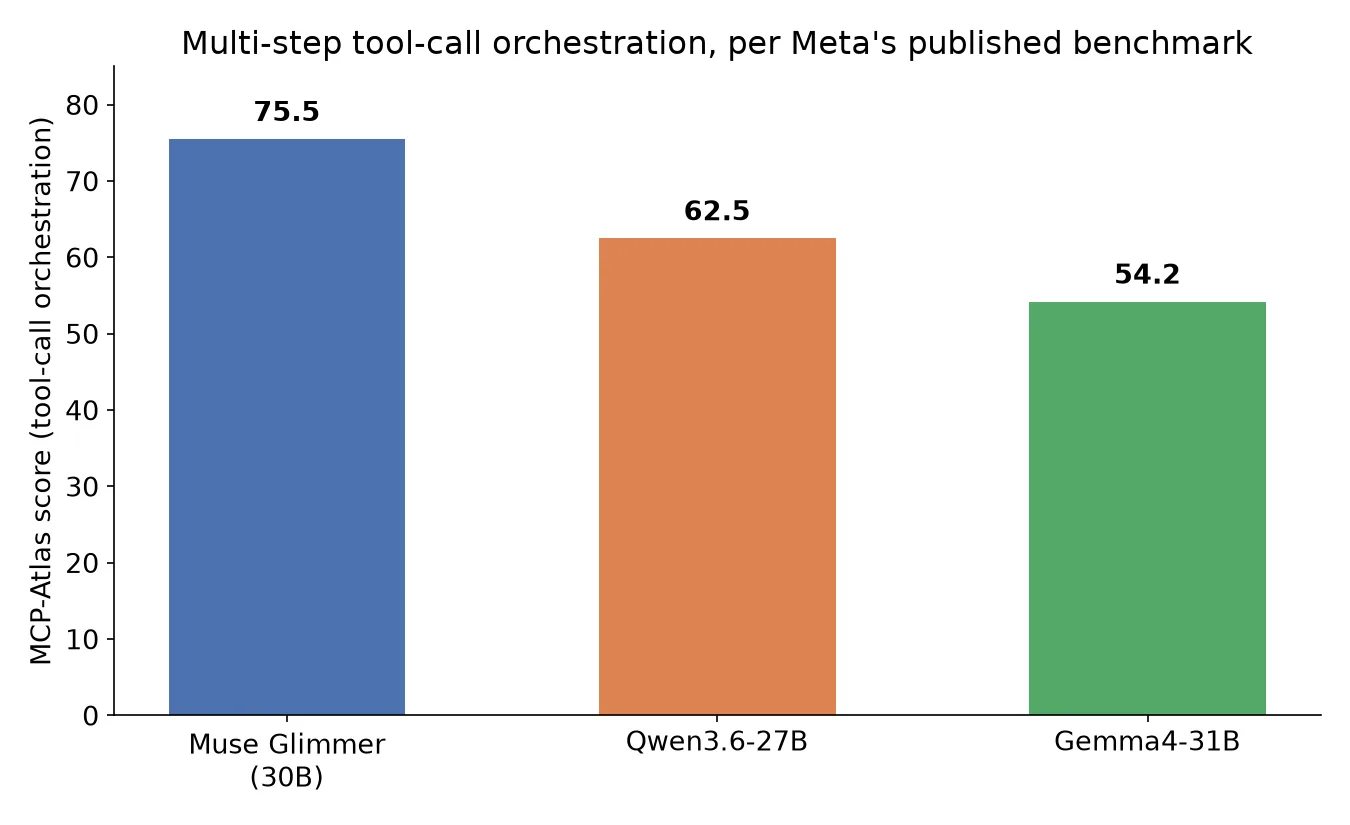
That’s a real margin on a benchmark aimed at the exact capability Glimmer was built for, not a marginal win on a generic leaderboard. It’s still one benchmark, though, and it’s Meta’s own comparison. Worth remembering that agent orchestration is only one slice of what a model needs to do well; a model can lead on chained tool calls and still trail on raw reasoning depth, long-document comprehension, or coding correctness. If your evaluation criteria differ from what MCP-Atlas measures, this score alone won’t tell you which model to pick.
Where this fits next to Muse Spark and Muse Code
Glimmer is Meta’s third Muse-branded agent release inside two weeks, and each one targets a different deployment shape rather than competing with the others directly. Muse Spark is a paid, cloud-hosted agentic model accessed through Meta’s API, built for teams that want frontier-tier capability without managing infrastructure. Muse Code is a terminal coding agent built on top of Spark, aimed at developers who want an agent living in their shell. Glimmer is the odd one out on purpose: open-weight, local, and free to self-host, aimed at workloads where a per-call API bill or a network dependency is actually the wrong architecture.
That’s a coherent product strategy even if it looks like release fatigue from the outside. A cloud-hosted frontier model and a local open-weight model solve different problems, and Meta shipping both under one family name is a bet that developers will pick based on deployment constraints, not brand loyalty to one tier.
What Glimmer is actually good for
The realistic use cases cluster around workloads that run constantly and don’t want a network round trip or a per-call charge for every step:
- Always-on local agents. Scheduling assistants, file-management agents, and background automation that need to run continuously on a developer’s machine or a local server without racking up API costs for every tool call.
- Coding assistants that need to work offline or on sensitive codebases. Local inference means the code never leaves the machine, which matters for teams with strict data residency or IP constraints that make a cloud API a non-starter regardless of model quality.
- Evaluation and testing harnesses. Running thousands of test cases through an agent loop is exactly the kind of high-volume, latency-tolerant workload where a local model’s zero marginal cost beats a hosted API’s per-token pricing, an angle worth pairing with a proper eval harness rather than eyeballing outputs.
What it’s a worse fit for: anything that benefits from the largest available context window, workloads with bursty, unpredictable traffic where provisioning dedicated GPU hardware doesn’t pencil out, or tasks where you specifically need frontier-tier general reasoning rather than agentic tool orchestration.
The actual decision in front of you
A benchmark win on MCP-Atlas is a real, specific data point, not a verdict. Before treating Glimmer as your team’s local agent model:
Test it against your own tool-call patterns, not the published benchmark. MCP-Atlas measures a particular style of multi-step orchestration; if your agent’s tool use looks different, from your API surface, your retry logic, your failure modes, run your own comparison before committing.
Price out the hardware against your actual usage volume. A 24GB GPU is a one-time cost against Muse Spark or another hosted API’s ongoing per-call pricing. That math favors Glimmer heavily at high, sustained volume and much less at low, occasional usage, where a hosted API’s zero upfront cost wins.
Check scaffold compatibility with whatever agent framework you’re already running. Meta says Glimmer works with existing orchestrators, but “compatible” and “well-tested with your specific stack” aren’t the same claim; verify it against your actual harness before betting a production workload on it.
Muse Glimmer is a legitimate option for teams that specifically need local, always-on agent inference, not a reason to abandon a hosted API that’s working fine for a bursty or exploratory workload. The interesting part isn’t that Meta beat two rival models on one benchmark. It’s that a 30B agentic model on a single consumer GPU is now a real, tested option rather than a research demo, and that changes the calculus for anyone who’s been assuming local agent inference wasn’t practical yet.
Frequently asked questions
- What is Muse Glimmer?
- An open-weight, 30-billion-parameter language model Meta released on August 10, 2026 under the Apache 2.0 license. It's purpose-built for agentic tasks (tool use, multi-step reasoning, failure recovery) and sized to run on a single consumer GPU with 24GB of VRAM, using 4-bit quantization and DFlash speculative decoding to fit within that budget.
- How does Muse Glimmer compare to Gemma4-31B and Qwen3.6-27B?
- On MCP-Atlas, a benchmark that specifically measures multi-step tool-call orchestration, Muse Glimmer scored 75.5 against Gemma4-31B's 54.2 and Qwen3.6-27B's 62.5. That's a meaningful lead on this particular benchmark and parameter tier, though it's one benchmark measuring one capability; general reasoning or coding tasks may rank the three models differently.
- Is Muse Glimmer the same as Muse Spark or Muse Code?
- No, they're three separate releases. Muse Spark is a paid, cloud-hosted agentic model accessed through Meta's API. Muse Code is a terminal coding agent built on top of Spark. Muse Glimmer is different from both: it's open-weight, runs locally on your own hardware, and is aimed at always-on agents that shouldn't depend on a network connection or per-call API pricing.
- What hardware do I actually need to run it?
- Meta's stated target is a single consumer GPU with 24GB of VRAM, achievable on cards like an RTX 4090 or similar, using 4-bit quantization. That's a meaningful jump in accessibility compared to most 30B-class models, which typically assume multiple GPUs or a cloud instance for comfortable inference.
- Should we replace our cloud agent API with Muse Glimmer?
- Only if your workload is a good fit for local, always-on inference: a scheduling agent, a file-management tool, a coding assistant, or an evaluation harness that runs constantly and would otherwise rack up per-call API costs. If your workload is bursty, needs the largest available context window, or benefits from a frontier-tier model's broader reasoning, a hosted API is still the better default. Test both against your actual tool-call patterns before committing.
Sources
Sponsored
More from this category
More from AI Integration
 R.01
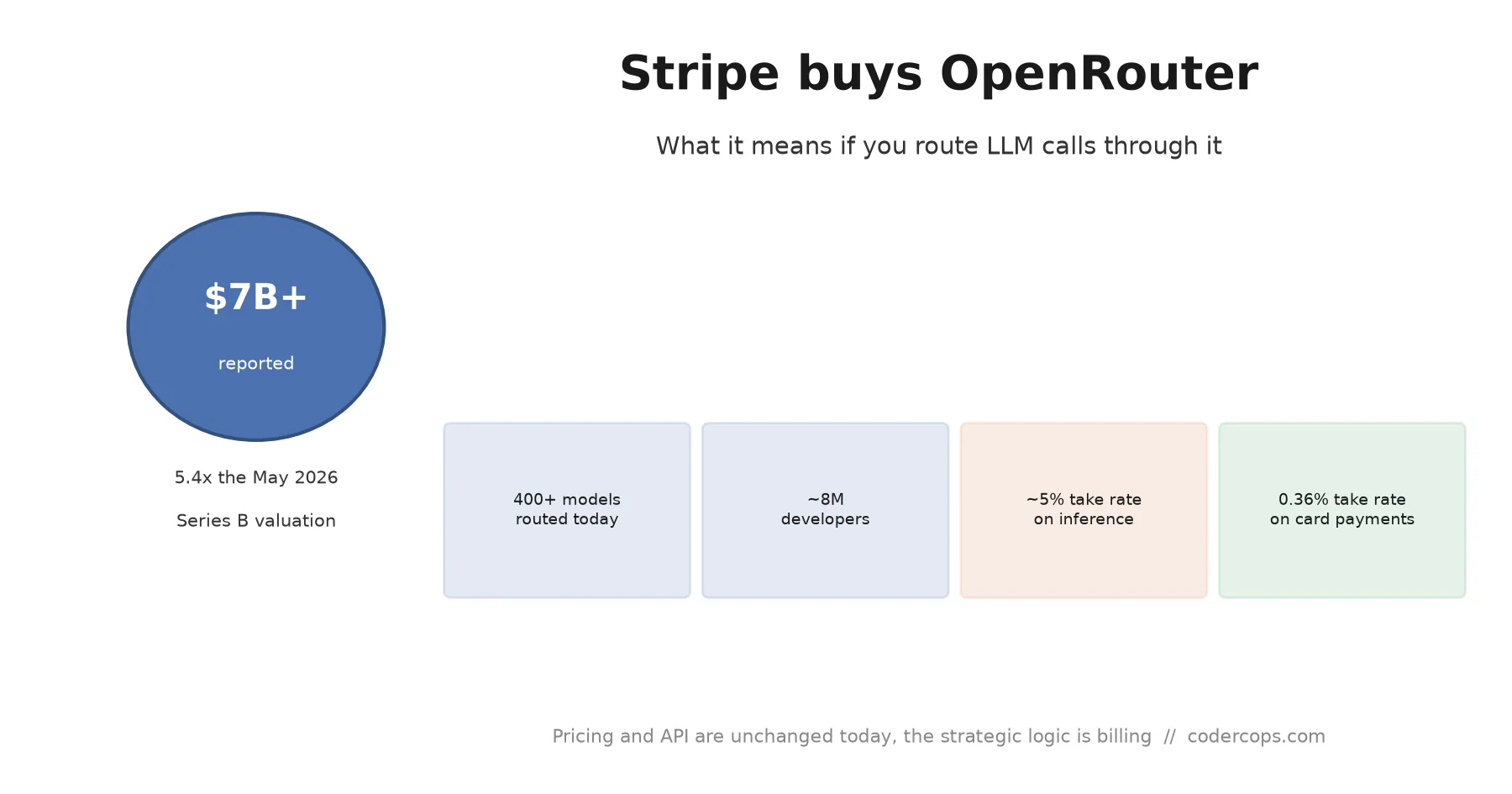
R.01 Stripe Bought OpenRouter for $7B. Here's What It Means If You Route LLM Calls
 R.02
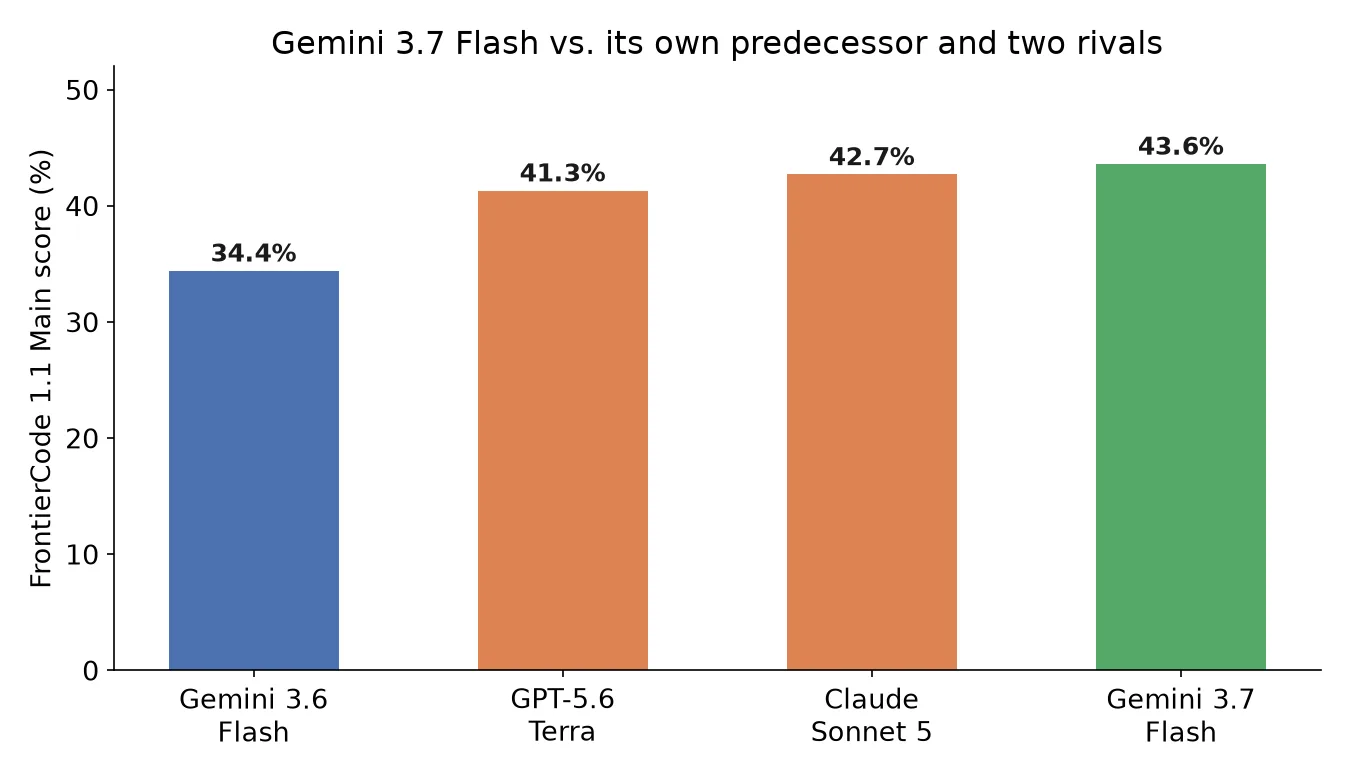
R.02 Gemini 3.7 Flash Is Out: What Google's Coding-Focused Model Actually Changes
 R.03
R.03 Gemini 3.7 Flash Is Out: Google's Cheap, Fast Coding Model Just Got Better at Both
Sponsored
Discussion
Join the conversation.
Comments are powered by GitHub Discussions. Sign in with your GitHub account to leave a comment.
Sponsored