Cybersecurity · Authentication
Passkey Adoption in 2026: What the FIDO Data Actually Shows
5 billion passkeys are active and 75% of people have enabled one, yet 57% of organisations still use phishable logins. What the FIDO data actually means.

Prathviraj Singh
6 min read
Sponsored
There are now 5 billion passkeys in active use worldwide. Three-quarters of people have turned one on for at least one account. Those two numbers, from the FIDO Alliance’s 2026 State of Passkeys report published around World Passkey Day, settle an argument that’s been running since 2023: passkeys aren’t a bet on the future anymore. They’re a thing people actually use.
But the same report has a second half that gets less attention, and it matters more for anyone planning a product roadmap. 57% of organizations still rely on phishable authentication, meaning passwords or SMS codes, as their primary sign-in method. Adoption crossed a real threshold. It did not finish the job. If you’re deciding what to prioritize this year, both facts need to sit in your head at once.
The headline numbers, in one place
Here’s what the report found, without editorializing yet:
- 5 billion passkeys in active use globally.
- 90% consumer awareness of passkeys as a concept.
- 75% of people have enabled a passkey on at least one account.
- 49% of people use a passkey regularly when one is available.
- 68% of organizations have deployed or are actively deploying passkeys for employee sign-ins.
- Login success rate: roughly 93% for passkeys versus 63% for traditional passwords.
- 82% of organizations say fully passwordless authentication is a goal they’ve reached or are actively pursuing.
- Only 28% report fully passwordless status across most of their workforce.
Read the awareness and enablement numbers next to the regular-use number and a pattern shows up immediately. 90% know what a passkey is, 75% have turned one on somewhere, but only 49% reach for one habitually. A lot of people set up a passkey once, probably when an app nudged them during a login flow, and then kept falling back to whatever they were doing before. Enablement is a checkbox. Habitual use is a behavior change, and behavior change is always the slower number.
Why passkeys actually win on reliability
The success-rate gap is the number I’d put in front of a skeptical product manager. A 93% login success rate against 63% for passwords isn’t a marginal UX improvement, it’s the difference between a login flow that mostly works and one that fails on more than a third of attempts. Every failed password login is a support ticket, a reset email, or a user who gives up and leaves. That cost is invisible until someone adds it up, and FIDO’s numbers are one of the first attempts to put a figure on it at this scale.
| Method | Login success rate |
|---|---|
| Passkeys | ~93% |
| Traditional passwords | ~63% |
That table alone should settle the “is this worth the engineering time” question for most teams. The harder question is where to start.
The industry adoption gap tells you where to start
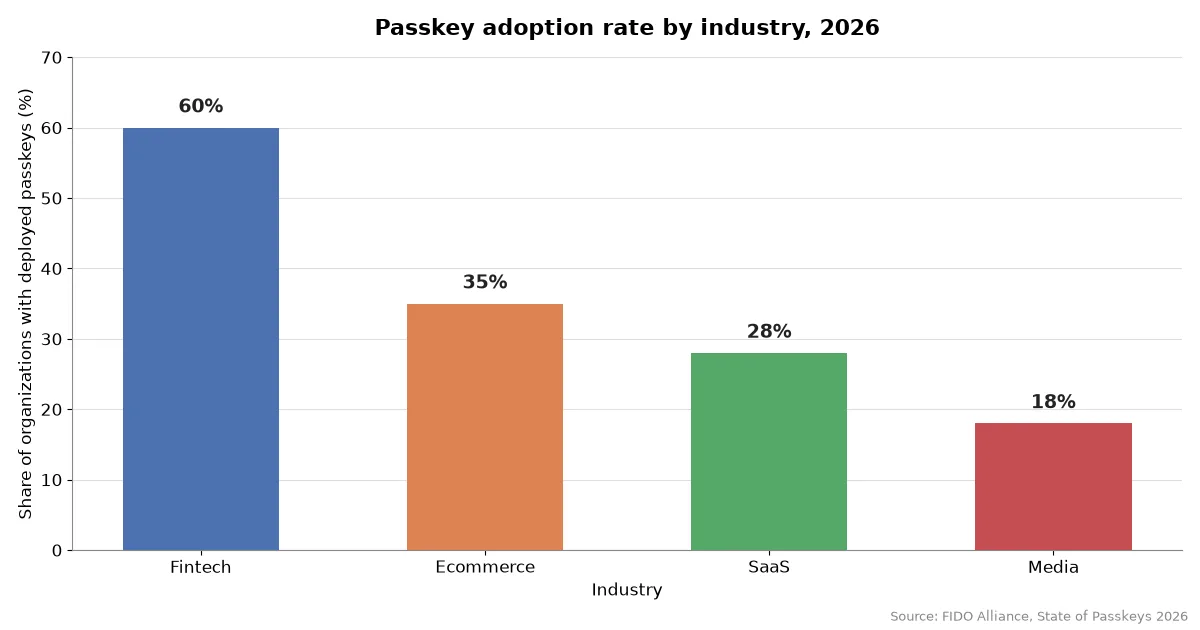
Adoption isn’t even across industries, and the unevenness is informative. Here’s the breakdown from the 2026 report:
| Industry | Passkey deployment rate |
|---|---|
| Fintech | 60% |
| Ecommerce | 35% |
| SaaS | 28% |
| Media | 18% |
Fintech is out ahead at 60%, which tracks with what you’d expect: account takeover in a banking or trading app costs real money immediately, and regulators have been pushing stronger authentication for years. Ecommerce is next at 35%, driven by the same fraud math on a smaller scale. SaaS sits at 28%, behind both, likely because a compromised SaaS account is often a slower-burning problem than a drained payment account, even when the downstream damage (data exposure, lateral movement into a customer’s systems) can be worse. Media trails at 18%, which makes sense given lower average account value and less regulatory pressure.
If you’re building in SaaS, this isn’t a reason to wait. It’s a reason to expect your users to be less passkey-literate than a fintech company’s users, and to design the fallback experience carefully rather than assuming everyone will glide through a passkey prompt on the first try.
The gap nobody’s advertising: deployed versus actually passwordless
This is the part of the report worth sitting with. 82% of organizations call full passwordless authentication a goal they’ve either hit or are actively working toward. Only 28% say they’ve actually reached it across most of their workforce. And 57% of organizations, more than half, still rely on phishable methods like passwords or SMS one-time codes as their primary sign-in.
Put plainly: a lot of organizations have added passkeys as an option and stopped there. That’s not a failure, it’s the sane first step, but it means “we support passkeys” and “we’ve eliminated passwords” describe two very different states of the world, and most companies quoting the first are nowhere near the second. If a vendor or a competitor tells you they’ve “gone passwordless,” ask what fraction of logins that actually covers.
For employee-facing systems specifically, the 68% deployment number sounds strong until you notice it’s deployment, not elimination. A company can offer passkeys to employees and still have every account fall back to a password the moment the passkey isn’t available on some device or browser. That fallback path is exactly where phishing keeps working.
What this means if you’re deciding a roadmap
The honest recommendation, based on what’s actually in the data rather than what’s convenient to say: add passkey support as an option now, and plan for a long period where passwords still exist alongside it. Don’t scope a project around “remove passwords by Q4.” Scope it around “offer passkeys as the preferred path, keep password and recovery flows solid, and measure how the regular-use number moves over time.”
That’s a less exciting pitch than “go passwordless,” but it matches what 57% of organizations are actually doing, and the coexistence period is going to last years, not quarters, especially outside fintech.
If you’re ready to actually add passkey support, here’s what the WebAuthn implementation looks like in code, including the registration and authentication flows, the database schema, and the account recovery gap that trips up most first attempts.
The concrete takeaway
Passkeys crossed from “emerging standard” to “mainstream, partially adopted technology” sometime in the last year, and the 2026 numbers prove it: 5 billion in use, 75% enablement, a login success rate 30 points ahead of passwords. None of that means you can delete your password table. It means passkeys earned a place as the default option you offer first, while your password and account-recovery flows stay fully maintained for the years it’ll take the rest of the gap to close. Build for both, measure the regular-use number for your own users, and let that number, not the industry average, tell you when it’s safe to change the default.
Frequently asked questions
- How many people actually use passkeys in 2026?
- FIDO Alliance's 2026 report puts consumer awareness at 90% and says 75% of people have enabled a passkey on at least one account. Regular use is lower: 49% of people use a passkey when one is offered, which tells you enabling one and reaching for it every time are different behaviors.
- Should my SaaS product prioritize passkeys right now?
- SaaS sits at 28% passkey deployment industry-wide, meaningfully behind fintech's 60%. That gap is closing, not closed, so adding passkey support as an option is worth doing this year, but you shouldn't assume most of your users will already expect it the way fintech users increasingly do.
- Which industries have adopted passkeys fastest?
- Fintech leads at roughly 60% deployment, driven by regulatory pressure and fraud costs. Ecommerce follows at 35%, SaaS at 28%, and media trails at 18%. The pattern tracks how much each industry loses to account takeover and how sensitive its login flow is.
- Can we actually get rid of passwords now that passkeys are mainstream?
- Not yet, for most organizations. 57% of organizations still rely on phishable authentication like passwords or SMS one-time codes as their primary sign-in method, and even among the 82% that call full passwordless a goal, only 28% have reached it across most of their workforce. Plan for a long coexistence period.
- Are passkeys actually more reliable than passwords, or is that just marketing?
- The 2026 data backs it up: passkeys see about a 93% successful login rate compared to 63% for passwords. That difference shows up as fewer failed logins, fewer password reset tickets, and fewer support calls, which is a real operational cost, not just a security argument.
- What's the difference between this post and the WebAuthn implementation guide?
- This post is about whether passkey adoption is real and what that means for prioritization. The companion post walks through the actual WebAuthn code for registration, authentication, and database schema if you're ready to build it.
Sources
Sponsored
More from this category
More from Cybersecurity
Sponsored
Discussion
Join the conversation.
Comments are powered by GitHub Discussions. Sign in with your GitHub account to leave a comment.
Sponsored