AI Integration · AI Models
Qwen3.7 Flash: Alibaba's Dirt-Cheap Vision Model
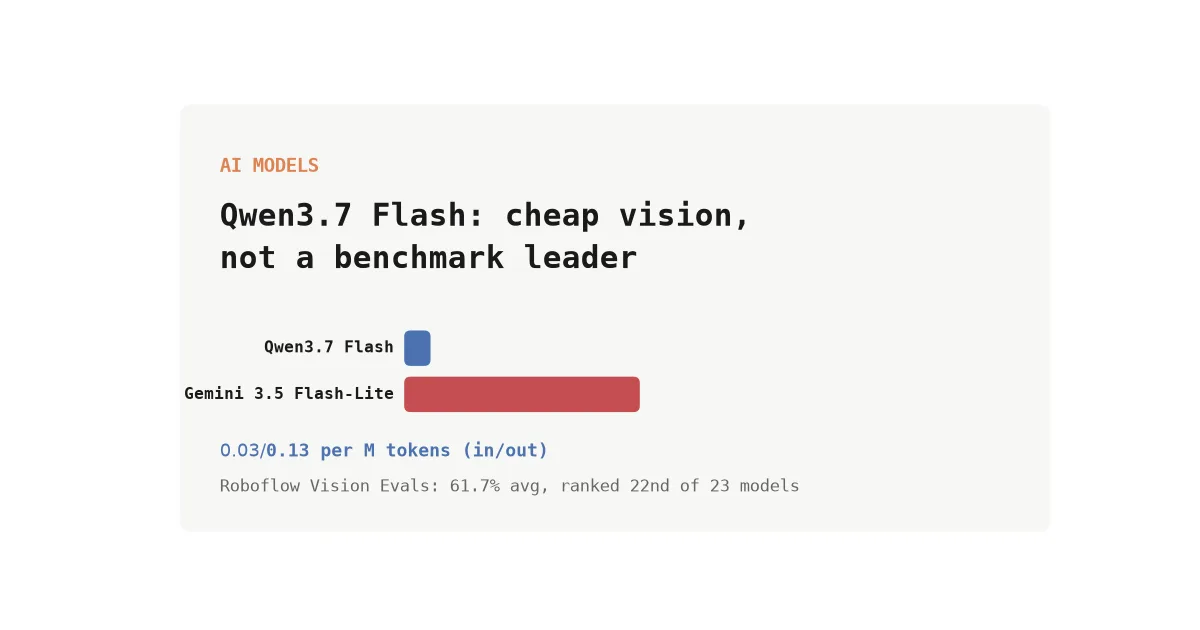
Qwen3.7 Flash costs $0.03 per million input and $0.13 per million output, roughly 10x cheaper than Gemini 3.5 Flash-Lite. When to actually use it.

Shashikant Gupta
6 min read
Sponsored
Alibaba pushed Qwen3.7 Flash onto OpenRouter on July 27, 2026, and the headline number is the pricing, not the intelligence. At $0.03 per million input tokens and $0.13 per million output tokens, it’s roughly 10x cheaper than Gemini 3.5 Flash-Lite on input and about 19x cheaper on output. That’s the practical story here: this is not the model you reach for when you need the sharpest vision reasoning available. It’s the model you reach for when you need to run a large number of cheap multimodal calls and can live with mid-tier accuracy.
Get that framing right up front, because the benchmark picture doesn’t flatter it. On Roboflow’s Vision Evals suite, Qwen3.7 Flash averaged 61.7% across six vision tasks and landed 22nd out of 23 models tested. It’s genuinely not a strong reasoner on vision benchmarks. What it is, is fast and cheap enough to make you rethink how often you’d actually call a vision model in the first place.
What Qwen3.7 Flash actually is
Qwen3.7 Flash is the low-latency, cost-oriented tier of Alibaba’s Qwen3.7 model family. It’s a vision-language model, meaning it accepts interleaved text and image input and returns text output. A few specifics worth knowing before you wire it into anything:
- Context window of roughly 1 million tokens, with a max generation length of 65,536 tokens.
- It’s a hybrid “thinking” model. Reasoning depth is controlled by an
enable_thinkingparameter, and for the Qwen3.7 generation that switch defaults to on. If you want the fastest, cheapest response path, check whether your integration is quietly leaving thinking mode enabled. - It arrives amid a wave of open and cheap model releases through July 2026, part of a broader pattern where Alibaba’s Qwen line has been picking up meaningful share of open-source AI usage.
None of that makes it a frontier reasoning model. It makes it a workhorse: something built to be called constantly, not something built to be right every single time.
Pricing in context
Here’s the comparison that matters most for anyone doing the math on a high-volume workload. The numbers below are the two data points we have confirmed pricing and ratios for; treat the rest of the market as context, not a claim.
| Model | Input ($/M tokens) | Output ($/M tokens) | Context window | Positioning |
|---|---|---|---|---|
| Qwen3.7 Flash | $0.03 | $0.13 | ~1M tokens | Cheapest multimodal model currently available with a 1M-token context window; optimized for volume, not peak accuracy |
| Gemini 3.5 Flash-Lite | ~10x Qwen3.7 Flash’s input price | ~19x Qwen3.7 Flash’s output price | (not specified here) | Google’s low-cost multimodal tier; the comparison point Alibaba is pricing against |
Run the math on a workload that makes a few hundred thousand vision calls a month, each with a modest image and a short text response, and the gap between these two tiers stops being academic. It’s the difference between a line item you barely notice and one that shows up in a budget review.
A quick look at calling it
Qwen3.7 Flash is available through OpenRouter, so the calling pattern looks like any other OpenRouter model: point your OpenAI-compatible client at OpenRouter’s endpoint, pass the model id, and send interleaved text and image content in the message body.
import os
from openai import OpenAI

client = OpenAI(
    base_url="https://openrouter.ai/api/v1",
    api_key=os.environ["OPENROUTER_API_KEY"],
)

response = client.chat.completions.create(
    model="qwen/qwen3.7-flash",
    messages=[
        {
            "role": "user",
            "content": [
                {"type": "text", "text": "What error state is shown in this screenshot?"},
                {"type": "image_url", "image_url": {"url": "https://example.com/screenshot.png"}},
            ],
        }
    ],
    extra_body={"enable_thinking": False},
)

print(response.choices[0].message.content)
That enable_thinking: False line is worth keeping in your template. Since thinking defaults to on for the Qwen3.7 generation, leaving it untouched means you’re paying for reasoning tokens on calls where you probably just wanted a fast read.
Where it actually makes sense
The honest use case is volume, not difficulty. Think about the kinds of multimodal calls that happen constantly and don’t each need to be perfect:
An agent that takes a screenshot after every action to check whether a UI step succeeded. A document intake pipeline that has to look at thousands of scanned pages a day and flag the ones that need a human. A monitoring loop that periodically glances at a dashboard image and reports whether anything looks off. These are all cases where the cost per call adds up fast at normal vision-model pricing, and where an occasional wrong read is annoying but recoverable, not catastrophic.
We covered a related pattern in our guide to running small language models like Qwen and Phi-4 at the edge: the logic is the same here, just applied to a hosted API instead of local deployment. You accept a real accuracy tax in exchange for a workload that would otherwise be too expensive or too slow to run at the frequency you actually need. If your team is also weighing inference cost against hardware choices, our chip comparison piece is a useful companion read for the infrastructure side of that same tradeoff.
Where it doesn’t make sense is anywhere a wrong visual read is expensive. Compliance document review, medical image triage, anything where a missed detail creates real liability. The Roboflow ranking (22nd of 23) is a fair warning sign there. Route those cases to a model with a stronger, independently verified accuracy record, even if it costs more per call.
The caveat worth repeating
No major third-party benchmark organization, including Artificial Analysis, had published independent scores for Qwen3.7 Flash as of this writing. The Roboflow numbers are the clearest public data point we have, and they’re not flattering. That doesn’t mean the model is bad at its actual job. It means you should treat any glowing early claims about it with the same skepticism you’d apply to a vendor’s own benchmark slide, and wait for more independent numbers before betting anything mission-critical on it.
The bottom line
Qwen3.7 Flash isn’t trying to win a leaderboard, and on the one public vision benchmark we have, it clearly doesn’t. What it does is make a certain class of multimodal workload cheap enough to run constantly instead of sparingly. If your use case is high-frequency, tolerant of mid-tier accuracy, and currently expensive because of vision API costs, it’s worth a real trial. If your use case needs the best possible visual reasoning, keep looking, and check back once independent benchmarks catch up to the pricing headlines.
Frequently asked questions
- Is Qwen3.7 Flash good for vision tasks?
- It's usable but not sharp. On Roboflow's Vision Evals suite it averaged 61.7% across six vision benchmarks and ranked 22nd out of 23 models tested. It will read a screenshot or a document image and give you a reasonable answer most of the time, but if the task needs precise visual reasoning, expect more errors than you'd get from a top-tier vision model.
- How much cheaper is Qwen3.7 Flash than Gemini 3.5 Flash-Lite?
- At $0.03 per million input tokens and $0.13 per million output tokens, it runs roughly 10x cheaper than Gemini 3.5 Flash-Lite on input and about 19x cheaper on output. It's currently described as the cheapest multimodal model available with a 1M-token context window.
- What is the enable_thinking switch?
- Qwen3.7 Flash is a hybrid model: it can run a quick response pass or a slower reasoning pass depending on a parameter called enable_thinking. For the Qwen3.7 generation, that switch defaults to on, so if you want fast, cheap, low-latency responses you may need to explicitly turn it off in your API call.
- Should I use Qwen3.7 Flash for a production agent?
- It depends on the job. For high-volume, low-stakes multimodal work such as screenshot QA, document triage, or a perception loop that checks in on an agent's progress every few seconds, the price makes it a strong default. For anything where a wrong visual read is expensive, like compliance document review or safety-critical inspection, its middling benchmark rank means you should route those cases to a stronger (and pricier) model instead.
- How does it compare to Claude or GPT vision models?
- This piece isn't a head-to-head against Claude or GPT-class vision models, since no independent benchmark org has scored Qwen3.7 Flash against them yet. What we do know is that it isn't competing on peak accuracy: its Roboflow ranking puts it well below the pack. It's competing on cost per call and how many of those calls you can afford to make.
Sources
Sponsored
More from this category
More from AI Integration
Sponsored
Discussion
Join the conversation.
Comments are powered by GitHub Discussions. Sign in with your GitHub account to leave a comment.
Sponsored