Technology · Systems Programming
Rust's Portable SIMD Just Landed on the GPU. Here's Why That's a Bigger Deal Than It Sounds
VectorWare mapped Rust's std::simd types directly onto GPU warps, letting the same vector code run on CPU and GPU without a rewrite. What it does, why it's hard, and where it still breaks.

Abhishek Gupta
5 min read
Sponsored
Most attempts to make Rust talk to a GPU end the same way: you write CUDA, or you write a shader in WGSL, or you reach for a crate that wraps one of those underneath a Rust-flavored API. VectorWare’s announcement on August 10 takes a different angle entirely. Instead of giving Rust a way to call into GPU code, they made GPU execution a target for code that was never written with a GPU in mind: ordinary Rust using the standard library’s portable SIMD types.
The two pieces, stacked
VectorWare’s approach builds in layers, and understanding it means separating what shipped earlier from what’s new this month.
The first layer, from their earlier work, maps each Rust std::thread onto a single GPU warp. A warp is the basic unit of parallel execution on a GPU, typically 32 threads that execute the same instruction in lockstep. By treating each warp as if it were one CPU thread, VectorWare lets ordinary multithreaded Rust code, code that spawns threads and coordinates them the normal way, run on GPU hardware without a rewrite. It works, but it leaves most of the GPU’s actual parallelism unused, because each warp’s 32 physical lanes are collapsed down to behave like a single thread.
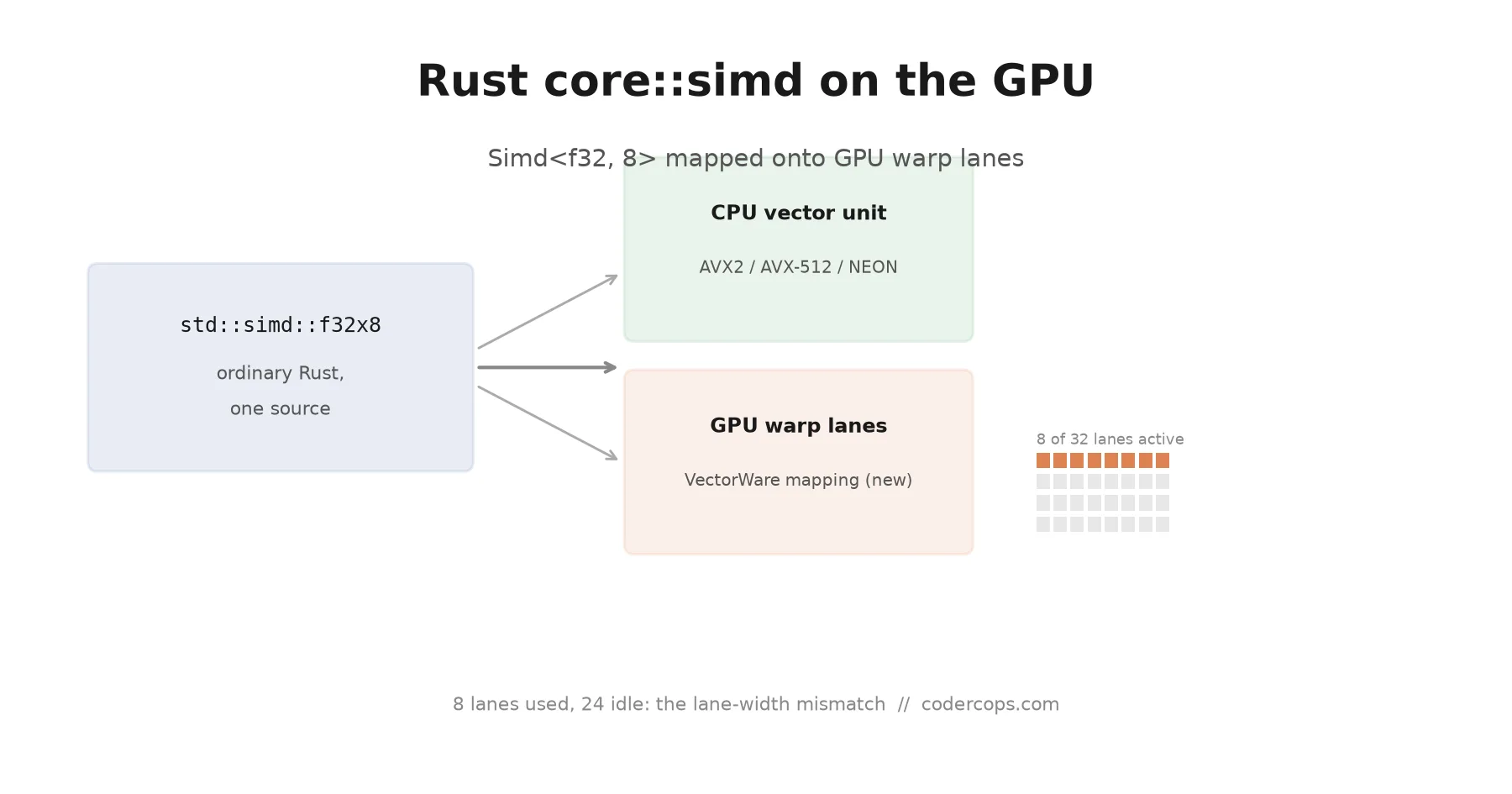
The second layer, announced this month, is what fixes that. Rust’s portable SIMD API gives you fixed-width vector types like Simd<f32, 8>, letting you write explicit vector operations once and have the compiler target whatever SIMD instructions the CPU actually has, AVX2 or AVX-512 on x86, NEON on ARM. VectorWare maps those same Simd<T, N> types onto the GPU’s warp lanes directly, so a vector operation that would use 8 CPU vector-register slots now uses 8 of the warp’s 32 physical lanes concurrently, instead of running as 8 sequential scalar operations.
use std::simd::f32x8;

fn scale_and_add(a: f32x8, b: f32x8, scalar: f32) -> f32x8 {
    a * f32x8::splat(scalar) + b
}
That function, written against nothing but the standard library, is the kind of code this targets: no CUDA kernel syntax, no #[gpu] annotations, no separate compilation unit for the accelerator. It’s a bet that the same code should be able to run well on a CPU core or a GPU warp, with the compiler deciding how to lower the vector operations for whichever target you’re building for.
Where it actually breaks right now
The lane-width mismatch is the practical problem worth understanding before getting excited. CPU SIMD widths are typically 4, 8, or 16 elements depending on the instruction set. GPU warps are usually 32 lanes wide. When a Simd<f32, 8> operation maps onto a 32-lane warp, you either leave 24 lanes idle, or the runtime has to do extra work batching multiple logical vector operations together to fill the warp, and that batching logic isn’t something the portable SIMD API was designed to express. VectorWare’s writeups are candid that this is unsolved, not a minor implementation gap.
There’s also the upstream dependency: Rust’s portable SIMD feature has been unstable for years, sitting behind a nightly compiler flag, with stabilization repeatedly deferred as the language team works through platform-consistency questions. Anything built on it inherits that instability. A project betting on core::simd today is betting on an API surface that can still change shape before it stabilizes.
Why it’s worth tracking anyway
The interesting part isn’t whether this specific implementation ships in a form you’d use next quarter. It’s the direction: making the GPU one more compilation target for ordinary code, the way WebAssembly turned “run in a browser” from a separate language problem (write JavaScript) into a compile target for languages that were never designed for the web. If that pattern holds for GPU compute the way it held for WASM, the payoff is architecture-agnostic performance code: you write the vector math once, and where it runs, CPU core or GPU warp, becomes a build-target decision instead of a rewrite.
That matters most for teams doing numerical or data-parallel work in Rust who currently face a real choice: stay CPU-bound and skip the GPU’s throughput entirely, or fork off a CUDA or WGSL implementation and maintain two versions of the same logic. A viable third option, even an early and rough one, is worth watching closely if you’re anywhere near that decision. It’s the same tradeoff we’ve walked through when WebAssembly started showing up as a genuine backend target outside the browser: the win isn’t the new runtime by itself, it’s not having to maintain a second implementation for it.
If you’re building performance-sensitive Rust today, this isn’t a tool to adopt yet. It’s a signal to keep your vector math written against the portable SIMD API where you reasonably can, rather than hand-rolling architecture-specific intrinsics, so that if this direction matures, your code is already positioned to benefit without a rewrite.
Frequently asked questions
- What is Rust's portable SIMD?
- core::simd is an unstable Rust standard library feature that gives you fixed-width vector types like Simd<f32, 8>, letting you write explicit SIMD (single instruction, multiple data) code once and have it compile to the vector instructions available on the target CPU, AVX2 or AVX-512 on x86, NEON on ARM, and so on, without hand-writing intrinsics for each architecture.
- What did VectorWare actually build?
- A way to run that same portable SIMD code on a GPU. Their earlier work mapped each Rust std::thread onto a single GPU warp, so ordinary multithreaded Rust code could execute on GPU hardware. The new SIMD work adds a second layer: within each of those warp-mapped threads, Simd<T, N> operations now use the GPU's own parallel lanes, instead of running as scalar code one element at a time.
- How is this different from just writing CUDA or a compute shader?
- CUDA and shader languages are separate languages or dialects you write specifically for the GPU, with their own toolchain and mental model. VectorWare's approach lets you write ordinary Rust using the standard library's SIMD types and have that code target the GPU as one more backend, similar in spirit to how a single Rust codebase can already target x86, ARM, or WebAssembly. You're not learning a second language for the accelerator.
- Is this ready for production use?
- No, and VectorWare doesn't claim otherwise. Rust's portable SIMD API itself is still unstable and gated behind a nightly feature flag, and the GPU mapping has known rough edges, particularly around lane-width mismatches when a CPU-oriented vector width doesn't divide cleanly into a GPU warp's width. Treat this as a serious research direction worth watching, not a tool to put in a production build pipeline this quarter.
Sources
Sponsored
More from this category
More from Technology
 R.01
R.01 Elevator Dispatch Algorithms Explained: The Scheduling Problem Hiding in Every Building
 R.02
R.02 Android Views Just Entered Maintenance Mode. Here's What That Means for Your App
 R.03
R.03 GitHub Locked Down Public Stargazer Lists. Here's What Actually Broke
Sponsored
Discussion
Join the conversation.
Comments are powered by GitHub Discussions. Sign in with your GitHub account to leave a comment.
Sponsored