Cybersecurity · Vulnerability Management
CVE-2026-34486: The Apache Tomcat Bug That Undid Its Own Fix
A one-line control-flow change meant to patch CVE-2026-29146 quietly broke Tomcat's cluster encryption instead. CISA confirmed active exploitation on August 4 and set an August 7 remediation deadline. Here's what happened and what to patch.

Prathviraj Singh
5 min read
Sponsored
CVE-2026-34486 exists because of a security patch. Fixing CVE-2026-29146 in Apache Tomcat’s clustering module changed one line of control flow, and that line is why a component built specifically to reject bad cluster traffic now lets some of it through. CISA confirmed active exploitation and added it to the Known Exploited Vulnerabilities catalog on August 4, with a remediation deadline of August 7, 2026, today, for federal agencies.
What EncryptInterceptor is supposed to do
Tomcat Tribes is the built-in clustering module that lets multiple Tomcat instances share session state and coordinate as a cluster. EncryptInterceptor sits in that message pipeline and does one job: decrypt each incoming cluster message, verify it, and only then hand it up to the next stage. Anything that fails decryption gets discarded. That’s the entire security model for cluster traffic, messages that can’t prove they came from a legitimate cluster member never reach application code.
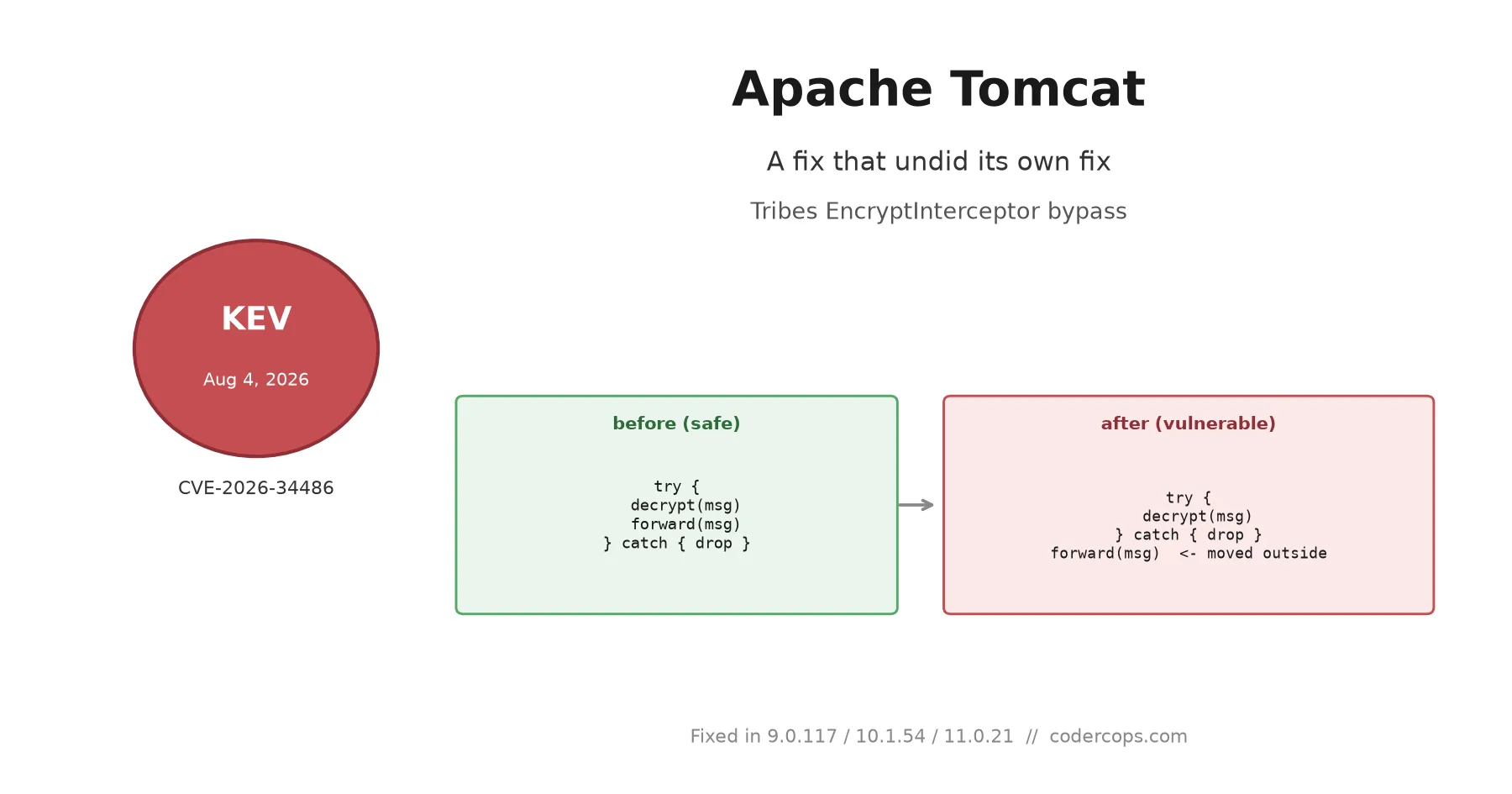
The mechanism for enforcing “discard on failure” was a try-catch block. Decrypt inside the try, forward the result inside the same try, and if decryption throws, the catch block stops the message from going anywhere.
How the CVE-2026-29146 fix broke it
CVE-2026-29146 was an earlier bug in the same interceptor. Fixing it meant restructuring that method, and somewhere in that restructuring, the call that forwards a message to the next handler, super.messageReceived(msg), ended up outside the try-catch block instead of inside it.
That’s the whole vulnerability. Move one function call outside a try-catch, and the logic that used to read “forward only on success” now reads “forward regardless.” A message that fails decryption still throws inside the try block, but the forwarding call downstream of it isn’t guarded by that exception anymore, so it can still execute depending on how the surrounding control flow resolves. The interceptor keeps its name and keeps most of its code. It stops doing the one thing that name promises.
This is a useful case study independent of Tomcat specifically: a fix that changes what code does without changing what it says. Reviewing a security patch by reading the diff for intent, not just confirming the reported bug no longer reproduces, is the only way to catch a regression like this before a scanner or an attacker does. It’s the same discipline behind treating a vulnerability chain’s severity as the severity of its weakest step, not the strength of any single control.
Who’s actually exposed
| Component | Status |
|---|---|
| Tomcat 9.0.116 | Vulnerable |
| Tomcat 9.0.117+ | Fixed |
| Tomcat 10.1.53 | Vulnerable |
| Tomcat 10.1.54+ | Fixed |
| Tomcat 11.0.20 | Vulnerable |
| Tomcat 11.0.21+ | Fixed |
| Standalone Tomcat, no clustering | Not applicable |
The exposure is narrower than a lot of CVEs that make the KEV catalog. This isn’t a bug in Tomcat’s HTTP handling or servlet container, it’s specific to Tribes, and Tribes only runs when you’ve configured clustering or session replication. A single Tomcat instance serving traffic on its own never loads EncryptInterceptor and has nothing here to bypass.
That narrowness doesn’t make it low priority for the deployments it does affect. Clustering is exactly how organizations run Tomcat at any real scale, session replication across nodes behind a load balancer, high-availability pairs, autoscaled instance groups all sharing state. If you’re running Tomcat in production behind anything more than a single box, there’s a real chance Tribes is in the picture.
What to check this week
Confirm your exact Tomcat version against the table above. If you’re on 9.0.116, 10.1.53, or 11.0.20 specifically, that’s the vulnerable set, upgrade to 9.0.117, 10.1.54, or 11.0.21. If you’re on an older version that predates the original CVE-2026-29146 patch, you don’t have this exact regression, but you’re also missing the fix for the bug that caused it, so the upgrade path is the same either way: get current.
If you can’t patch immediately, the mitigating control is network isolation for cluster traffic. Tribes communication should already be confined to a private network segment or VPN between cluster nodes rather than reachable from anywhere that can also reach your public endpoints; if it isn’t, that’s a bigger gap than this one CVE. Review cluster membership logs for nodes you don’t recognize while you plan the upgrade window.
The broader lesson travels past this one component. When a security fix changes control flow, the review that matters is the one that asks what else that flow used to guarantee, because a patch that’s correct against its own test case and wrong about a nearby invariant is exactly how a fixed CVE produces a new one. If your team runs infrastructure like this in production, our engineering team has handled cluster hardening reviews like this across a number of client deployments, and it’s worth a second look anywhere your own patch history has a fix on top of a fix.
Frequently asked questions
- What is CVE-2026-34486?
- A Missing Encryption of Sensitive Data vulnerability (CWE-311) in Apache Tomcat's Tribes clustering component. It lets unauthenticated or unencrypted messages reach a cluster node's message-handling chain even though the EncryptInterceptor is configured to block anything that fails decryption.
- Why does a security patch need a second patch?
- The original fix for CVE-2026-29146 changed EncryptInterceptor's control flow. Before the fix, a call to forward the decrypted message ran inside the same try-catch block as the decryption itself, so a decryption failure prevented forwarding. The patch moved that forwarding call outside the try-catch, which meant it ran regardless of whether decryption succeeded. The fix for one bug created the conditions for another.
- Which Tomcat versions are affected?
- 9.0.116, 10.1.53, and 11.0.20. If you're running any of those exact versions, you're exposed. Anything before them predates the CVE-2026-29146 patch and doesn't have this specific regression, though it may have the original bug. Upgrade to 9.0.117, 10.1.54, or 11.0.21 to get both fixes.
- Is this actually being exploited?
- Yes. CISA added CVE-2026-34486 to its Known Exploited Vulnerabilities catalog on August 4, 2026, which only happens with confirmed evidence of real-world exploitation, and set a remediation deadline of August 7 for federal agencies under Binding Operational Directive 26-04.
- Do I need to patch if I'm not running Tomcat in a cluster?
- No. The vulnerable code path is entirely inside Tribes, Tomcat's clustering and session-replication module. A single-instance Tomcat deployment with no cluster membership configured doesn't load EncryptInterceptor and isn't exposed by this specific CVE, though staying current on Tomcat patches generally is still good hygiene.
Sources
Sponsored
More from this category
More from Cybersecurity
 R.01
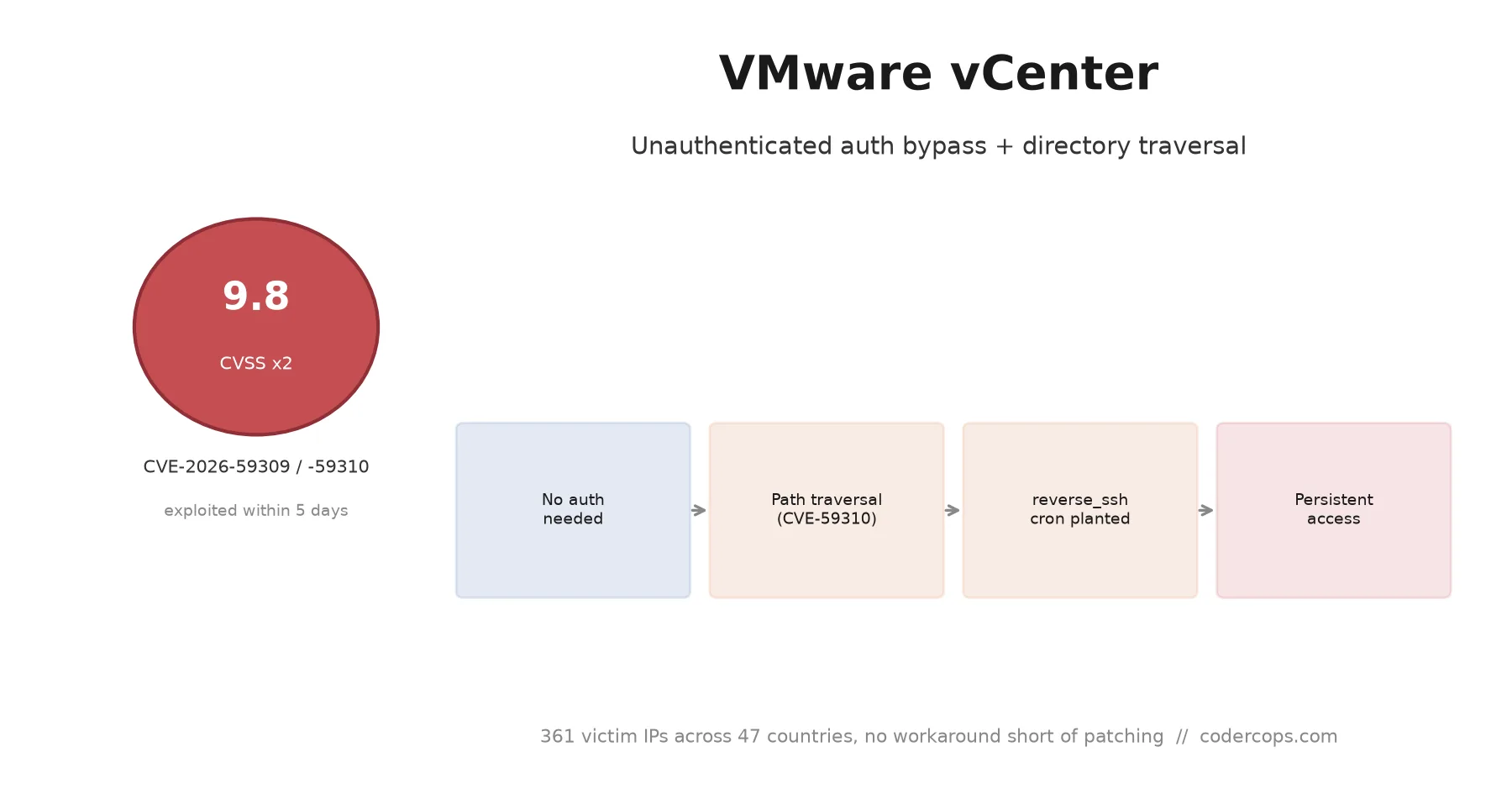
R.01 CVE-2026-59309 and 59310: VMware vCenter Bugs Attackers Hit in Five Days
 R.02
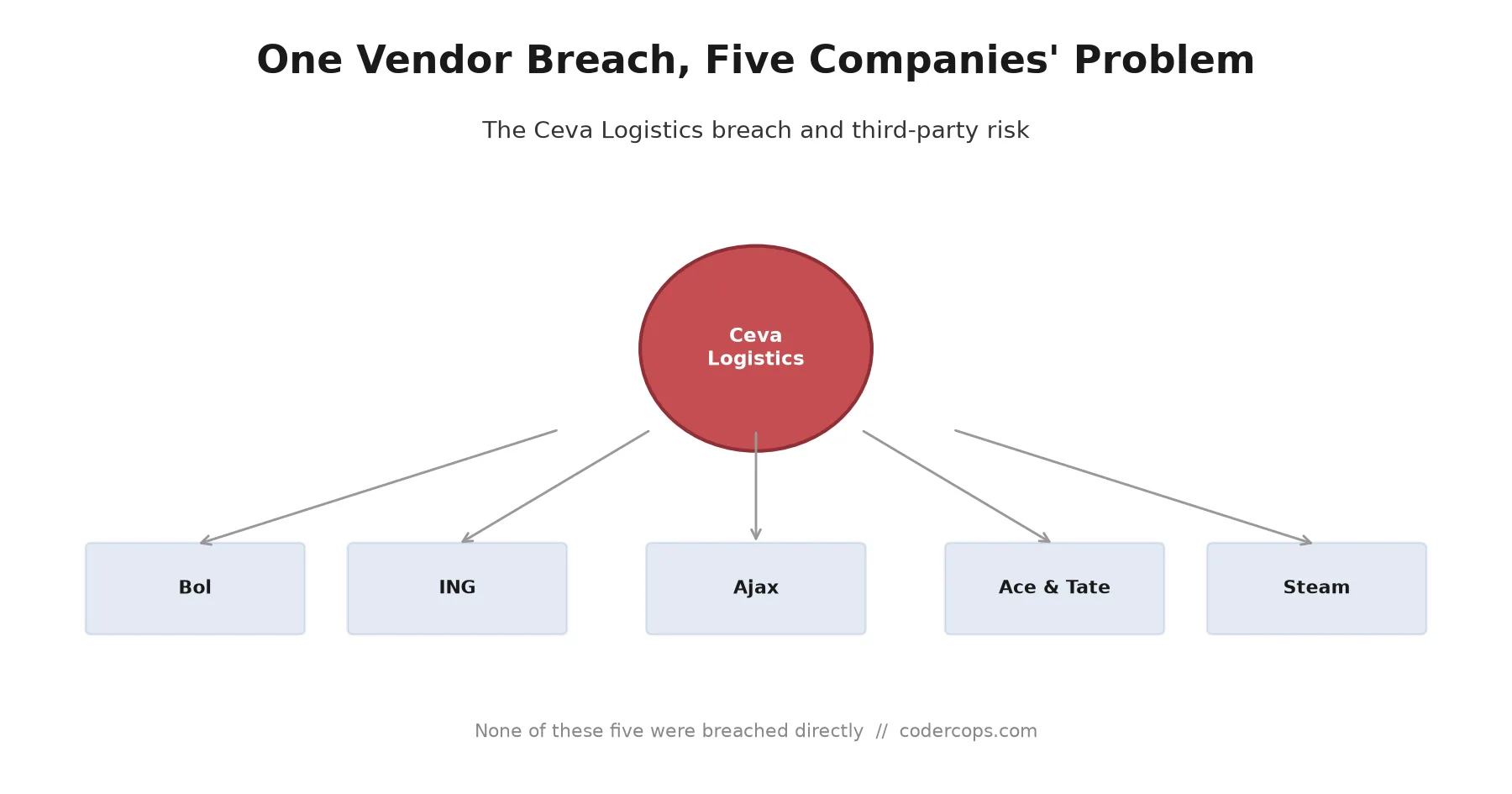
R.02 The Ceva Logistics Breach Shows Why Your Vendor's Vendor Is Your Problem
 R.03
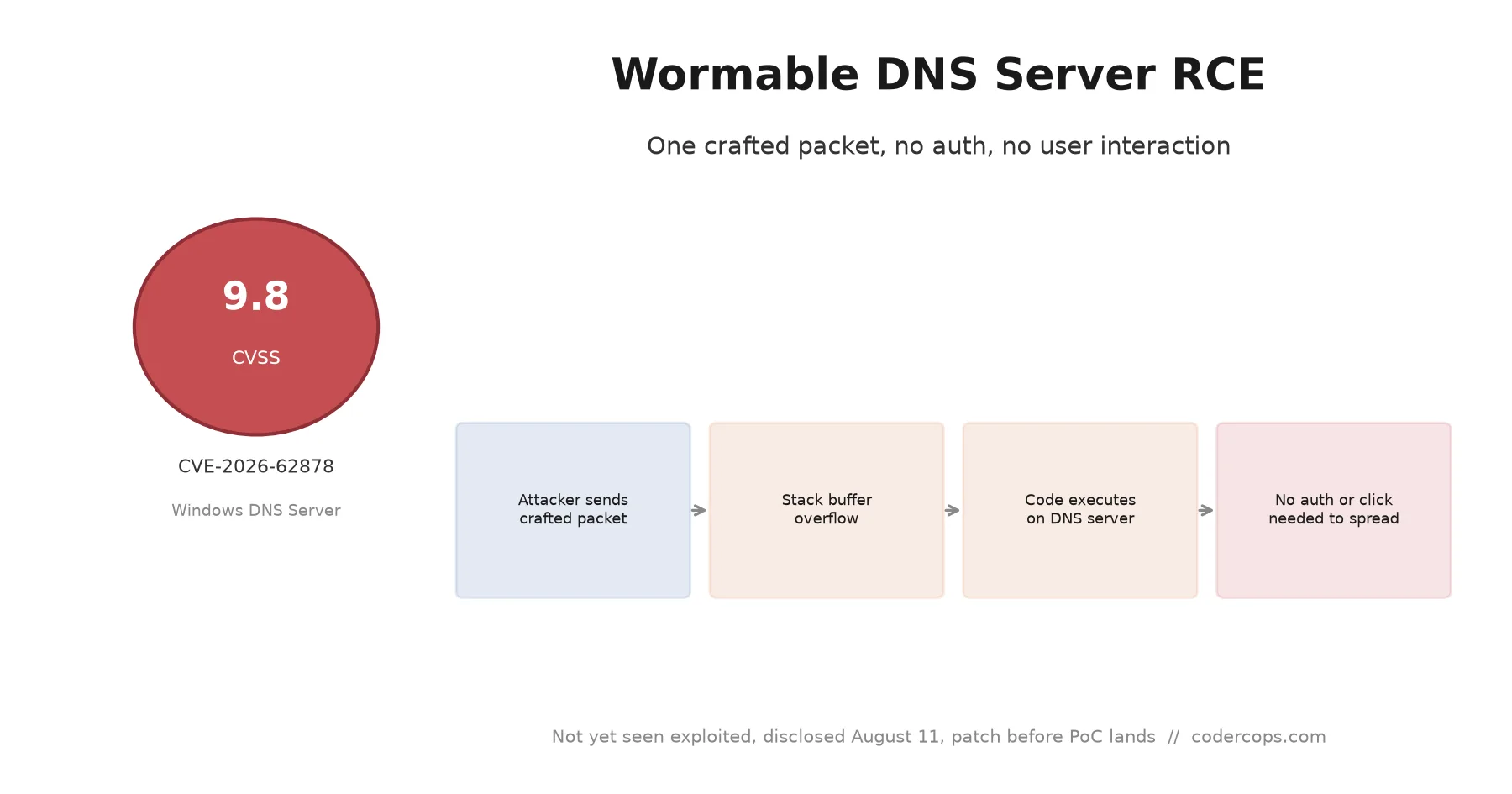
R.03 CVE-2026-62878: The Wormable Windows DNS Server Bug You Need to Patch Now
Sponsored
Discussion
Join the conversation.
Comments are powered by GitHub Discussions. Sign in with your GitHub account to leave a comment.
Sponsored