Cybersecurity · Vulnerability Management
CVE-2026-8452: Citrix's DoS Bug Is Pre-Auth RCE
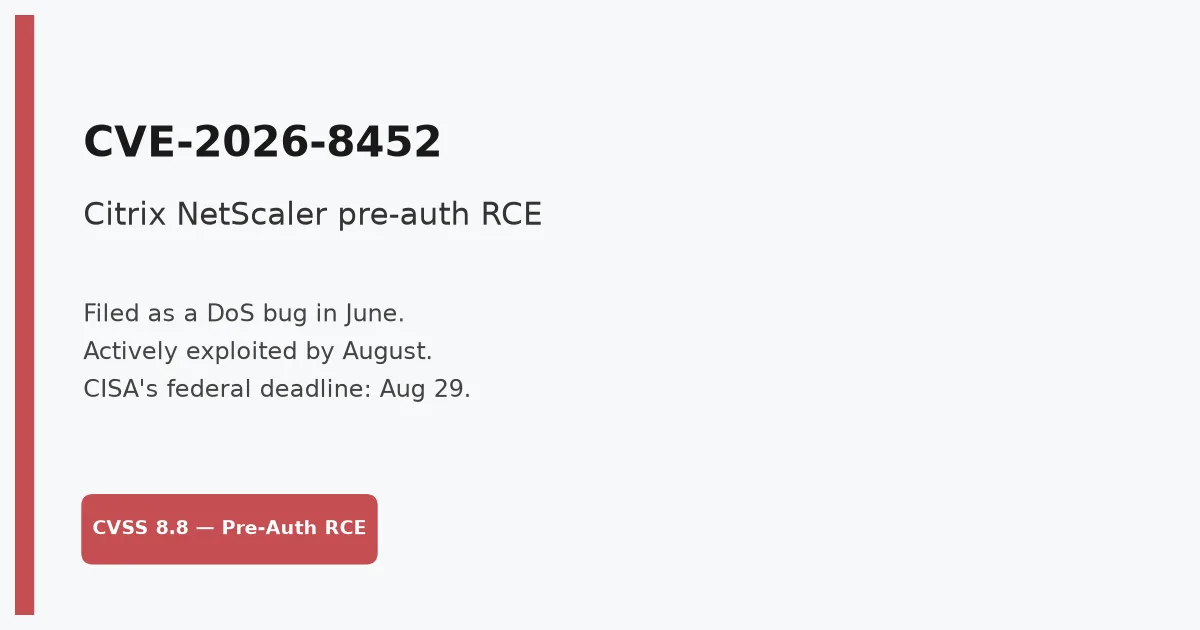
Citrix shipped CVE-2026-8452 as a routine DoS fix in June. watchTowr showed it's a pre-auth heap overflow with a path to RCE. CISA's deadline was August 29.

Prathviraj Singh
5 min read
Sponsored
On June 30, Citrix shipped a fix for a “memory overflow vulnerability leading to unpredictable or erroneous behavior and denial of service” in NetScaler ADC and Gateway. Most security teams read that sentence, filed it under routine patching, and moved on. Seven weeks later, that same bug, tracked as CVE-2026-8452, is on the CISA Known Exploited Vulnerabilities catalog with a federal remediation deadline of August 29, because it isn’t a denial-of-service bug. It’s an unauthenticated remote code execution primitive, and attackers are already using it.
If your NetScaler is patched from June, you’re covered, the binary fix hasn’t changed. If it isn’t, the risk math just changed underneath you.
What the bug actually is
CVE-2026-8452 lives in how NetScaler validates SAML authentication messages on a Gateway (SSL VPN, ICA Proxy, CVPN, RDP Proxy) or AAA virtual server. Before checking whether a SAML message’s signature is valid, NetScaler rewrites part of the message into a standard form, a step called canonicalization. One attacker-controlled field in that process, the PrefixList attribute inside the XML signature’s InclusiveNamespaces element, gets copied into a fixed-size buffer with no bounds check.
Send a PrefixList longer than the buffer expects, and you overflow the heap. That’s the whole bug: one HTTP request, no credentials, no signature that actually needs to be valid, because the crash happens during canonicalization, before validation ever runs.
Why “DoS” was the wrong ceiling
A heap overflow that corrupts memory can crash a process, that’s the denial-of-service framing Citrix’s original advisory used, and it’s not wrong on its own. But heap corruption in a process that handles all traffic through the appliance is also, in the right hands, a memory-write primitive. watchTowr Labs’ August 14 writeup laid out exactly that path: the same overflow that crashes the process under naive triggering can, with a carefully sized and positioned PrefixList, corrupt adjacent heap metadata in a controlled way. From there, independent researchers pushed the analysis toward a full pre-authentication remote code execution chain, hence the ”(?)” that shows up in some early writeups before the RCE path was nailed down publicly.
This is the part worth internalizing beyond this one CVE: a vendor’s initial severity rating reflects what they tested and were willing to claim at disclosure time, not a hard ceiling on what the bug can do. Security researchers routinely take a “denial of service” primitive and push it further once they have time with the binary. Treating “just a DoS” as a reason to deprioritize a memory-safety bug in an internet-facing authentication component is a bet that nobody will do that work. This time, someone did, in under seven weeks.
The exploitation timeline moved fast
| Date | Event |
|---|---|
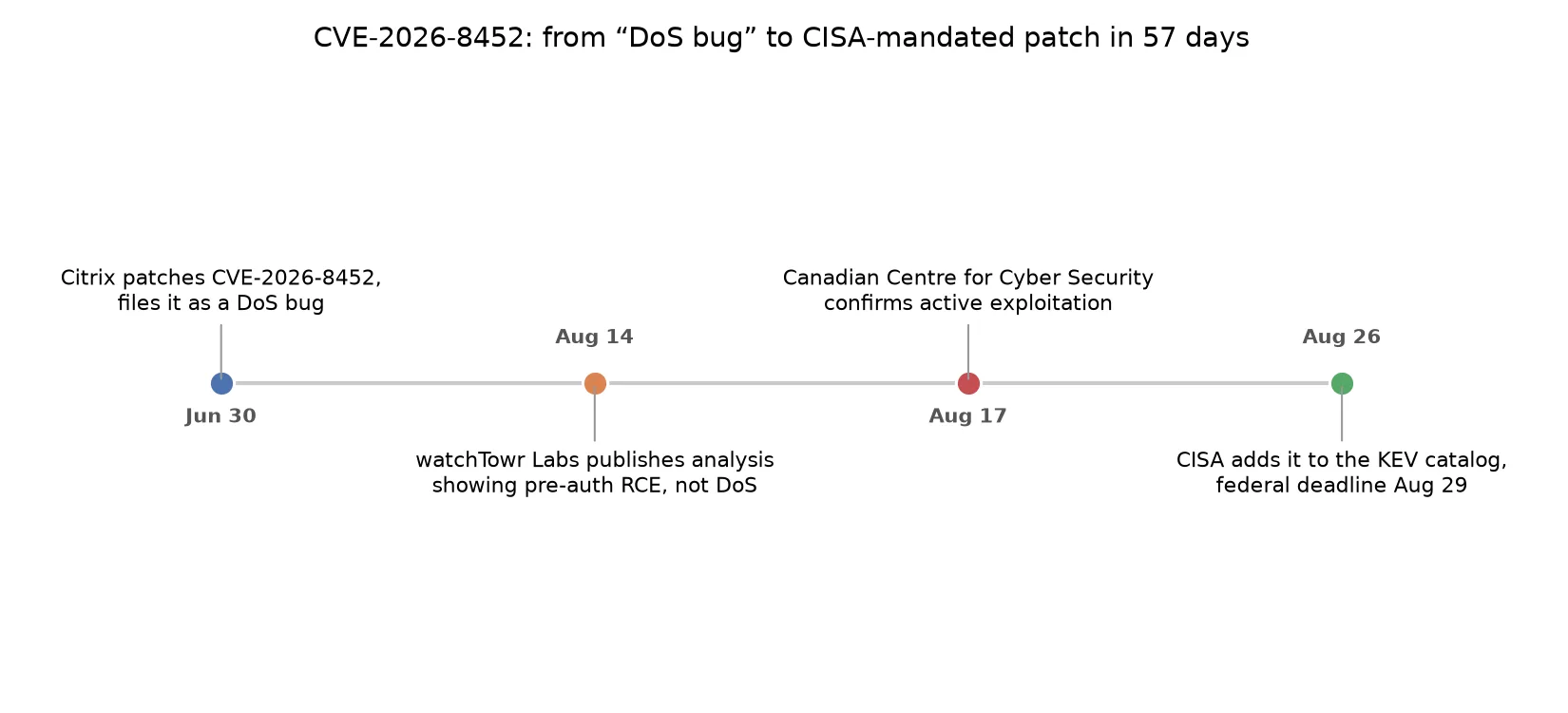
| Jun 30 | Citrix patches CVE-2026-8452, discloses it as a DoS bug (14.1-72.61, 13.1-63.18, 13.1-37.272) |
| Aug 14 | watchTowr Labs publishes technical analysis and PoC showing pre-auth RCE potential |
| Aug 17 | Canadian Centre for Cyber Security confirms active exploitation in the wild |
| Aug 26 | CISA adds CVE-2026-8452 to the KEV catalog, federal deadline August 29 |
Fifty-seven days from quiet patch to confirmed in-the-wild exploitation, and only three days from public PoC to confirmed attacks. That gap, PoC to exploitation, keeps shrinking across the CVEs we’ve tracked this year, and it’s the strongest argument for patching internet-facing infrastructure on disclosure rather than on a monthly cycle. The same compressed timeline showed up with the arrayref supply chain attack and the SharePoint JWT bypass earlier this month. If your patch cadence assumes attackers need weeks to weaponize a public writeup, that assumption is no longer holding.
What to check right now
Confirm your build number first. The fix applies to:
NetScaler ADC / Gateway 14.1 before 14.1-72.61  -> upgrade to 14.1-72.61 or later
NetScaler ADC / Gateway 13.1 before 13.1-63.18  -> upgrade to 13.1-63.18 or later
NetScaler ADC / Gateway 13.1 before 13.1-37.272 -> upgrade to 13.1-37.272 or later (FIPS/NDcPP builds)
If you’re already on one of those builds or newer, you have the fix, full stop. There’s no separate “RCE patch” to apply on top of the June update; the severity story changed, the binary didn’t.
If you’re behind, prioritize by exposure. Any Gateway or AAA virtual server with SAML enabled and reachable from the internet is the profile watchTowr’s research targets directly. Bishop Fox’s follow-up analysis is useful here too: it describes how to verify the patch actually took effect without needing to trigger a crash against a production appliance, worth reading before you assume a version-number check tells the whole story.
If you can’t patch immediately, disabling SAML authentication on exposed virtual servers removes the vulnerable code path entirely, at the cost of breaking SAML-based SSO for those users until you can complete the upgrade. That’s a real tradeoff, but it’s a faster mitigation than an emergency change window for the full appliance update.
The broader pattern
This is at least the third time in 2026 that an internet-facing network appliance, not an application, not a library, has turned into the highest-priority patch of the month. The SharePoint JWT bug and this NetScaler flaw share a shape: authentication infrastructure that terminates a lot of trust, running code most security teams don’t read, discovered by researchers who do. If you run any SAML, SSO, or VPN gateway appliance, exposed to the internet by design, this class of bug deserves the same patch urgency as your application layer, not a lower one because it’s “just infrastructure.”
Check your NetScaler build number today. If you can’t confirm it’s patched by end of week, that’s the actual priority ahead of whatever else is on the roadmap.
Frequently asked questions
- Do I need to do anything if I already applied the June patch?
- No. The fix for CVE-2026-8452 is the same binary update Citrix shipped on June 30 (14.1-72.61, 13.1-63.18, and 13.1-37.272). If you're already on one of those builds or later, you're patched, regardless of what the original advisory called the bug.
- What makes this different from a normal Citrix CVE?
- The severity classification changed after the fact. Citrix's original advisory described it as a denial-of-service issue, which many teams triage as 'patch on the normal cycle.' watchTowr Labs' August analysis showed the same memory corruption can be steered into remote code execution by an unauthenticated attacker, which is a different urgency tier entirely. The lesson isn't about this one CVE, it's that a vendor's initial severity call isn't always the ceiling.
- Which NetScaler configurations are actually exposed?
- Appliances configured as a Gateway, covering SSL VPN, ICA Proxy, CVPN, or RDP Proxy, or as an AAA virtual server with SAML authentication enabled. The vulnerable code path is in SAML signature canonicalization, so a NetScaler with no SAML configured isn't exposed to this specific bug, though it's still worth confirming your build number against the fixed versions.
- What happens if I miss the CISA deadline?
- The August 29 deadline is a Binding Operational Directive requirement for U.S. federal civilian executive branch agencies specifically, it doesn't carry a penalty for private companies. But 'no deadline' isn't the same as 'no risk.' Public PoC code plus confirmed in-the-wild exploitation means every unpatched, internet-facing NetScaler with SAML enabled is a live target regardless of what sector you're in.
Sources
Sponsored
More from this category
More from Cybersecurity
Sponsored
Discussion
Join the conversation.
Comments are powered by GitHub Discussions. Sign in with your GitHub account to leave a comment.
Sponsored