Web Development · Architecture Patterns
CQRS Explained: When Splitting Reads From Writes Is Actually Worth It
CQRS separates the code path that changes data from the code path that reads it. It solves real scaling and modeling problems, and it's also one of the most over-applied patterns in backend architecture. Here's when it earns its complexity.

Prathviraj Singh
5 min read
Sponsored
CQRS sounds like the kind of pattern you adopt because it sounds rigorous, not because you need it. Sometimes that’s exactly what happens, and the result is a codebase with twice the moving parts and no problem it actually solved. Other times the split solves a real, specific pain: a write model straining under denormalization hacks bolted on to serve reads it was never designed for. The difference is whether your read and write patterns are actually in tension, and most teams adopt the pattern without checking.
What CQRS actually is
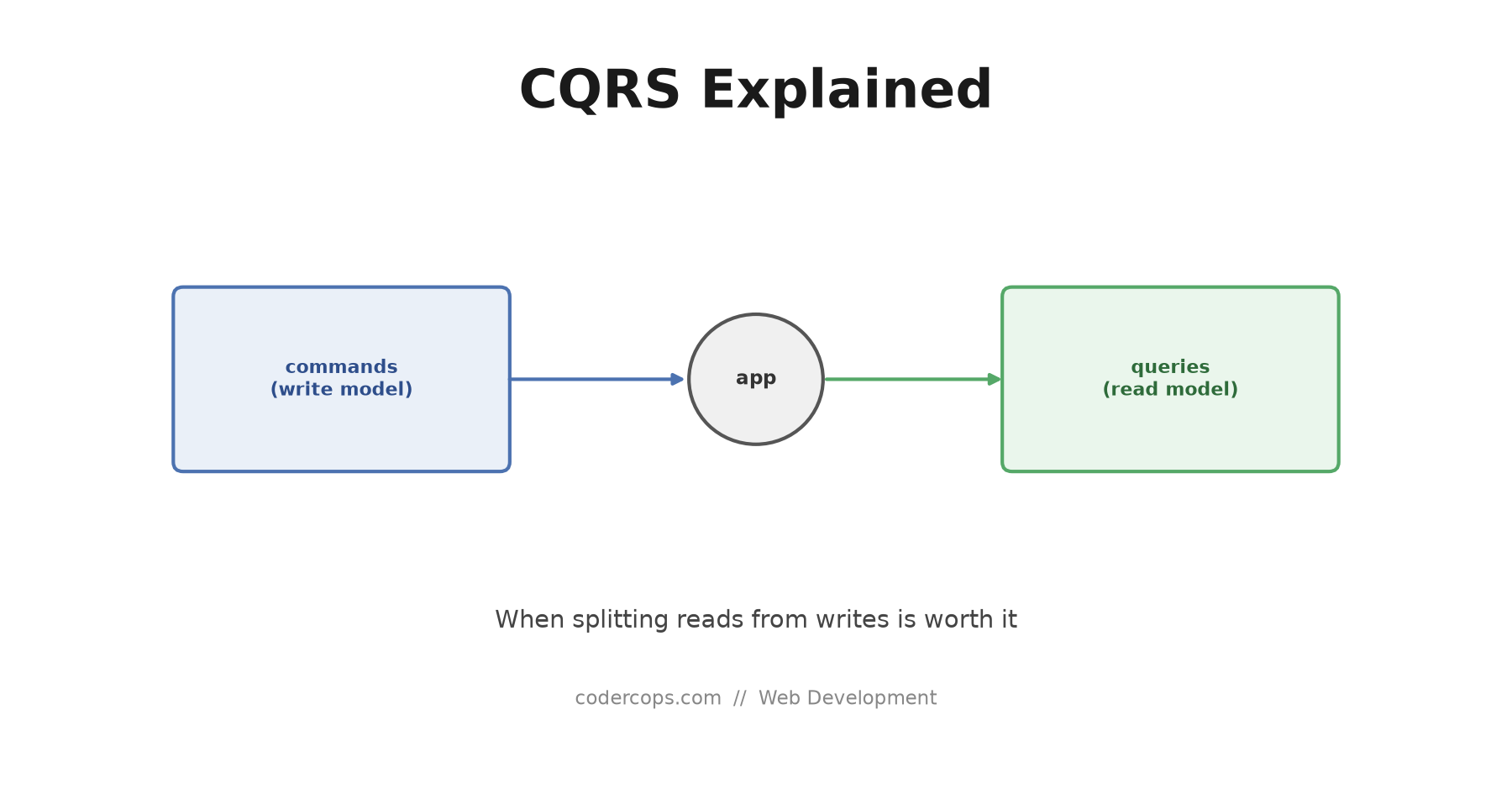
Command Query Responsibility Segregation splits your data layer into two paths: commands, which change state, and queries, which read it. Instead of one model (often one ORM entity, one repository class) handling both, you get two models, each shaped for its own job.
Traditional:
  UserService.getUser(id) -----> User model -----> users table
  UserService.updateUser(id, data) -----> User model -----> users table

CQRS:
  UserQueryService.getUserProfile(id) -----> UserProfileReadModel -----> denormalized view
  UserCommandService.updateUser(id, data) -----> User write model -----> users table (normalized)
The write model stays strict: validated fields, foreign key constraints, business rules enforced at the point of change. The read model is free to be shaped however the consumer needs it, which is often a flattened, joined, pre-aggregated structure that would be a bad fit for the write side’s normalization rules.
The version most teams actually need
Full CQRS, separate databases for reads and writes, connected by an event stream or message bus, is a significant architectural commitment. Most teams that reach for CQRS don’t need that version. A lighter form gets most of the benefit at a fraction of the cost:
# Write side: normal ORM model, validation, constraints
class OrderCommandService:
    def place_order(self, user_id, items):
        order = Order(user_id=user_id, status="pending")
        order.full_clean()  # validation
        order.save()
        for item in items:
            OrderLine.objects.create(order=order, **item)
        return order.id

# Read side: a query shaped for exactly what the UI needs, same database
class OrderQueryService:
    def get_order_summary(self, order_id):
        return Order.objects.select_related("user").prefetch_related("lines").annotate(
            total=Sum("lines__price"),
            item_count=Count("lines"),
        ).values(
            "id", "user__name", "status", "total", "item_count"
        ).get(id=order_id)
Same database, same transaction, no eventual consistency, no message bus. What you get is a read path that’s free to denormalize, aggregate, and shape data for its consumer without those decisions leaking into the write model’s validation logic. For a lot of teams, this is the entire benefit CQRS was promising, without the operational cost of a second data store.
Where full CQRS earns its complexity
The heavier version, separate read and write stores kept in sync asynchronously, pays off in specific situations:
Read and write load need to scale independently. A system with heavy read traffic (a public catalog, a dashboard hit by every user on every page load) and comparatively light write traffic benefits from scaling read replicas or a dedicated read store (Elasticsearch, a denormalized read database, a cache layer) without that scaling decision touching the write path at all.
The read model shape is fundamentally incompatible with the write model. Some domains need read views that aggregate across so many write-side entities, in so many different shapes for different consumers, that maintaining them as views or queries against the write schema becomes its own maintenance burden. A dedicated read store, built by projecting write-side changes into purpose-built read documents, can be simpler than an ever-growing set of complex queries.
You’re already event-sourcing. If write-side state changes are already modeled as a sequence of events (a common pairing with CQRS but not a requirement of it), projecting those events into one or more read models is a natural fit, and you get audit history and read-model rebuilding as a side effect.
The cost you’re signing up for
Full CQRS with separate stores means eventual consistency: a write succeeds, and the read model reflecting it updates some time later. That gap has to be handled somewhere. A user who submits a form and immediately navigates to a page reading from the (not-yet-updated) read model sees stale data, unless you explicitly design around it, reading from the write side immediately after a write the user just performed, or accepting and communicating the lag.
You’re also operating two systems instead of one: monitoring both, keeping the projection mechanism between them healthy, and debugging a wider class of bugs (a projection that silently stopped updating is a different failure mode than a query bug, and it’s easy to miss until someone notices stale data days later).
Deciding if you need it
| Signal | What it suggests |
|---|---|
| Read queries full of joins and denormalization hacks on a write-optimized schema | Lightweight CQRS (same database, separate models) is worth trying |
| Read and write load scaling requirements are genuinely different and can’t be met by one model | Full CQRS with a separate read store is worth evaluating |
| You’re already event-sourcing write-side changes | Full CQRS is a natural extension, not new complexity |
| Your read and write patterns aren’t actually in tension | Skip it; you’re adding complexity with nothing to show for it |
CQRS pairs conceptually with other resilience and scaling patterns worth knowing on their own terms, like the circuit breaker pattern for containing downstream failures; both solve a specific, narrow problem well and both get over-applied when teams reach for them as a default instead of a response to an observed pain point.
Start with the lightweight version: same database, separate read and write models in code. Move to full CQRS only when you can point at a specific scaling or modeling constraint that the lightweight version doesn’t solve, not because the pattern has a name that sounds like good architecture.
Frequently asked questions
- What problem does CQRS actually solve?
- It solves the mismatch between what a good write model looks like and what a good read model looks like. Writes usually want a normalized, validated, consistency-enforcing structure, one row per entity, foreign keys, constraints. Reads usually want denormalized, pre-shaped data that matches exactly what a screen or API response needs, often pulling from multiple entities at once. A single model trying to serve both jobs well ends up compromised at both. CQRS lets each side be optimized for its own job.
- Do I need event sourcing to use CQRS?
- No, and conflating the two is a common source of over-engineering. CQRS is just separate models for reading and writing; event sourcing is a separate pattern about storing state as a sequence of events rather than current values. They're often used together because they complement each other, event sourcing gives you a natural way to project write-side events into read-side models, but plenty of production CQRS implementations use a normal database on both sides with no event log at all.
- What does a lightweight version of CQRS look like?
- Same database, same transaction, two different models in code: a write model with your normal ORM entities and validation logic, and a set of read-optimized query functions or views that return exactly the shape a given endpoint needs, potentially denormalized, potentially joining across tables in ways your write model never would. No eventual consistency, no separate data store, no message bus. This gets most teams the main benefit, an unconstrained read model, without full CQRS's operational cost.
- What's the actual cost of full CQRS with separate read and write stores?
- Eventual consistency is the big one: a write succeeds, and the read model that reflects it updates some time later, milliseconds to seconds depending on your propagation mechanism. Every part of your UI and API that assumes 'what I just wrote is what I'll read next' needs to handle that gap, either by tolerating slightly stale reads or by explicitly reading from the write side right after a write. You're also running and monitoring two data stores and the sync mechanism between them, which is real operational surface area that a single-database system doesn't have.
- How do I know if my team actually needs this?
- Ask whether your read and write patterns are genuinely in tension today, not hypothetically. Signs you might: your read queries are full of joins and denormalization hacks bolted onto a write-optimized schema, your write-side validation logic is getting tangled with read-side formatting concerns, or your read load and write load need to scale independently and can't on a shared model. If none of that describes your system, CQRS is solving a problem you don't have yet, and the complexity cost lands immediately while the benefit stays theoretical.
Sponsored
More from this category
More from Web Development
 R.01
R.01 MySQL Now Has a Native VECTOR Type. Should You Drop pgvector For It?
 R.02
R.02 React 19.2 vs 'React 20': There Is No React 20, and Here's What's Actually New
 R.03
R.03 Next.js's First Scheduled Security Release Shipped: 9 Advisories, What to Patch
Sponsored
Discussion
Join the conversation.
Comments are powered by GitHub Discussions. Sign in with your GitHub account to leave a comment.
Sponsored