Cybersecurity · Vulnerability Management
CVE-2026-60004: Gitea's diffpatch RCE Is Now Being Exploited
A flaw in Gitea's diffpatch API turns a crafted merge conflict into an executable Git hook. CISA added it after miner payloads showed up. What to patch.

Prathviraj Singh
5 min read
Sponsored
Gitea is the self-hosted Git server a lot of teams reach for instead of paying for GitHub Enterprise or running a GitLab instance nobody wants to maintain. That makes CVE-2026-60004 an uncomfortable one: a CVSS 9.8 remote code execution bug in Gitea’s diffpatch API that turns a crafted merge conflict into a shell on the box hosting your source code. CISA added it to the Known Exploited Vulnerabilities catalog on August 25 after reports of compromised instances running crypto miners, and gave federal agencies until August 28 to patch. If you self-host Gitea and haven’t checked your version this week, do it before you finish reading.
What’s actually broken
The diffpatch API exists to let Gitea apply a submitted patch against a repository, the kind of thing that happens routinely when a pull request gets merged. It does the work inside a temporary Git clone, applies the patch, and cleans up.
The bug is in how that temporary clone is structured. A crafted patch can force an add/add collision, a specific kind of merge conflict where two sides of a merge both introduce the same new file. Git resolves that with a three-way merge fallback, and that fallback is where the attack lands: it lets attacker-controlled content get written into a location that becomes an executable Git hook, specifically a post-index-change hook.
Here’s the part that turns a weird merge quirk into remote code execution. The temporary clone diffpatch uses is a bare repository, but its working directory and its Git directory are the same location. A hook written into that directory isn’t sitting in some inert temp folder. It’s live, in the one place Git will actually execute it from, and the next index operation on that clone triggers it. The hook runs as the operating system account that runs the Gitea service, with whatever file access and network reach that account has.
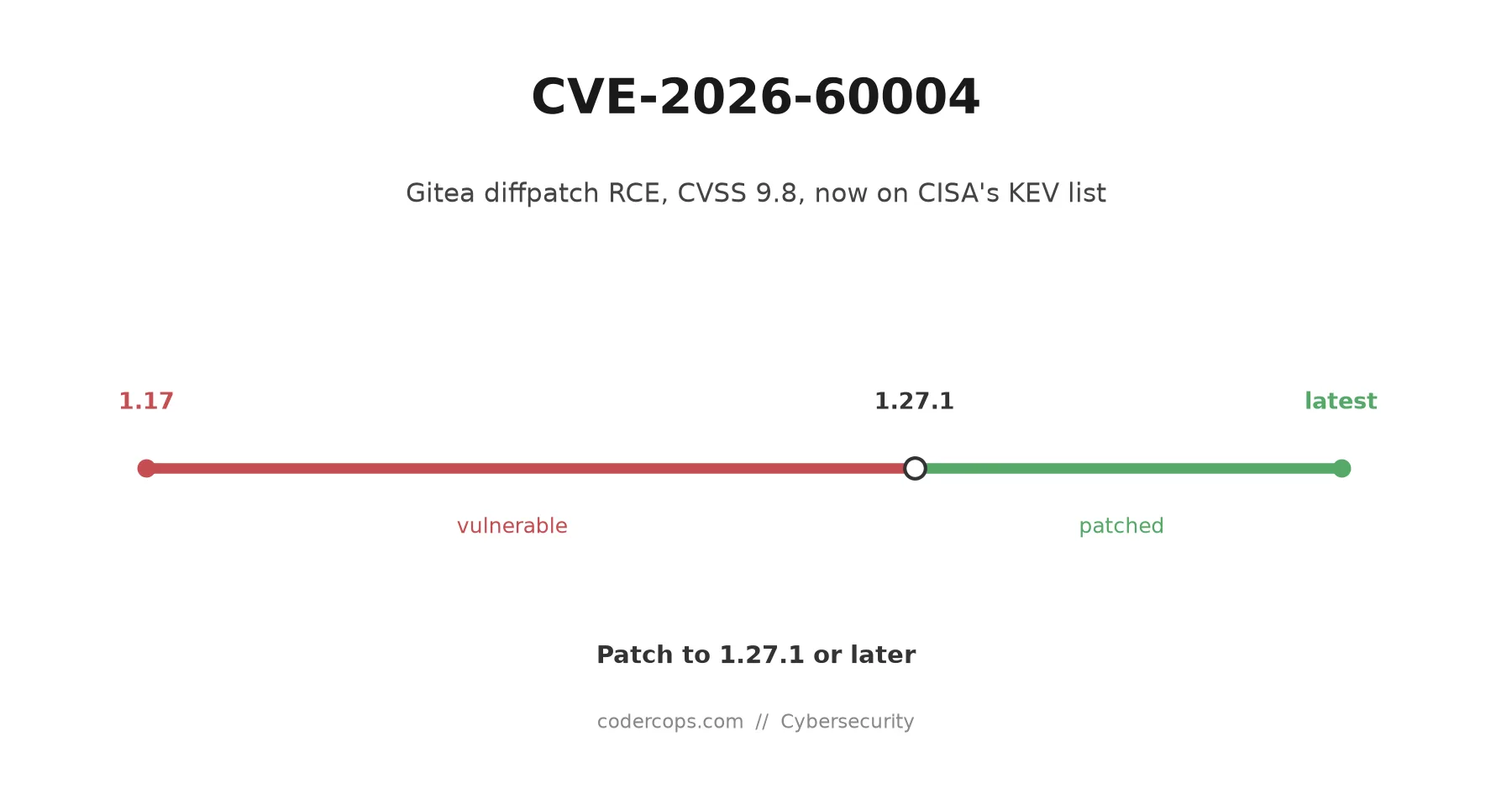
Gitea fixed this in 1.27.1 by changing that temporary clone from a bare repository to a non-bare one, which breaks the specific overlap between working directory and Git directory that made the hook active. The fix shipped as pull requests #38637 and #38638 upstream.
Why “requires write access” doesn’t mean what it sounds like
The diffpatch endpoint requires repository write permission, which on paper sounds like a meaningful barrier. It isn’t one in practice, because Gitea ships with self-registration enabled by default. An attacker with zero prior access can create an account, create a repository they fully control, and call the vulnerable endpoint against their own repo. There’s no privileged access to steal and no social engineering required. The only real gate is whether your instance still has open registration turned on, and most do, because closing it is a deliberate opt-out step most admins never think to take.
That’s the same pattern that keeps showing up in this category of bug: an authorization check that’s technically present but sits behind a door anyone can walk through. It’s worth comparing to TeamCity’s unauthenticated RCE from earlier this year, where the barrier was missing entirely rather than trivially bypassable. Different mechanism, same outcome: a tool your whole engineering org trusts by default turns out to be reachable by anyone who can reach it at all.
The timeline
The flaw was first disclosed publicly in July 2026, alongside the release of Gitea 1.27.1 carrying the fix. For a few weeks, this looked like a routine patch note. That changed by late August, when reports began surfacing of compromised self-hosted Gitea instances running crypto-mining payloads, consistent with an attacker using the flaw for opportunistic access rather than anything targeted. CISA added CVE-2026-60004 to its KEV catalog on August 25, which is the point where “you should patch this” becomes “assume you’re already a target if you’re exposed.”
The gap between disclosure and confirmed exploitation here was measured in weeks, not days, which is actually the more common pattern than the 24-hour turnarounds that make headlines. It’s also the more dangerous one for defenders, because a slower burn gives a false sense that the window has closed when it hasn’t. A patch that sat in your backlog for a month because “nothing’s happened yet” is exactly the kind of gap this bug was built to exploit.
What to do
- Check your Gitea version. Anything before 1.27.1 is vulnerable. Upgrade now if you’re behind.
- Turn off open self-registration unless you have a specific reason to keep it on. It’s the single control that turns this from “needs an insider” into “needs an internet connection.”
- Audit recent repositories and accounts for anything you don’t recognize, especially ones created in the last month with unusual patch or merge activity.
- Check the host for signs of compromise, particularly unexpected processes, elevated CPU usage consistent with mining, or outbound connections you can’t explain. Patching closes the door; it doesn’t reverse anything that already walked through it.
Self-hosted developer tooling keeps landing on the KEV list for the same structural reason: it’s software your team didn’t write, it usually runs with more privilege than anyone budgets for, and it rarely gets the same review cadence as the application code sitting next to it. If Gitea, Jenkins, or a similar tool is part of your stack, a periodic security review that specifically inventories self-hosted infrastructure and its exposure is cheaper than finding out about a gap from a KEV alert.
Frequently asked questions
- What is CVE-2026-60004?
- A remote code execution vulnerability in Gitea, the self-hosted Git platform, reachable through its diffpatch API. It carries a CVSS score of 9.8 and lets an attacker with repository write access run arbitrary shell commands as the operating system user running the Gitea service.
- Which Gitea versions are affected?
- Every version from 1.17 up to, but not including, 1.27.1. Gitea 1.27.1 contains the fix. If you're on an older release line that hasn't backported it, treat yourself as vulnerable until you confirm otherwise.
- Do I need to be logged in to exploit this?
- The vulnerable API call requires repository write permission, but Gitea allows open self-registration out of the box. An attacker with no existing account can register, create a repository they control, and exploit the flaw from there. Unless you've disabled open registration, treat this as effectively unauthenticated.
- How does the exploit actually work?
- diffpatch processes a submitted patch inside a temporary Git clone. A crafted patch forces an add/add collision, which pushes Git into its three-way merge fallback. That fallback writes attacker-controlled content into what becomes an executable post-index-change hook. Because the temporary clone's working directory doubles as its Git directory, the hook is live and runs during the next index operation, executing shell commands with the privileges of the Gitea process.
- Is this actually being exploited?
- Yes. The bug was first disclosed in July 2026, and Gitea shipped 1.27.1 with the fix. By late August, reports surfaced of compromised self-hosted instances running crypto-mining software, and CISA added CVE-2026-60004 to its Known Exploited Vulnerabilities catalog on August 25, giving federal civilian agencies until August 28 to remediate.
- What should I do right now if I run Gitea?
- Check your version and upgrade to 1.27.1 or later immediately. Then disable open self-registration if you don't need it, review your instance for unfamiliar repositories or accounts created recently, and check for unexpected processes on the host, since a patch stops new exploitation but does not undo anything that already happened.
Sources
Sponsored
More from this category
More from Cybersecurity
Sponsored
Discussion
Join the conversation.
Comments are powered by GitHub Discussions. Sign in with your GitHub account to leave a comment.
Sponsored