AI Integration · Cost & Infrastructure
OpenAI Cut GPT-5.6 API Prices 80%. Here's What That Actually Changes for Your Budget
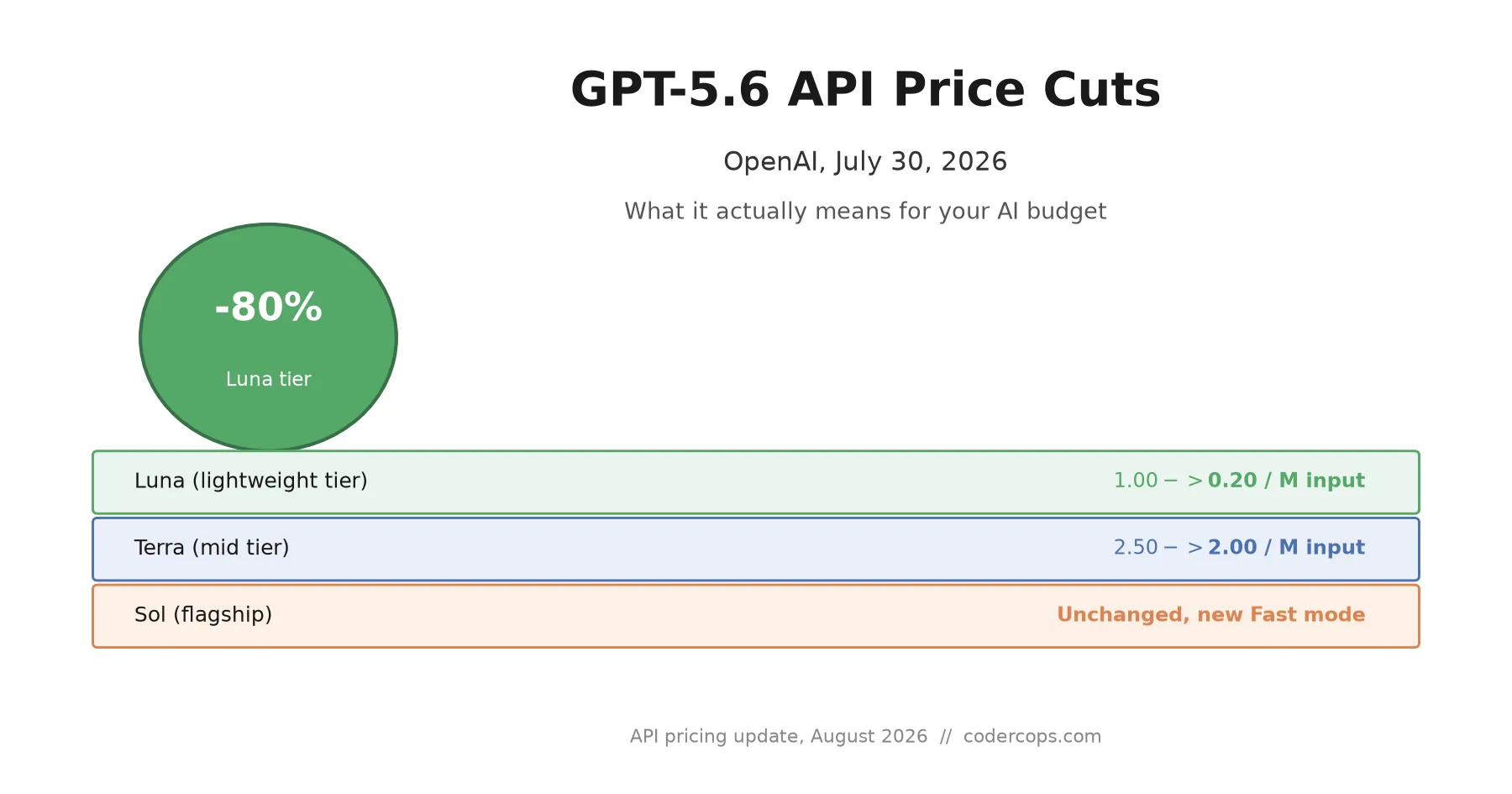
OpenAI cut GPT-5.6 Luna's API price 80% and Terra's 20% on July 30, three weeks after launch. Here's what moved, why it moved that fast, and how to decide whether to switch tiers instead of just enjoying a smaller bill.

Shashikant Gupta
5 min read
Sponsored
Three weeks. That’s how long GPT-5.6 Luna and Terra had been generally available before OpenAI cut their API prices, in Luna’s case by 80%. A model that just launched getting a price cut that steep isn’t a routine adjustment, it’s a signal about how fast the ground is moving under anyone budgeting for LLM API costs right now.
What actually moved
The July 30, 2026 change hit the three GPT-5.6 tiers differently:
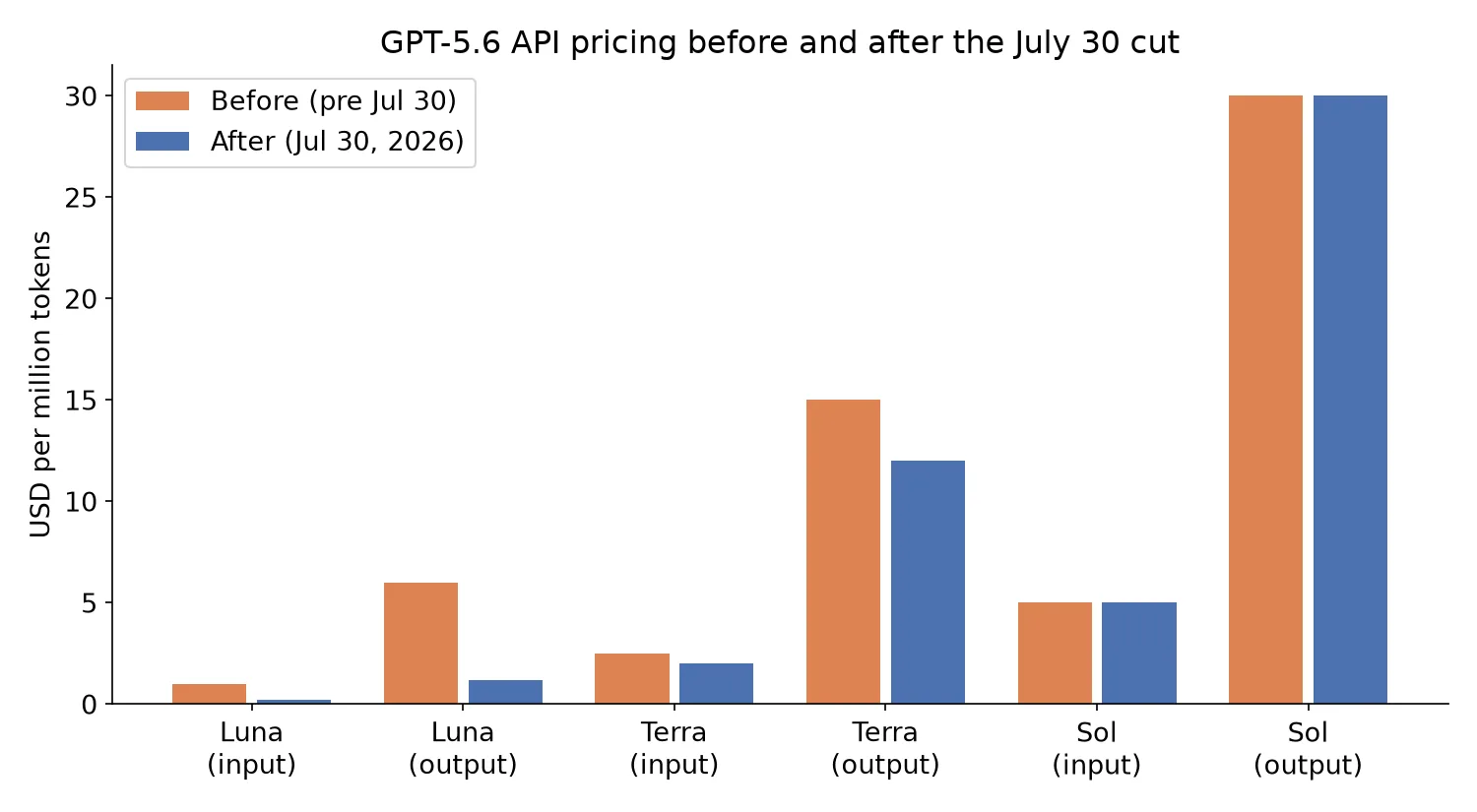
- Luna, the high-volume, lightweight tier, dropped from $1.00 to $0.20 per million input tokens and from $6.00 to $1.20 per million output tokens. That’s an 80% cut on both sides.
- Terra, the mid-tier model, went from $2.50 to $2.00 input and $15.00 to $12.00 output, a 20% cut.
- Sol, the flagship, kept its $5/$30 pricing but picked up a new Fast mode: up to 2.5x the standard throughput for double the per-token rate, replacing the Priority Processing option that existed before.
Existing paid corporate products, ChatGPT Work and Codex, get the same reduction indirectly: Luna and Terra usage now consumes less of a fixed monthly quota, without OpenAI touching the subscription price itself.
Why the cut happened this fast
OpenAI’s own explanation credits part of the savings to Sol: the model was used to autonomously rewrite production inference kernels, and that work is credited with roughly a 20% reduction in model-serving costs. That’s a real efficiency gain, and it’s also a story OpenAI has an obvious incentive to tell, since “our model made itself cheaper to run” is a better headline than “we’re matching a competitor’s price.”
The competitive read matters too. Cheaper open-weight models and aggressive per-token pricing from rival providers have been the dominant story in API economics all year. A three-week-old flagship product line getting a price cut this size, on the cheapest tier hit hardest, reads less like a pure cost-passthrough and more like a response to what’s happening elsewhere in the market. Whichever story you find more convincing, the effect on your invoice is the same.
The mistake: treating this as just a smaller bill
The easy reaction to a price cut is to do nothing and enjoy the savings. The better reaction is to treat it as a trigger to re-check tier assignment, because the economics that decided your original tier choice just changed underneath you.
Two directions are worth checking:
Workloads that were priced out of a higher tier might not be anymore. If a feature was running on Luna specifically because Terra’s per-call cost didn’t pencil out at your volume, Terra’s 20% cut changes that math. Worth a fresh comparison, especially for anything where output quality was the limiting factor, not latency.
Workloads running on Sol out of caution might fit a cheaper tier now. Teams often default to the flagship model for anything customer-facing, treating the cost gap as an acceptable insurance premium against quality complaints. Luna at $0.20/$1.20 changes that calculation for straightforward tasks like classification, extraction, or short-form summarization, the kind of work that rarely needed frontier reasoning in the first place.
If your team hasn’t done a per-feature audit of which model tier actually serves each call path, that’s the concrete next step here, not “we saved money this month.” A quick table of feature, current tier, requests per day, and whether output quality has ever been a complaint takes an afternoon and usually finds at least one call path running on more model than it needs, in either direction.
What Fast mode is actually for
Fast mode is the one addition here that isn’t about cost, it’s about latency at a cost premium. Doubling the per-token rate for 2.5x throughput only makes sense for a narrow set of use cases: live user-facing interactions where response time directly affects whether someone keeps using the feature, not batch jobs or background processing where a few extra seconds costs nothing. If you’re running synchronous chat, live code completion, or anything in a product surface with a visible “thinking” indicator, it’s worth benchmarking against your current Sol setup. For anything asynchronous, it’s a rate increase with no corresponding benefit and should stay off by default.
The pattern to watch
This is the second notable pricing and infrastructure move around GPT-5.6 in a month, following the Cerebras-backed low-latency inference option that shipped days after general availability. Pricing on frontier models isn’t settling into something stable yet, it’s still moving on a roughly monthly cadence as providers respond to each other. Teams that treat their model-tier assignments as a one-time decision made at launch are going to find themselves overpaying or underprovisioning within weeks, not years. Building a lightweight recurring check, even just a calendar reminder to re-run the cost comparison every time a provider announces a pricing change, is cheaper than the alternative of finding out three months later that you’ve been paying flagship rates for commodity work. If your team is weighing whether to build this kind of monitoring in-house or wants a second opinion on current model spend, our engineering team has done this exercise across a number of client stacks and can usually spot the obvious misallocations in an afternoon.
For more on what the GPT-5.6 launch itself changed beyond pricing, see our breakdown of the Sol, Terra, and Luna three-tier split.
Frequently asked questions
- What exactly changed in the GPT-5.6 price cut?
- GPT-5.6 Luna dropped from $1.00 to $0.20 per million input tokens and from $6.00 to $1.20 per million output tokens, an 80% cut. GPT-5.6 Terra dropped from $2.50 to $2.00 input and $15.00 to $12.00 output, a 20% cut. GPT-5.6 Sol's price held at $5/$30, but gained a new Fast mode option. The change took effect July 30, 2026.
- Why did OpenAI cut prices so soon after launch?
- OpenAI said part of the reduction comes from Sol being used to autonomously rewrite production inference kernels, cutting model-serving costs by about 20%. The rest is competitive: rival API providers have been undercutting on price all year, and a three-week-old model getting a price cut this size is a signal aimed as much at competitors as at customers.
- Should I switch which GPT-5.6 tier I'm using?
- It's worth re-running the math rather than assuming your current tier is still the right one. Luna at the new price is viable for workloads that were previously borderline for cost reasons even at Terra-tier quality. Terra's 20% cut may make it worth reconsidering for jobs currently running on Sol out of caution rather than genuine need for frontier quality.
- What is GPT-5.6 Fast mode?
- A new option for the Sol tier that delivers up to 2.5x the standard throughput for double the per-token price. It replaces the previous Priority Processing tier and targets latency-sensitive product surfaces, like a live chat feature, where response time matters more than raw cost per call.
- Does this price cut affect ChatGPT subscription pricing?
- No, this cut is specific to API pricing for developers building on GPT-5.6. OpenAI extended the reduced Luna and Terra costs to paid corporate products like ChatGPT Work and Codex in the form of lower quota consumption per call, but the underlying subscription price tiers didn't change.
Sources
Sponsored
More from this category
More from AI Integration
 R.01
R.01 Stripe Bought OpenRouter for $7B. Here's What It Means If You Route LLM Calls
 R.02
R.02 Gemini 3.7 Flash Is Out: What Google's Coding-Focused Model Actually Changes
 R.03
R.03 Gemini 3.7 Flash Is Out: Google's Cheap, Fast Coding Model Just Got Better at Both
Sponsored
Discussion
Join the conversation.
Comments are powered by GitHub Discussions. Sign in with your GitHub account to leave a comment.
Sponsored