AI Integration · Voice AI
GPT-Live-1 Is Out, But You Can't Build on It Yet
OpenAI's full-duplex voice model powers ChatGPT Voice but isn't in the API yet. What GPT-Live-1 changed, and what to build with right now instead.

Abhishek Gupta
5 min read
Sponsored
OpenAI shipped a genuinely different voice model on July 8, 2026, and if you build products, the useful question isn’t “is GPT-Live-1 impressive” (it is), it’s “can I build with it yet” (you can’t). Here’s what actually changed, and what to reach for instead if a voice feature is on your roadmap this quarter.
What GPT-Live-1 actually changed
Every voice assistant before this one, including OpenAI’s own earlier Realtime API and Advanced Voice Mode, worked in turns. You spoke, the system detected silence, decided you were done, and then it responded. That silence-detection approach is why voice assistants have always had an awkward tell: pause too long mid-sentence to think, and the model jumps in over you. Get interrupted by a dog barking, and it might cut you off mid-thought too.
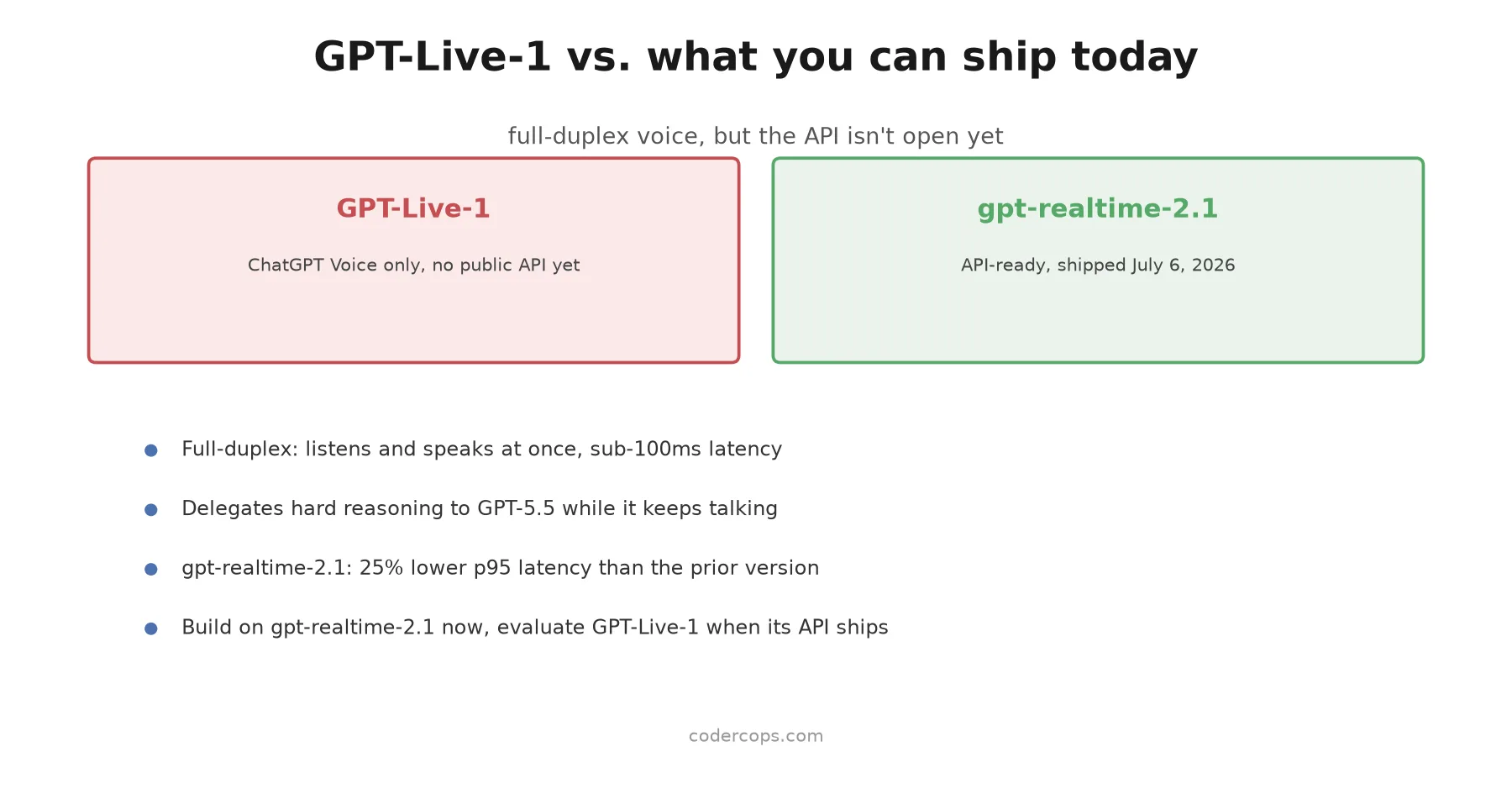
GPT-Live-1 is full-duplex, meaning it processes incoming and outgoing audio continuously and simultaneously, closer to how an actual phone call works. According to OpenAI, the model makes a decision many times per second about whether to speak, keep listening, drop in a short acknowledgment like “mhmm,” or quietly call a background tool, rather than waiting for a hard turn boundary. That’s a real architecture change, not a prompt tweak, and it shows up as the model handling interruptions, back-channel noises, and thinking pauses in a way that reads as far more natural.
Under the hood, OpenAI has described it as running two systems together: a continuous interaction layer that manages the live conversation, and a delegation layer that hands harder reasoning or search tasks to GPT-5.5 running in the background while GPT-Live-1 keeps the conversation going and folds in the answer once it’s ready. That’s a meaningfully different design than bolting a voice interface onto a single monolithic model.
Where it lives right now
GPT-Live-1 became the default model behind ChatGPT Voice for Go, Plus, and Pro subscribers, and GPT-Live-1 mini became the default for Free users, replacing the older Advanced Voice Mode entirely. That’s a ChatGPT product change, not a platform release.
If you’re a developer wanting to put this in your own app, there’s nothing to call yet. OpenAI has said API access is coming, and has framed the timeline as weeks rather than months since the July 8 launch, but as of this writing there is no public GPT-Live-1 endpoint, no documented pricing for API use, and no confirmed GA date. The company opened a notification form for interested developers rather than shipping access.
What to actually build with today
If a voice feature is on your roadmap now, the answer isn’t “wait for GPT-Live-1.” It’s gpt-realtime-2.1, which OpenAI shipped through the existing Realtime API on July 6, two days before the GPT-Live consumer launch. It’s a separate model family from GPT-Live, built specifically for developers, and it’s already production-ready:
import { RealtimeAgent, RealtimeSession } from '@openai/agents/realtime'

const agent = new RealtimeAgent({
  name: 'Support Assistant',
  instructions: 'You are a concise, helpful voice support agent.',
})

const session = new RealtimeSession(agent, {
  model: 'gpt-realtime-2.1',
})

await session.connect({
  apiKey: process.env.OPENAI_API_KEY,
})
gpt-realtime-2.1 brought its own real improvements over the prior version: better alphanumeric recognition (reading out order numbers, confirmation codes, and addresses correctly), improved handling of silence and background noise for turn detection, and a reported 25% drop in p95 latency compared to gpt-realtime-2. It’s not full-duplex the way GPT-Live-1 is, so you’ll still see occasional turn-detection awkwardness on long pauses, but it’s the model actually shipping to production voice apps right now.
Don’t confuse the two model families
It’s worth being explicit about this because the naming invites confusion: GPT-Live is the consumer product line behind ChatGPT Voice. GPT-Realtime is the developer-facing API line for building your own voice applications. GPT-Live-1 is not simply “the API version of the ChatGPT voice feature,” and there’s no guarantee its eventual API release will match gpt-realtime-2.1’s pricing, latency, or feature set when it does show up. Treat them as two separate products on two separate timelines, because that’s how OpenAI has shipped them so far.
What this means if you’re scoping a voice feature now
For a team evaluating whether to add a voice interface, this is a reasonable moment to prototype: gpt-realtime-2.1 is genuinely capable and its latency numbers are good enough for a real customer-facing experience, not just a demo. Build against it, ship, and measure. If GPT-Live-1’s API access lands with a meaningfully better experience once it’s out, migrating a well-architected voice integration is a model swap, not a rewrite, assuming you’ve kept your conversation logic reasonably decoupled from the specific model you’re calling. Teams we’ve helped scope AI integration work on voice features specifically have found that the bigger risk isn’t picking the “wrong” model this month, it’s building the integration tightly enough coupled to one vendor’s API shape that swapping later becomes its own project.
The actual takeaway
GPT-Live-1 is a real architectural step forward for conversational AI, full-duplex processing genuinely fixes a longstanding problem with how these systems handle interruptions. But it’s a ChatGPT feature today, not a building block. If a voice feature is actually on your plate this quarter, build it on gpt-realtime-2.1, which is shipping now with real latency and accuracy improvements of its own, and treat GPT-Live-1’s eventual API release as something to evaluate when it actually arrives, not something to design around in advance.
Frequently asked questions
- Can I use GPT-Live-1 in my own app right now?
- No. GPT-Live-1 currently only powers ChatGPT's own voice mode on iOS, Android, and the web. OpenAI has said API access is coming, targeting weeks rather than months from the July 8 consumer launch, but as of this writing there's no public GPT-Live-1 model in the API and no confirmed general availability date.
- What's the difference between GPT-Live and GPT-Realtime?
- GPT-Live is the consumer-facing model family that powers ChatGPT Voice. GPT-Realtime is the separate, API-accessible model family OpenAI ships for developers building their own voice applications. They're related but distinct products: GPT-Live-1 isn't simply the API version of GPT-Realtime, and the two follow separate release and access timelines.
- What should I build a voice product with today?
- gpt-realtime-2.1, released July 6, 2026 through the Realtime API. It's the current production option, with improved alphanumeric recognition, better handling of silence and background noise, and a 25% drop in p95 latency compared to the prior gpt-realtime-2 model. Build against it now and plan to evaluate GPT-Live-1 once it actually reaches the API rather than waiting on a roadmap date.
- What does full-duplex actually mean for a voice model?
- It means the model processes incoming and outgoing audio continuously and simultaneously, the way a real phone call works, instead of alternating between listening and speaking in discrete turns. Older systems detected the end of your turn by waiting for silence, which caused false interruptions whenever you paused to think or background noise crept in. A full-duplex model keeps listening while it talks, so it can back off mid-sentence if you start speaking, or drop in a quick acknowledgment without taking the floor.
- How much does GPT-Live-1 cost?
- It's not priced separately per API call yet since there's no public API. Inside ChatGPT, GPT-Live-1 mini is available to Free users at no added cost, GPT-Live-1 is included for Go ($8/mo), Plus ($20/mo), and Pro ($100 to $200/mo) subscribers with usage limits that scale by tier. OpenAI hasn't published API pricing, since GPT-Live-1 isn't in the API yet.
Sources
Sponsored
More from this category
More from AI Integration
Sponsored
Discussion
Join the conversation.
Comments are powered by GitHub Discussions. Sign in with your GitHub account to leave a comment.
Sponsored