Cybersecurity · AI Infrastructure Security
CVE-2026-42271: LiteLLM Gateway Unauthenticated RCE
A command injection in LiteLLM's MCP test endpoints, chained with a Starlette host-header bypass, gives unauthenticated RCE and every provider key behind it.

Prathviraj Singh
6 min read · Updated Sep 5, 2026
Sponsored
If your team runs LiteLLM as the gateway in front of OpenAI, Anthropic, Google, or your own model endpoints, stop and check your version before reading the rest of this post. CVE-2026-42271 is being actively exploited, CISA has added it to the Known Exploited Vulnerabilities catalog, and it chains into full unauthenticated remote code execution against your AI infrastructure.
What the vulnerability actually is
LiteLLM is one of the most widely deployed AI gateways: a proxy that sits between your applications and every LLM provider you talk to, handling routing, retries, cost tracking, and (critically) holding the API keys for each provider. That last part is what makes this bug dangerous.
The flaw lives in two endpoints: /mcp-rest/test/connection and /mcp-rest/test/tools/list. Both were built to let an admin test an MCP (Model Context Protocol) server connection before wiring it into production. To do that, they accept a server configuration in the request body, including command, args, and env fields, and pass that configuration directly into a subprocess call.
There’s no allowlist of permitted commands. There’s no restriction limiting the endpoint to admin roles. There’s no sandbox isolating the spawned process from the host. If you can reach the endpoint with valid credentials, you can supply your own command and run it.
Why this is worse than a normal authenticated bug
A vulnerability that needs valid credentials is bad, but it’s a smaller blast radius than one that doesn’t. CVE-2026-42271 was originally reported as requiring authentication, which limited who could realistically hit it.
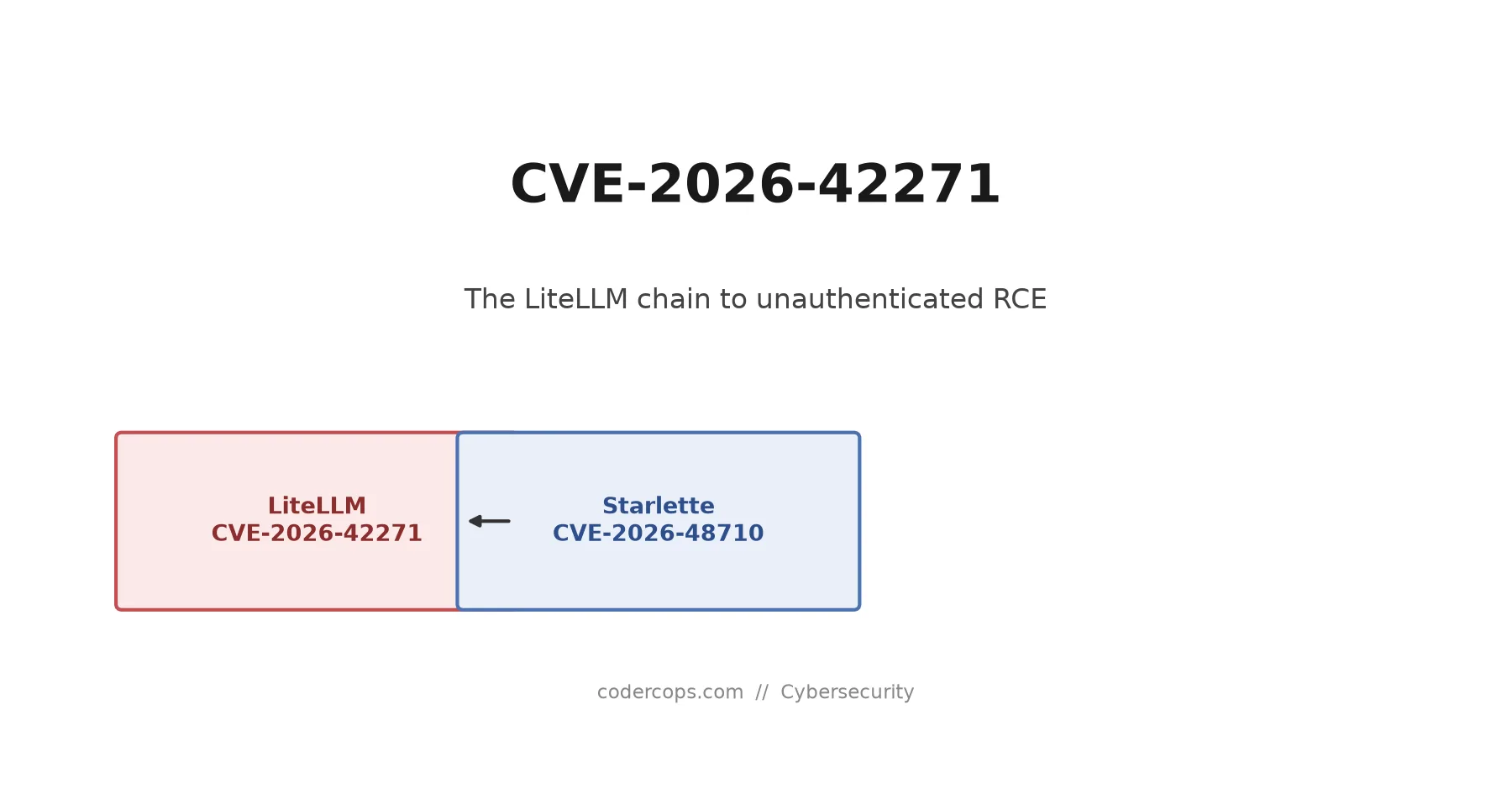
Then Horizon3.ai published a chain. CVE-2026-48710, nicknamed “BadHost,” is a host-header validation bypass in Starlette (the ASGI framework underneath FastAPI, which LiteLLM is built on). Starlette’s own maintainer rated it a moderate 6.5 on CVSS; independent researchers at X41 D-Sec put it at 7.0. The disagreement doesn’t matter much once you see what it enables: crafting a malformed Host header lets an attacker skip host-validation checks that would otherwise gate access to internal-only endpoints.
Chain the two together and the authentication requirement on CVE-2026-42271 disappears. An attacker with no credentials at all can reach the command-injection endpoint and get a shell.
| CVE | Component | What it does alone | CVSS |
|---|---|---|---|
| CVE-2026-42271 | LiteLLM | Command injection via MCP test endpoints (needs auth) | 8.7 |
| CVE-2026-48710 | Starlette | Host-header validation bypass (“BadHost”) | 6.5–7.0 (disputed) |
| Chained | LiteLLM + Starlette | Unauthenticated remote code execution | Critical in practice |
Who is affected
LiteLLM versions 1.74.2 through 1.83.6 carry the vulnerable endpoint. If you’re running a self-hosted LiteLLM proxy, gateway, or admin UI anywhere between those version bounds, and it’s reachable from an untrusted network (which for a lot of teams means the public internet, because the whole point of a gateway is that other services can call it), you’re exposed.
This isn’t a niche deployment pattern. LiteLLM’s proxy mode is a common way to centralize provider billing, add fallback routing between models, and enforce rate limits across a team. If your setup looks anything like the routing patterns in our LLM routing production guide, it’s worth the five minutes to check your version now.
pip show litellm | grep Version
# or, if running the proxy via Docker
docker exec <litellm-container> pip show litellm
Patching, and why you need both halves
The fix is to upgrade LiteLLM to 1.83.7 or later. That patches the command injection at the source: the MCP test endpoints now validate and restrict what can be passed to the subprocess call.
But if you only patch LiteLLM and leave an old Starlette version underneath it, the host-header bypass is still there. It just means the specific chain researchers demonstrated might need a different entry point to reach the now-patched endpoint. The safer assumption is to patch both:
pip install --upgrade litellm>=1.83.7
pip install --upgrade starlette>=1.0.1

# If LiteLLM pins its own Starlette dependency, check requirements.txt
# or pyproject.toml doesn't silently downgrade it back
pip show starlette | grep Version
For containerized deployments, rebuild from the updated base rather than patching in place:
# Bump both in your requirements before rebuilding
# litellm>=1.83.7
# starlette>=1.0.1
FROM python:3.12-slim
COPY requirements.txt .
RUN pip install --no-cache-dir -r requirements.txt
If you can’t patch right now
Patching takes a deployment window; blocking an endpoint doesn’t. If you run LiteLLM behind an nginx, Envoy, or cloud load balancer, block the two vulnerable paths immediately as a stopgap:
location ~ ^/mcp-rest/test/(connection|tools/list) {
    return 403;
}
This isn’t a substitute for the upgrade. It closes the specific paths researchers have demonstrated, but it doesn’t fix the underlying flaws, and a determined attacker who finds another route to the same subprocess call isn’t stopped by it. Treat it as buying time until the real patch lands.
The broader pattern worth noticing
This is the second AI-infrastructure-specific CVE chain to hit widely-deployed tooling this year, and the shape is becoming familiar: a convenience feature (here, a “test your MCP connection before you commit to it” endpoint) built without the same threat model you’d apply to a production API, sitting in software that now holds credentials for every model provider a team uses. The npm supply chain attacks we covered in June targeted a different layer of the stack, but the underlying lesson is the same: the tooling wrapped around AI infrastructure is now valuable enough to be a primary target, not an afterthought.
If your team runs any AI gateway, proxy, or MCP-adjacent tooling in production, this is a good week to audit which admin and debug endpoints are reachable without a VPN or an allowlist, not just LiteLLM’s. Test-and-debug endpoints get bolted on quickly and reviewed less carefully than the request path your users actually hit, and that gap is exactly where this bug lived.
Patch LiteLLM to 1.83.7+, patch Starlette to 1.0.1+, and block the MCP test endpoints at your edge if you can’t do both today.
Update, September 2026: LiteLLM’s MCP surface picked up a second, unrelated CVE. CVE-2026-59822 is a broken OAuth2 fallback in the MCP Streamable HTTP endpoint, fixed in 1.84.0, not 1.83.7. If the version check above only confirmed you were past 1.83.7, that patched this bug, not that one. Worth a second look if you haven’t upgraded since June.
Frequently asked questions
- What does CVE-2026-42271 actually let an attacker do?
- The vulnerable endpoints accept a server configuration in the request body (including command, args, and env fields) and pass it straight to a subprocess call with no allowlist and no sandboxing. Anyone who can reach those endpoints with a valid session can run arbitrary shell commands on the host running LiteLLM.
- Do I need to be authenticated to exploit this?
- CVE-2026-42271 alone requires an authenticated session. But researchers at Horizon3.ai showed it chains with CVE-2026-48710, a Starlette host-header validation bypass, to skip authentication entirely. Combined, the two give an unauthenticated attacker full remote code execution against any internet-facing LiteLLM deployment.
- Which LiteLLM versions are affected and what do I upgrade to?
- Versions 1.74.2 through 1.83.6 are vulnerable. Upgrade LiteLLM to 1.83.7 or later. Because the exploit chain also depends on the Starlette host-header bug, upgrade Starlette to 1.0.1 or later too. Patching LiteLLM alone still leaves the authentication bypass half of the chain in place if you're pinned to an old Starlette version.
- What can an attacker get if they compromise a LiteLLM gateway?
- LiteLLM's whole job is to sit between your application and every LLM provider you use, holding the API keys for each one. A shell on that host means access to every provider credential it proxies, plus whatever internal service credentials, secrets, or environment variables live alongside it. Horizon3.ai's writeup describes lateral movement into connected AI infrastructure as a realistic next step, not a theoretical one.
- What should I do right now if I can't patch immediately?
- Block POST requests to /mcp-rest/test/connection and /mcp-rest/test/tools/list at your reverse proxy or API gateway. That closes the specific attack surface without requiring a deployment. It's a stopgap, not a fix, so schedule the version upgrade as soon as you can.
- Update, September 2026: is CVE-2026-48710 still just a chaining component?
- No, that's changed. CISA independently added CVE-2026-48710 (Starlette's BadHost bug) to its Known Exploited Vulnerabilities catalog on September 2, 2026, based on evidence of active exploitation beyond this specific chain. It's no longer just the second half of the LiteLLM RCE story from June, it's now a confirmed, independently exploited bug in its own right, in any Starlette-based service, not only LiteLLM. If you patched Starlette to 1.0.1+ back when this post first went up, you're already covered. If you only patched LiteLLM and left Starlette pinned below 1.0.1, treat that as unfinished.
Sources
- The Hacker News: LiteLLM Flaw CVE-2026-42271 Exploited in the Wild
- Horizon3.ai: CVE-2026-42271 chained with CVE-2026-48710
- Help Net Security: LiteLLM vulnerability under active attack, CISA warns
- CSO Online: FastAPI-based AI tools exposed to auth bypass by Starlette flaw
- CISA: Adds Seven Known Exploited Vulnerabilities to Catalog, Sept 2, 2026 (includes CVE-2026-48710)
Sponsored
More from this category
More from Cybersecurity
Sponsored
Discussion
Join the conversation.
Comments are powered by GitHub Discussions. Sign in with your GitHub account to leave a comment.
Sponsored