AI Integration · Model Releases
GPT-5.6 Sol, Terra, and Luna: The Three-Tier Split
GPT-5.6 splits into three tiers: Sol for frontier work, Terra at half GPT-5.5's cost, Luna for volume. What changed, what it costs, which tier fits you.

Shashikant Gupta
5 min read
Sponsored
OpenAI didn’t ship one new model this cycle. It shipped three, priced differently, tuned for different jobs, and that split matters more for your API bill than any single benchmark number does.
Three tiers, not one model
GPT-5.6 arrives as a family: Sol, Terra, and Luna. Each targets a different point on the cost-versus-capability curve, and OpenAI is explicit that they’re meant to be chosen deliberately rather than defaulted to the top tier out of habit.
Sol is the flagship: OpenAI’s strongest model for coding, scientific reasoning, and cybersecurity-adjacent tasks, paired with what the company describes as its most advanced safety stack to date. Sol gets a new “max” reasoning setting that gives it more time to think before answering, and an “Ultra” configuration that splits complex work across coordinated subagents instead of one linear reasoning chain.
Terra is the mid-tier, and the one most teams should actually benchmark first. OpenAI’s own framing is that Terra delivers performance competitive with GPT-5.5 at roughly half the cost. If your production workload currently runs on GPT-5.5, Terra, not Sol, is the tier to test against your existing prompts.
Luna is built for volume: fast, cheap, and meant for the high-throughput, lower-complexity calls that make up the bulk of most applications’ actual token spend (classification, extraction, short chat turns, simple tool routing).
What it costs
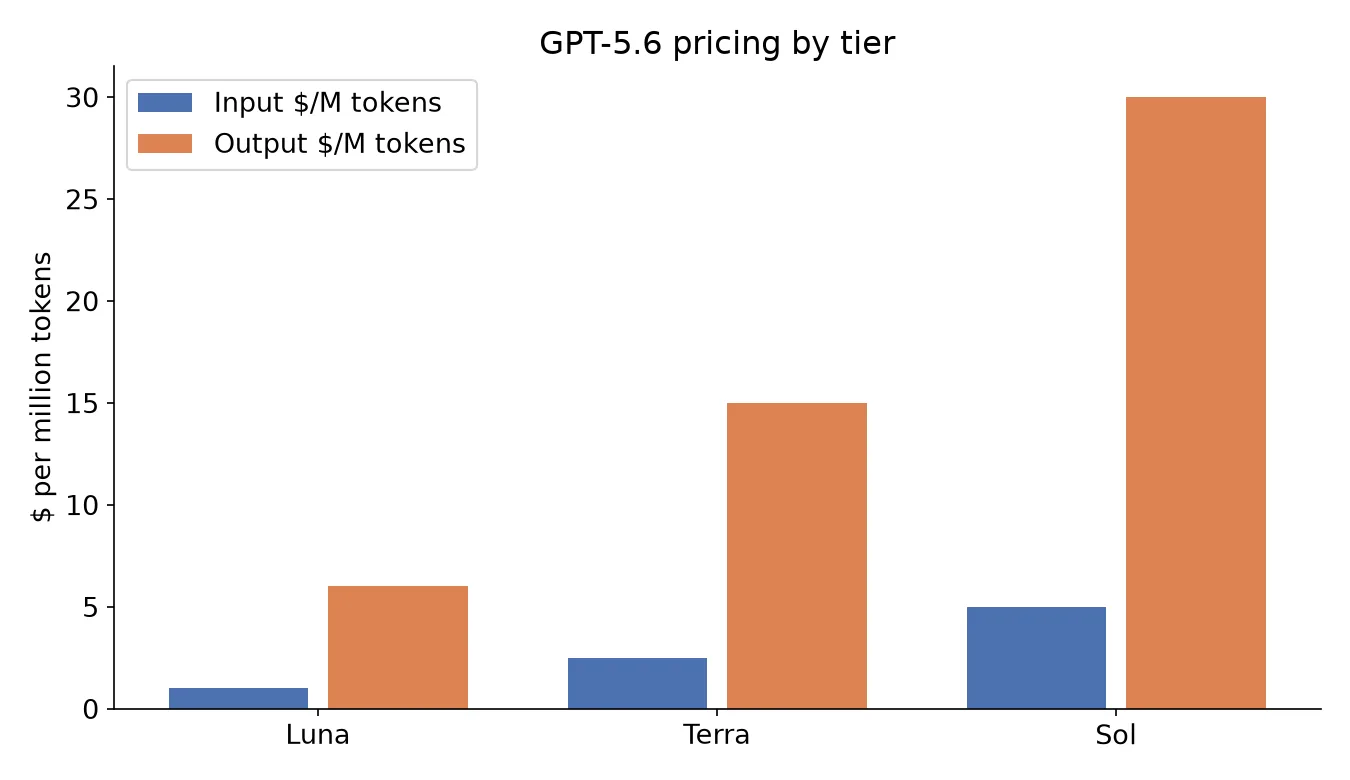
| Tier | Input ($/M tokens) | Output ($/M tokens) | Positioning |
|---|---|---|---|
| Sol | $5.00 | $30.00 | Flagship: hard coding, science, cyber |
| Terra | $2.50 | $15.00 | Everyday work, ~GPT-5.5 parity at ~half cost |
| Luna | $1.00 | $6.00 | High-volume, low-complexity |
The gap between Sol and Luna is 5x on input and exactly 5x on output too, which is a wider spread than OpenAI has typically offered within a single model generation. That spread is the actual news here: it’s an explicit invitation to route different parts of your application to different tiers instead of picking one model for everything.
Sol’s benchmark numbers
For coding specifically, Sol posts the highest publicly reported score on Terminal-Bench 2.1 at 88.8%. Running Sol in Ultra mode, which coordinates subagents across a complex task rather than working sequentially, pushes that to 91.9%.
Ultra mode isn’t free, and it isn’t fast. Coordinating multiple subagents costs more compute than a single reasoning pass, so it makes sense for genuinely decomposable work: a large multi-file refactor, a research task with several independent sub-questions, a migration that touches many independent modules. For a single quick coding question, standard Sol (or Terra) is the more sensible default; Ultra’s overhead only pays off when there’s real parallel structure to exploit.
OpenAI also reports improvements on GeneBench v1 for biology-adjacent workflows, using fewer tokens than GPT-5.5 to get there, which matters for teams doing scientific or technical reasoning at volume where token cost compounds fast.
What changed on the infrastructure side
Two changes matter more for production teams than the headline benchmarks:
Prompt caching got more predictable. GPT-5.6 introduces explicit cache breakpoints and a 30-minute minimum cache life. If your application sends a large, mostly-static system prompt or context block on every call (a common pattern for RAG and agentic setups), this is where real cost savings show up in practice, independent of which tier you pick.
Reasoning controls are more granular. Sol’s new “max” setting is a distinct lever from Ultra mode: it’s about how long the model reasons before responding, not how many subagents coordinate on the task. The two can be combined, but they solve different problems: max reasoning depth versus parallel task decomposition.
The availability catch
None of this is generally available yet. Sol, Terra, and Luna are in preview, reachable only through the API and Codex, and only for a limited group of trusted partners. GPT-5.6 is not in ChatGPT during this preview window. OpenAI says general availability is coming “in the coming weeks,” which is a real commitment but not a date you can plan a migration around.
If you’re not in the preview group, the practical move is to prepare your evaluation harness now (the prompts and test cases you’d run against Terra as a GPT-5.5 replacement) so you can move fast once broader access opens, rather than starting that work cold.
What this means for your architecture
The three-tier split is a nudge toward a routing pattern that’s already common in production LLM setups: send simple, high-volume calls to the cheap tier, and reserve the expensive tier for the subset of requests that actually need deep reasoning. If your application already routes between providers or models based on task complexity, similar to the patterns in our LLM routing production guide, adding a third internal tier here is a natural extension rather than a rework.
If you’re running everything through a single model today because that’s simpler to reason about, GPT-5.6’s pricing spread is a good forcing function to reconsider. A 5x cost difference between Sol and Luna, multiplied across millions of monthly calls, is real money left on the table if your classification and extraction calls are running on flagship pricing they don’t need.
Benchmark Terra against your current GPT-5.5 workload first. It’s the tier built specifically to replace it, and it’s the one most likely to change your bill without changing your prompts.
Frequently asked questions
- What's the difference between GPT-5.6 Sol, Terra, and Luna?
- They're three distinct model sizes released as one family. Sol is the flagship, built for the hardest coding, science, and cybersecurity tasks, with a new 'max' reasoning setting and an 'Ultra' mode that splits complex projects across coordinated subagents. Terra is positioned as the everyday-work model, with OpenAI claiming performance comparable to GPT-5.5 at roughly half the cost. Luna is the fast, cheap tier built for high-volume, simple-task API calls where latency and cost matter more than reasoning depth.
- How much does GPT-5.6 cost compared to GPT-5.5?
- Per million tokens: Sol is $5 input / $30 output, Terra is $2.50 input / $15 output, and Luna is $1 input / $6 output. OpenAI positions Terra as the direct GPT-5.5 replacement, delivering what it describes as competitive performance at roughly half of GPT-5.5's cost. If your workload currently runs on GPT-5.5, Terra is the tier to benchmark against your existing prompts before assuming Sol is the upgrade path.
- Is GPT-5.6 available to everyone right now?
- No. As of this preview, Sol, Terra, and Luna are available only through the API and Codex to a limited group of trusted partners. GPT-5.6 is not yet available in ChatGPT. OpenAI has said general availability is planned for the coming weeks, but there's no committed date. If you're not in the preview group, plan your evaluation timeline around that uncertainty rather than assuming immediate access.
- What is Sol's 'Ultra' mode and when would I use it?
- Ultra mode deploys coordinated subagents that split a complex task into parts and work them in parallel, instead of routing everything through a single sequential reasoning chain. On Terminal-Bench 2.1, standard Sol scores 88.8% and Sol Ultra pushes that to 91.9%. The tradeoff is cost and latency: coordinating subagents costs more compute than a single reasoning pass, so Ultra mode makes sense for large, decomposable tasks (a multi-file refactor, a research task with independent sub-questions) rather than a single quick query.
- Which tier should my team actually build against?
- Match the tier to the task, not the newest release. Luna fits high-volume, low-complexity calls: classification, extraction, simple chat turns, anything where you're making thousands of calls and latency or cost dominates the decision. Terra is the default for general application logic that currently runs on GPT-5.5 or an equivalent mid-tier model. Sol is worth its premium specifically for hard coding tasks, multi-step agentic workflows, and anything where a wrong answer is expensive to catch downstream. Most production systems should end up running a mix instead of a single tier everywhere.
Sources
Sponsored
More from this category
More from AI Integration
Sponsored
Discussion
Join the conversation.
Comments are powered by GitHub Discussions. Sign in with your GitHub account to leave a comment.
Sponsored