AI Integration · Model Selection
GLM-5.3 Is Out: Z.ai's $18/Month Coding Plan and What Same-Base Training Gets You
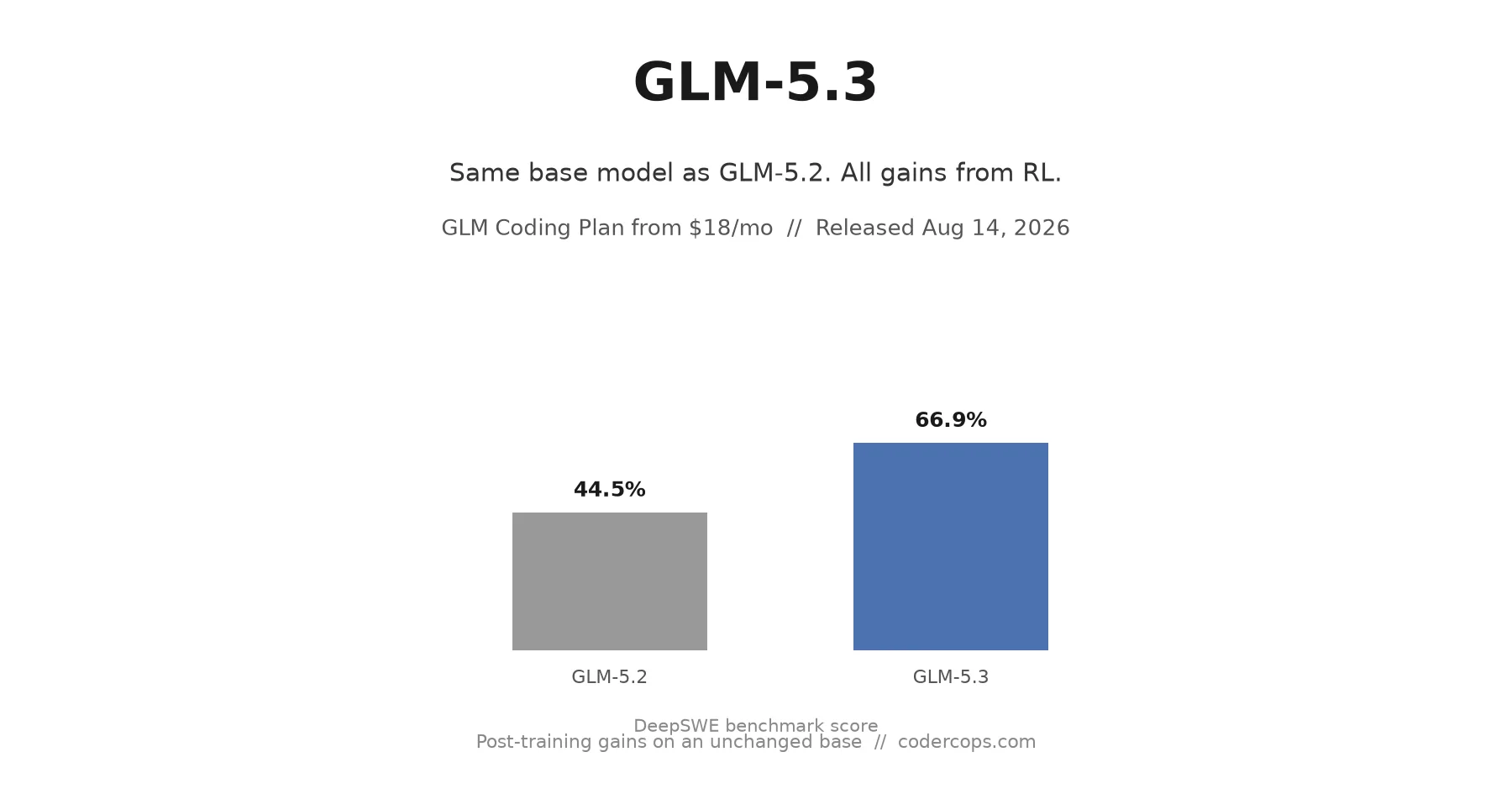
Z.ai shipped GLM-5.3 on the same 743B base as GLM-5.2, with every gain coming from reinforcement learning on top. Here's what changed, what it costs, and why the training approach matters more than the parameter count this time.

Shashikant Gupta
4 min read
Sponsored
Most model releases ship a bigger base and call the resulting benchmark gains progress. Z.ai’s GLM-5.3, released August 14, took a different bet: same 743-billion-parameter base as GLM-5.2, no retrain, and every reported capability gain coming from additional reinforcement learning and refined training environments layered on top. If that approach holds up under independent testing, it’s a more interesting data point about where AI progress is actually coming from right now than another parameter-count headline would be.
What actually changed
Z.ai has been explicit that GLM-5.3 is post-trained on the exact same foundation model as GLM-5.2. No new pretraining run, no larger base, no architecture change to the underlying model. The reported gains come entirely from what happens after that: more reinforcement learning, and deliberately redesigned training environments meant to elicit better performance from the same underlying weights.
On Z.ai’s own reported benchmarks, that approach produced real movement:
| Benchmark | GLM-5.2 | GLM-5.3 | What it measures |
|---|---|---|---|
| DeepSWE | under 45% | 66.9% | Real-world software engineering tasks |
| Code Bench (internal) | baseline | +50% | Z.ai’s internal coding benchmark |
| Humanity’s Last Exam (with tools) | n/a | 62.5% | Broad reasoning with tool use |
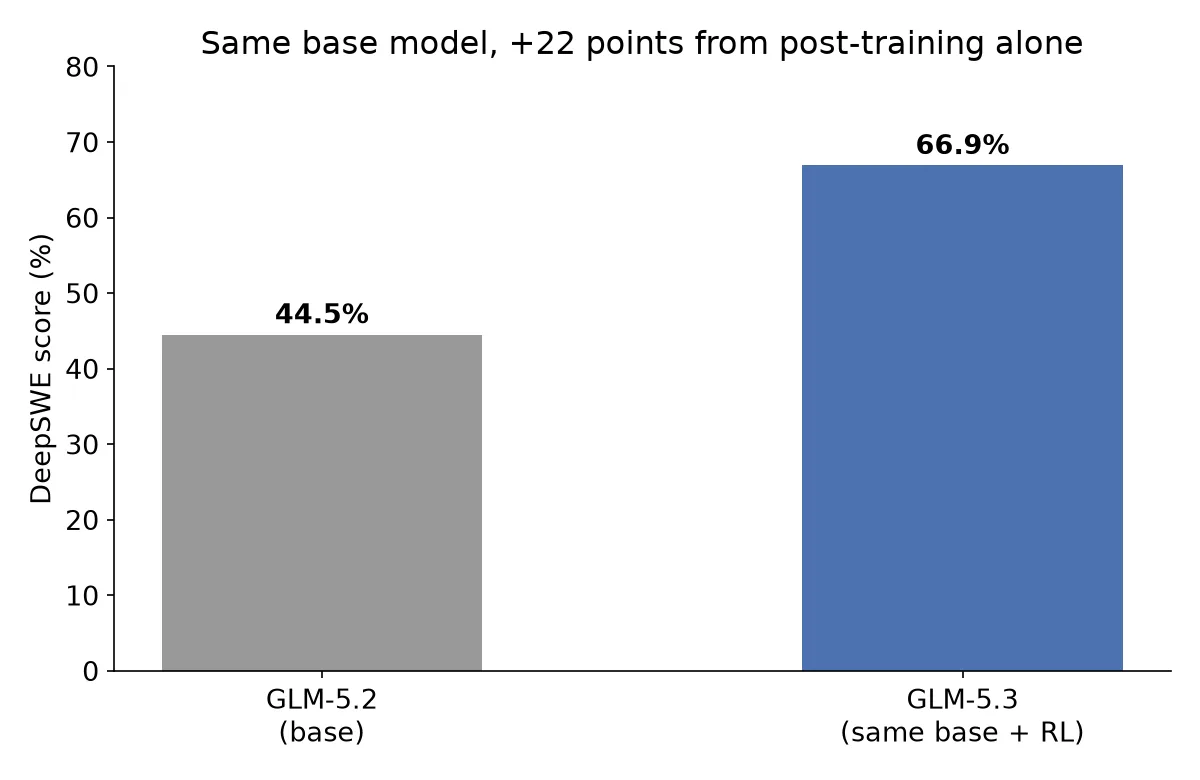
A more than twenty-point jump on DeepSWE from RL and environment design alone, without touching the base model, is a meaningful result if it holds up. It’s also, so far, a single-vendor claim: independent benchmark trackers haven’t reproduced these numbers as of this writing, which is worth keeping in mind before treating any of this as a settled comparison against other coding models.
Why “same base, more RL” is the story worth tracking
The industry’s default move for the last several release cycles has been scaling the base model: more parameters, more pretraining compute, then whatever post-training polish fits in the schedule. GLM-5.3 is a bet on the opposite lever. If a fixed base model can pick up a twenty-point jump on a hard software engineering benchmark purely from better reinforcement learning and training environments, that’s evidence there’s still real headroom in post-training technique that doesn’t require the capital expense of a bigger pretraining run.
That matters beyond Z.ai specifically. It’s the same question the industry has been circling since reasoning and “thinking” models demonstrated that inference-time and training-time technique changes could move benchmark scores as much as raw scale does. GLM-5.3 is a fairly clean natural experiment on that question: identical base weights, different post-training investment, a directly comparable before-and-after.
What it costs and how to get it
GLM-5.3 is live now through the GLM Coding Plan, starting at $18 a month, and through ZCode. Z.ai hasn’t published separate per-token API pricing as of this writing, so the coding plan is the practical entry point if you want to evaluate it today. Public weights are planned for release around August 28, 2026, pending further safety testing, following the same pattern Z.ai used with GLM-5.2: API access first, open weights once internal review clears.
At $18 a month for coding-plan access, the barrier to running your own evaluation is low enough that there’s little reason to wait for third-party benchmark verification before testing it against your actual codebase, the same way we’d recommend testing any new model entrant against your production workload rather than a published leaderboard number.
What this means for your model choices
If you’re already running a coding-model evaluation rotation, GLM-5.3 is worth adding at this price point, particularly if your workload resembles the kind of real-world software engineering tasks DeepSWE is designed to measure. If you’re not actively evaluating alternatives, the more durable takeaway isn’t about this specific model: it’s that meaningful capability gains are showing up from post-training investment on fixed base models, not just from labs racing to ship bigger ones. That’s a signal worth factoring into how often you re-run model comparisons generally, since a provider you ruled out six months ago on capability grounds may have shipped a same-base, RL-driven update since then that changes the calculus without you noticing.
The takeaway
GLM-5.3’s headline isn’t really the benchmark numbers, which are Z.ai’s own claims and still awaiting independent verification. It’s the method: real, substantial capability gains from reinforcement learning and training-environment design on an unchanged base model. Whether that pattern generalizes across the industry or turns out to be specific to where GLM-5.2’s base model had headroom left, it’s a data point worth watching, and a $18-a-month coding plan is a low-cost way to see for yourself whether it holds up against your own work.
Frequently asked questions
- What is GLM-5.3?
- It's Z.ai's newest model release, shipped August 14, 2026. Unlike a typical version bump, it's post-trained on the exact same 743-billion-parameter base model as its predecessor, GLM-5.2, with Z.ai stating plainly that the entire capability improvement comes from additional reinforcement learning and training-environment design layered on top, not a larger or retrained base model.
- How much does GLM-5.3 cost to use?
- It's available through the GLM Coding Plan, which starts at $18 a month, and through ZCode. Z.ai has not published per-token API pricing separately as of this writing; the coding plan is the primary access path at launch.
- Are GLM-5.3's weights open?
- Not yet at launch. Z.ai has stated it plans to release public weights around August 28, 2026, pending further safety testing, which would follow the same API-first, weights-later pattern the company used with GLM-5.2.
- What does it mean that GLM-5.3 uses the 'same base' as GLM-5.2?
- It means Z.ai didn't pretrain a new, larger foundation model for this release. Instead, they took the existing GLM-5.2 base and applied additional reinforcement learning and refined training environments on top of it, then measured meaningful capability gains from that alone. It's evidence that post-training technique, not just base model scale, is still producing real improvements, which is a different bet than the industry's usual approach of shipping a bigger base model each cycle.
- Should I evaluate GLM-5.3 for coding tasks?
- It's worth adding to an evaluation rotation if you're already comparing coding models, particularly given the reported jump on Z.ai's internal Code Bench and the low-cost access via the $18/month coding plan. As with any single-vendor benchmark claim at launch, validate against your own codebase and tasks rather than committing based on Z.ai's reported numbers alone, since independent verification hadn't caught up as of this writing.
Sources
Sponsored
More from this category
More from AI Integration
 R.01
R.01 OpenAI's Zero Data Retention Update: What Private Safety Processing Changes
 R.02
R.02 Cloudflare Built a Browser With No Tabs. It's Not for You, It's for Your Agents
 R.03
R.03 AI Code Review Tools Compared: Copilot, CodeRabbit, Greptile, and Qodo
Sponsored
Discussion
Join the conversation.
Comments are powered by GitHub Discussions. Sign in with your GitHub account to leave a comment.
Sponsored