AI Integration · Data Governance
OpenAI's Zero Data Retention Update: What Private Safety Processing Changes
OpenAI confirmed it will keep offering Zero Data Retention on frontier models and previewed Private Safety Processing, a way to run abuse detection without staff ever seeing customer prompts. Here is what it means if you build on the API.

Prathviraj Singh
6 min read
Sponsored
On 19 August 2026, OpenAI said Zero Data Retention is staying. That is the headline for anyone who has spent the past year writing “we cannot send that to a hosted model” into an architecture doc. Prompts and responses on covered API requests are not retained after processing, personnel cannot review them, and enterprise data is not used for training unless you opt in.
The interesting half of the announcement is the mechanism that makes that survivable. OpenAI previewed something called Private Safety Processing: abuse detection that reasons across related requests instead of one request at a time, without giving OpenAI staff access to the content it is reasoning about.
That tension is worth naming, because it is the reason ZDR looked shaky in the first place.
Why retention and safety pull against each other
Abuse detection on a chat product is comparatively easy. One request comes in, a classifier scores it, you act. You can do that on data you never keep.
Agentic workloads break that model. A single request in an agent run is usually innocuous. The problem shape lives in the sequence: a reconnaissance step, then a credential step, then an exfiltration step, spread across dozens of calls over hours. Judging each call alone tells you nothing. To see the pattern you need to correlate requests, and correlation has historically meant retention.
So providers ended up at an uncomfortable fork. Keep the logs and lose the enterprise customers who cannot allow it, or drop the logs and lose the ability to catch the exact misuse that matters most as models get more capable. OpenAI’s own pacing model development post frames the same problem from the capability side.
This announcement is an attempt to refuse the fork.
What Private Safety Processing is claimed to do
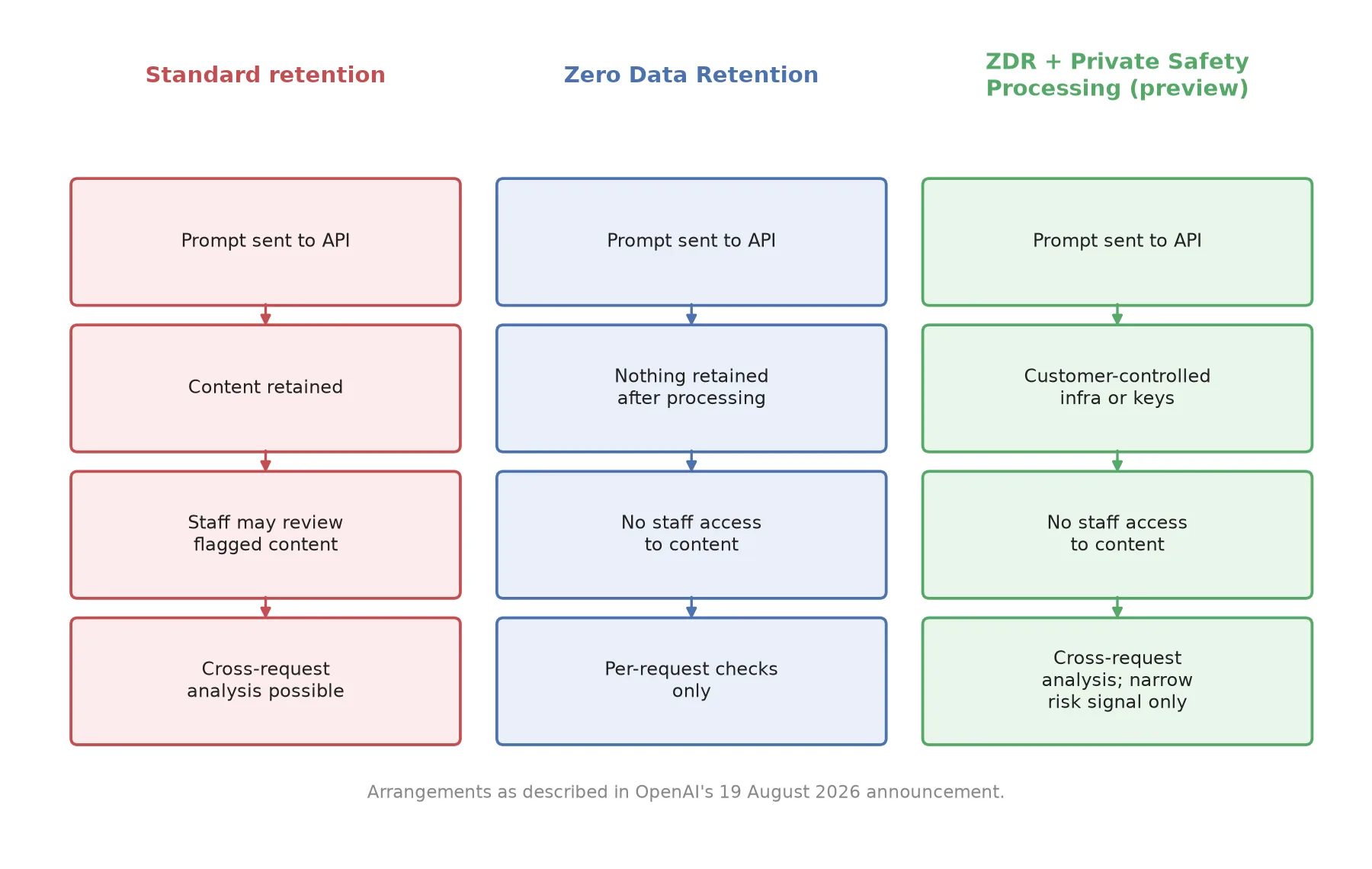
Stripped of marketing, the described design has three parts.
Content lives somewhere you trust. Either it stays on infrastructure the customer controls, or OpenAI stores it encrypted under keys the customer controls. In the second case OpenAI states its personnel do not hold a copy of those keys, so the stored content is not readable by them.
Analysis runs across related activity rather than per request, which is the part that makes agent-shaped misuse detectable at all.
When a risk is identified, OpenAI receives a narrowly defined signal about the type of activity involved. Not the prompt. Not the response. A category.
That third point is the load-bearing one, and it is also where I want the white paper. “A narrowly defined signal” covers a wide range of implementations, from a single enum value to something rich enough to reconstruct intent. The gap between those two matters a great deal to a security reviewer, and right now it is unspecified.
The parts that are actually confirmed
It is easy to read an announcement like this and come away believing more than was said. Here is the split as of today.
| Claim | Status |
|---|---|
| ZDR remains available on frontier models | Stated commitment, in effect now |
| Prompts and responses not retained on covered requests | Existing ZDR behaviour, restated |
| Enterprise data not used for training without opt-in | Existing commitment, restated |
| Customer-controlled keys, no OpenAI copy | Described as part of the new design |
| Cross-request analysis without personnel access | Preview, small group of early customers |
| Narrow risk signals rather than content access | Described, not independently verifiable yet |
| Wider rollout and technical white paper | Planned for September 2026 |
If you are writing a compliance memo this month, the top three rows are things you can lean on. The rest is a roadmap. Do not let a vendor questionnaire response cite a preview as a control.
Axios noted that this lands while providers are diverging on the question, with some requiring retained logs as a condition of frontier access. That divergence is the thing to watch. If ZDR becomes a differentiator rather than a table-stakes checkbox, model selection stops being purely about benchmark scores and starts being about what your legal team will sign.
What to do with this on Monday
Most teams reading a ZDR announcement reach for the wrong lever. They start evaluating providers when their actual exposure is somewhere else entirely.
Work through your own pipeline first.
Check what you log. In almost every review we run, the provider is not the retention problem. The application is. Full prompts land in the application log, the log ships to a third-party aggregator, and the aggregator holds them for ninety days in a region nobody chose deliberately. ZDR at the model layer does nothing about that. The same failure mode shows up in error tracking configuration, where request bodies get captured by default and nobody notices until an audit.
Check what your agent framework keeps. Trace tooling for agents is built to record everything, because that is what makes debugging possible. Conversation history, tool arguments, intermediate reasoning. Those traces are frequently more sensitive than the original prompt, and they usually live in a vendor you never security-reviewed.
Check whether you have ZDR at all. It is not automatic. It applies to eligible customers on covered endpoints. If your contract predates the arrangement or you are on a standard API tier, the assumption that you have it is exactly the kind of thing that surfaces badly during a customer security review. The same category of unexamined assumption shows up constantly in shadow AI usage inside organisations.
Write the data flow down. Which fields leave your network, to which endpoint, under which agreement, retained for how long, and who can read them at each hop. Teams that have this diagram answer procurement questionnaires in a day. Teams that do not spend three weeks reconstructing it under pressure. It is the same discipline that makes SOC 2 evidence collection survivable.
Put retention in the client contract. If you build for clients, their expectations about model providers belong in writing alongside everything else you negotiate. We cover the specific language in AI contract clauses for agency work.
The honest read
This is a good announcement and a partial one. The commitment to keep ZDR on frontier models is real and takes effect now. Private Safety Processing is a preview with a white paper attached to a future month, and previews slip.
The useful reaction is not to rewrite your architecture around it. It is to find out whether provider retention was ever your real constraint. Go look at your own logs, your trace vendor, and your contract terms. If those three are clean and provider retention is genuinely the last blocker, this changes your options in September. If they are not clean, this changes nothing, and you have work to do that no provider announcement can do for you.
Frequently asked questions
- What does Zero Data Retention actually mean at OpenAI?
- For eligible API customers, OpenAI does not retain prompts or model responses after the request is processed. That content is not available to OpenAI personnel for review, and enterprise customer data is not used to train models unless the customer explicitly opts in. It is a contractual and architectural commitment applied to covered API requests, not a setting you flip in the dashboard.
- Is Private Safety Processing available now?
- No. As of 19 August 2026 it is a preview being tested with a small group of early customers. OpenAI said wider rollout and a technical white paper are planned for September 2026. If you are writing a compliance document this quarter, treat it as announced-but-unshipped.
- Does Zero Data Retention satisfy GDPR or HIPAA on its own?
- No. ZDR removes one specific risk, which is provider-side retention of your prompts. It does not address lawful basis, data subject rights, your own logging, subprocessor chains, or a BAA. It is a useful input to a compliance argument and never the whole argument.
- How can abuse detection work if nobody can see the data?
- The stated design is that automated systems analyse related activity to spot patterns of misuse rather than judging each request in isolation, and when a risk is identified OpenAI receives a narrowly defined signal describing the type of activity. The underlying prompts and responses stay inaccessible to personnel. The technical detail behind that claim is what the September white paper is supposed to cover.
- Should I switch providers because of this?
- Only if provider-side retention is genuinely your blocker, and you should confirm it is. Most teams that say they cannot use a hosted model turn out to be blocked by something else, usually their own logging or an unsigned data processing agreement. Fix those first, because they are in your control and this is not.
Sources
Sponsored
More from this category
More from AI Integration
 R.01
R.01 Cloudflare Built a Browser With No Tabs. It's Not for You, It's for Your Agents
 R.02
R.02 AI Code Review Tools Compared: Copilot, CodeRabbit, Greptile, and Qodo
 R.03
R.03 GLM-5.3 Is Out: Z.ai's $18/Month Coding Plan and What Same-Base Training Gets You
Sponsored
Discussion
Join the conversation.
Comments are powered by GitHub Discussions. Sign in with your GitHub account to leave a comment.
Sponsored